
Get Your Certified Utah Birth Certificate
Order your official Utah birth certificate online from home. We prepare and file your application, and your certified copy is delivered by mail.
Order Utah Birth CertificateTrusted by +1.5 million customers

 on ShopperApproved
 on Google
Disclaimer
Vital Records Online (VRO) is an officially approved third-party vendor for some state health departments, offering vital record services such as birth, marriage, death, and divorce certificates. VRO is an independent, SOC 2 compliant document filing service and is not a government agency.
Order with confidence
Utah Birth Certificate
Learn how to order a copy of your Utah birth certificate from the Utah Department of Health - Office of Vital Records and Statistics (OVRS). The current processing time is a minimum of three weeks. A copy of a Utah birth certificate costs $22.00, and additional copies cost $10.00 each when requested in the same order. Expedited processing is available for a $15.00 fee. Authorized individuals include the person on record, certain family members, and legal representatives.
Are Utah Birth Certificates Issued by the State or Local Offices?
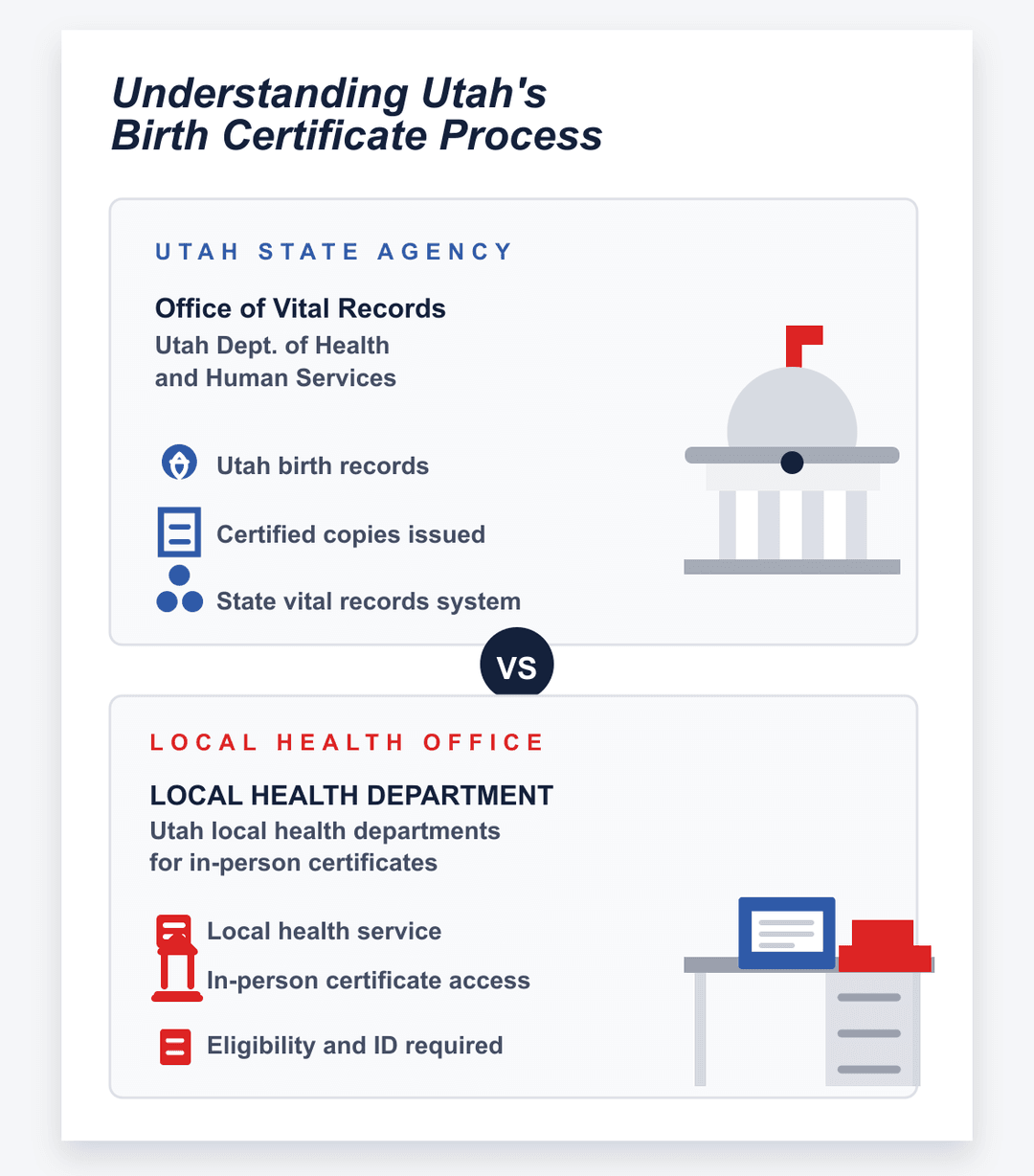
Utah birth certificates are issued through the Utah Department of Health and Human Services, Office of Vital Records and Statistics. The state office maintains Utah vital records and provides certified copies to eligible applicants.
Utah also provides in-person certificate service through local health department vital records offices. These local offices are part of the state vital records process, not a separate county clerk certificate system.
Applicants should choose the state office or a local health department, then bring the required identification and any documents needed to prove eligibility for the certified copy.
How to Order State of Utah Birth Certificate
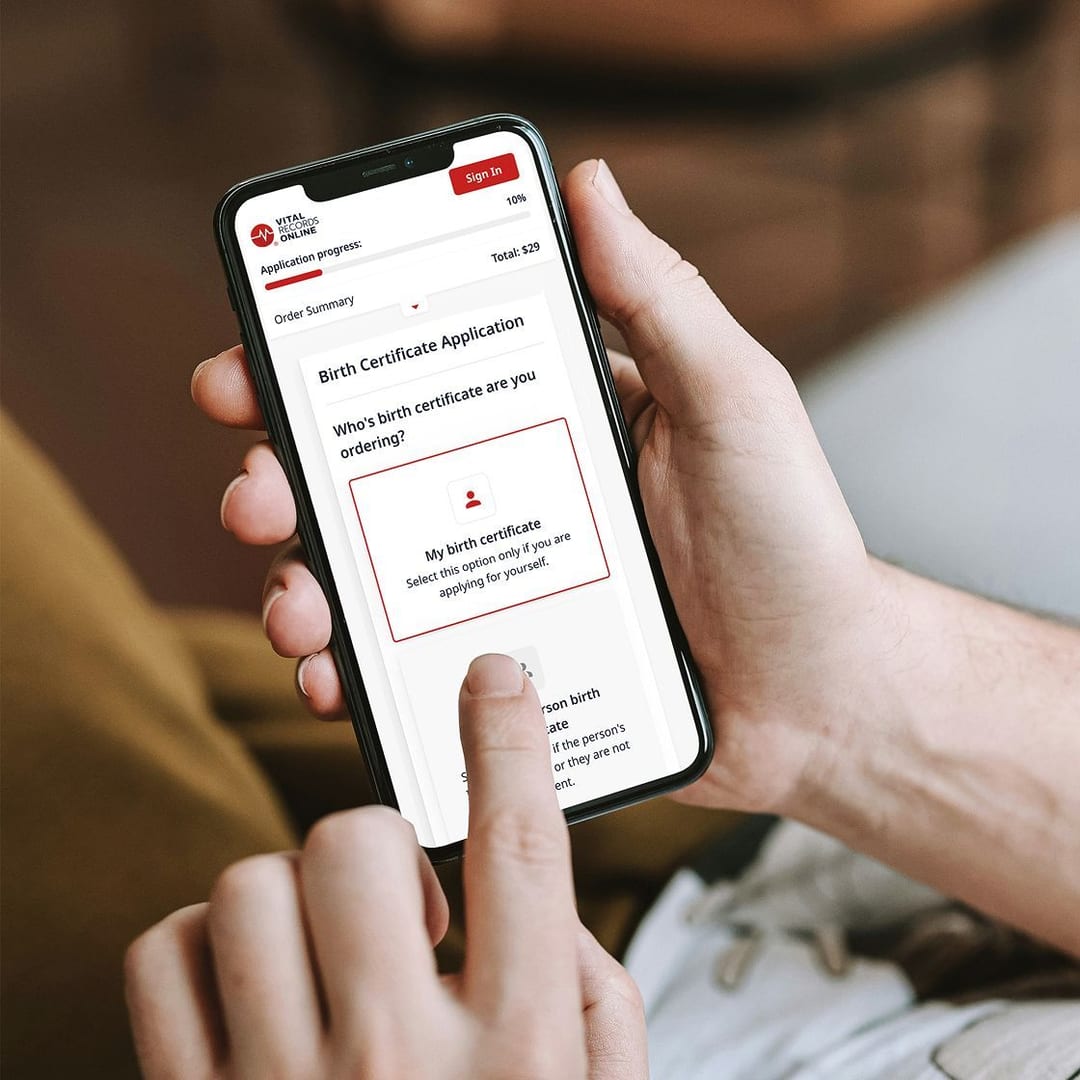
You can now order Utah birth certificate through VRO's online filing service. VRO offers a secure and simple way to order birth certificate. We handle the entire application process, ensuring accuracy and ease. Your application is securely delivered to the Utah Department of Health - Office of Vital Records and Statistics (UDOH-OVRS) for processing, allowing them to issue and mail your birth certificate to you. You can place the order yourself in person or by mail through the UDOH-OVRS by following the specific steps and meeting certain requirements. Before placing your order, verify the costs, eligibility, requirements, and processing times.
Ordering with VRO
Requesting a Utah birth certificate through our online filing service is quick and easy.
- Complete the online application and upload your documents.
- Process your order.
Starting from
$29 VRO service fee
+ $22.00 state fee, 1 certified copy included
Extra copies $10.00 each, added to the same order
Benefits of Ordering Online with VRO
- 5 minutes process
- No waiting in lines
- No handling paperwork or mail
- Simplified application process
- 24 hour service
- Online assistance by specialists
- Verification and error-checking
- Order tracking
- Online notary
- Pay online by credit card
- Remote processing time
Ordering in Person
If you reside near a county health department, you can apply for your Utah birth certificate in person. The process will include:
- Complete the Birth Certificate Application Form.
- Gather the required information and documents.
- Obtain photocopies of your documents.
- Present the application and documents to the health department during regular business hours.
Ordering By Mail
To order your Utah birth certificate by mail, you need to follow these steps:
- Complete the Birth Certificate Application Form.
- Gather the required information and documents.
- Obtain photocopies of your documents.
- Purchase an envelope.
- Include a physical check or money order issued to "Vital Records."
- Send all of the above to the UDOH-OVRS's mailing address:
required documents
What Documents Are Required to Order State of Utah Birth Certificate?
All applicants must present proof of identity when requesting a certificate. Acceptable photo IDs include a valid state-issued driver's license, a passport, or a U.S. military ID. The requirements for requesting a Utah birth certificate depend on your situation. Review the table below for the required information and documents.
Primary ID Requirements Options | Secondary ID Requirements Options |
|---|---|
Driver's License | Work ID |
How to Get a Utah Birth Certificate Without ID
If you do not have a valid primary ID, you can submit two forms of secondary identification listed in the table above. Examples of accepted secondary IDs include an employee ID card, a student ID card, a social security card, or a utility bill. Alternatively, you can have an authorized third party request the birth certificate on your behalf.
Cost & fees
Utah Birth Certificate Fees
The total costs for ordering a Utah birth certificate will vary depending on whether you make your request in person, by mail, or online. The UDOH's fee for one birth certificate is $22.00. Additional copies can be ordered at the same type for $10.00 each. When using VRO's online filing service, the fee starts at $29.00, plus the state fee. VRO provides a secure online solution for ordering birth certificate.
State Fee |
|---|
$22.00 |
Rush Processing |
|---|
Not offered for mail-in orders |
Additional Copy |
|---|
1 x $10.00 |
Processing time
Utah Birth Certificate Processing Time
The time it takes to receive your Utah birth certificate depends on the method of application you use and the current wait times set by the Utah Department of Health. Standard processing typically takes at least 3 weeks, while rush processing can be completed by the next business day through the UDOH-OVRS website. To avoid delays, we recommend using VRO's easy online service, which helps prevent incomplete submissions and errors.
Processing Time |
|---|
3-4 weeks |
Rush Processing Time |
|---|
Not offered for mail-in orders |
Authorization
Who is Authorized to Order a Utah Birth Certificate?
Utah birth certificate are confidential for 100 years, and access to birth records is restricted to the record holder and immediate family members during that time. Authorized third parties, such as eligible family members and non-eligible third parties who provide evidence of legal interest, can request certified copies, however, additional documentation may be necessary. If you request a certificate on someone else's behalf, confirm the conditions before applying.
Authorized People
- Children
- Grandchildren
- Grandparents
- Interested Parties with Legal Need
- Parents
- Person on Record
- Siblings
- Spouse
Do I Need to Notarize My Application?
A notary is generally not required to obtain authorized copies of Utah vital records. A photocopy of your ID is sufficient to verify your identity.
Tracking
Track Your Utah Birth Certificate Order
When you place an order with VRO, you can track the status of your application online while we are handling it. VRO verifies your documents before forwarding them to the Utah Department of Health - Office of Vital Records and Statistics (UDOH-OVRS) for further processing. Additionally, you can request mail tracking through VRO to monitor your application's journey to the health department for extra verification.
If you are mailing your birth certificate application manually, it is recommended to know when your application is delivered to the UDOH-OVRS.
The UDOH-OVRS does not include tracking the delivery of your vital records certificate to your address. Once the records leave the state office, the state is not responsible for lost or misdirected certificate.
Order Other Utah Vital Records
Need more than a birth certificate? VitalRecordsOnline helps you order every Utah vital record through one streamlined application. Whether you're gathering documents for a passport, name change, estate settlement, or family history project, we handle the paperwork, verify everything is complete before submission, and track your order from start to delivery.
Utah Marriage Certificate - Required for name changes, spousal benefits, visa applications, divorce filings, and proof of marital status.
Utah Death Certificate - Needed for estate settlement, life insurance claims, pension transfers, Social Security notifications, and closing accounts of a deceased loved one.
Utah Divorce Certificate - Proves the legal dissolution of a marriage. Required for remarriage in some states, name restoration, and certain immigration or legal matters.
For use abroad, ask about our apostille service - we authenticate Utah vital records for international use in Hague Convention countries.
frequently asked questions
Other FAQs
How to Obtain a Utah Birth Certificate if Born on an Overseas Military Base
If you were born overseas on a U.S. military base, your birth would have been recorded with the U.S. Department of State rather than the state of Utah. You can request a Consular Report of Birth Abroad (CRBA) or form FS-240 from the U.S. Department of State. The CRBA is the equivalent of a U.S. birth certificate and serves as evidence of U.S. citizenship. The CRBA can be used for legal purposes such as applying for a passport or accessing social services.
For original copies of your birth certificate, contact the hospital in the country where the birth took place.
Why Do I Need Certified Copies of My Utah Birth Certificate?
Certified copies of your Utah birth certificate are critical for many of life's milestones. A birth certificate establishes legal proof of your identity and citizenship, with important information such as your legal name, place and date of birth, and parent's names. Certified birth certificates can be required for various legal proceedings, family matters, school enrollment, employment, and travel.
Birth certificates are often useful or required for:
Applying for a driver's license
Applying for a new passport
Issuing or obtaining a Social Security Card
Applying for Social Security benefits
Claiming pension or insurance benefits
Genealogy research
Claiming family inheritance
Applying for a new job
Enrolling in school
Enlisting in military
Obtaining a marriage license
You may also need to order a Utah death certificate through our secure online service.
What Does a Utah Birth Certificate Look Like?
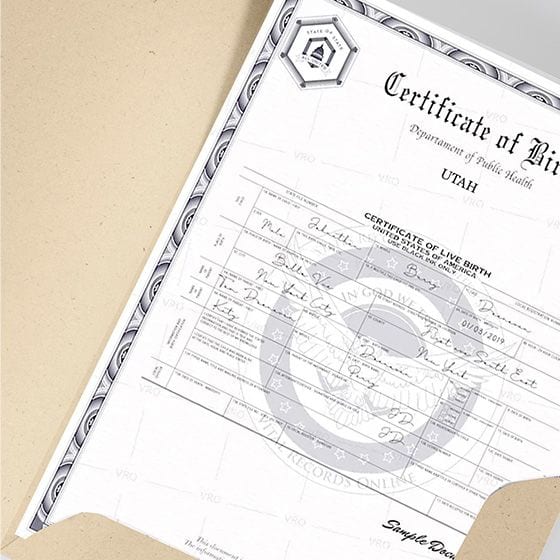
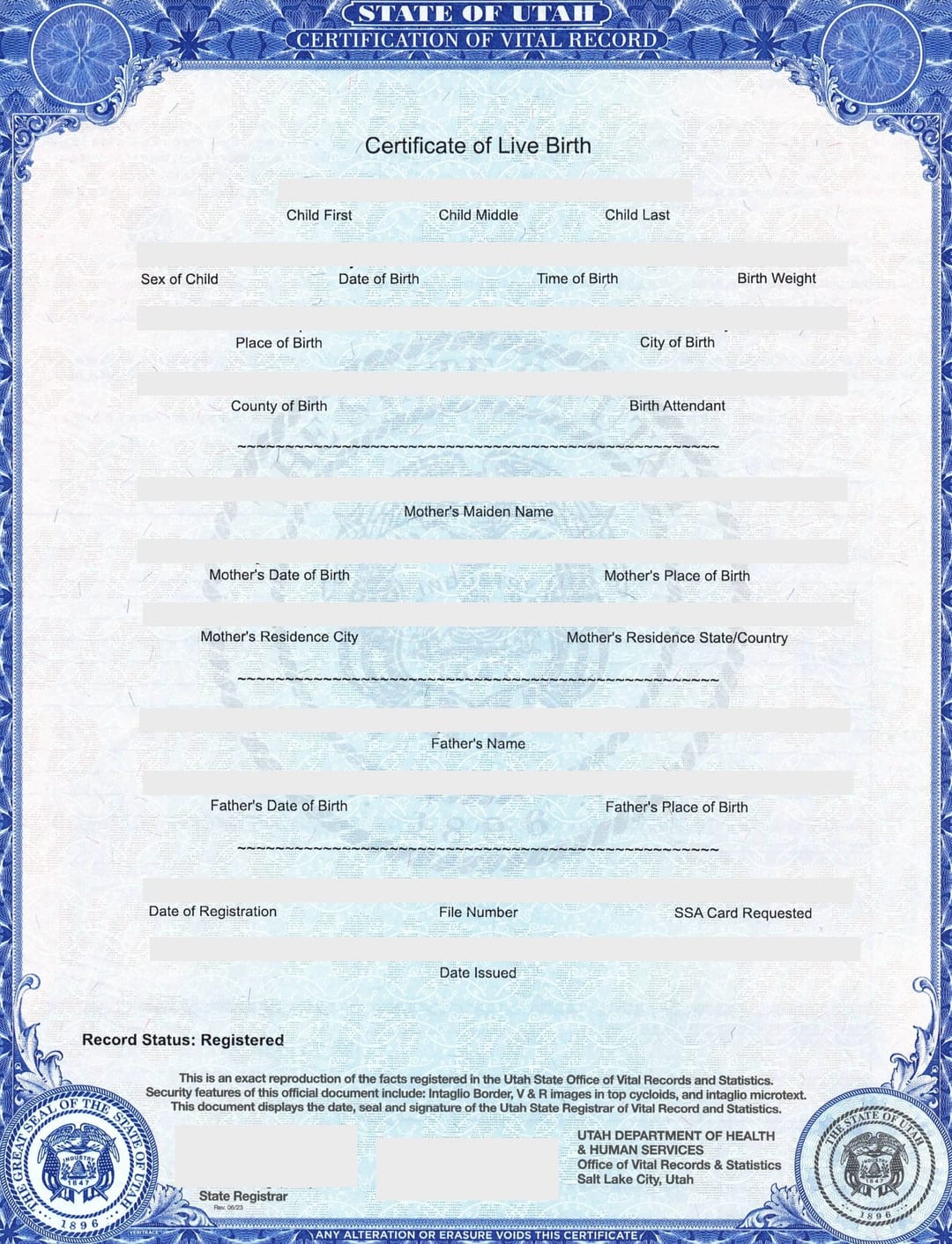
Official birth certificates issued by the Utah Department of Health (UDOH) have unique features to ensure their authenticity. The appearance of these certificates can vary depending on the year of issue. Still, they all adhere to state guidelines that stipulate standard features such as the state seal, the individual's name, the registrar's signature, and the use of secure paper. These certificates contain essential information about the individual's identity and citizenship. Note that official (long-form) birth certificates are specifically intended for legal purposes and differ from informational (short-form) copies, which are typically used for personal or commemorative reasons.
• Full Name of the Person: The full legal name of the person whose birth is being recorded.
• Date of Birth: The exact date of birth of the individual.
• Place of Birth: The city, county, and state where the birth took place.
• Parents' Names: The full names of both parents, including the mother's maiden name.
• State Seal: A raised, embossed, or printed multicolor or black and white seal of the issuing authority, which validates the document.
• Signature of State Registrar: The signature of the state registrar or authorized official responsible for issuing the certificate.
• Date of Issuance: The date when the state officially issued the birth certificate.
• Printed on Security Paper: Printed on specialized paper to prevent counterfeiting.
In some instances, a certified birth certificate may also include:
• Name of the Hospital where the birth was recorded.
• Name of the Physician who attended the labor.
For a complete overview of birth certificate types, costs, and requirements across all states, visit our birth certificate guide.
How to Replace a Lost or Stolen Utah Birth Certificate
If you lose your birth certificate:
- Apply for a certified replacement copy in person, by mail, or online through VRO. You must complete the application, gather the required identification and documents, and pay the fees determined by the Utah Department of Health (UDOH).
a. For in-person applications: Present the completed application and required documents to a county health department during hours of operation.
b. For applying by mail: Send your application, documents, and a check or money order for the replacement fee to the UDOH at:
Vital Records
PO Box 141012, Salt Lake City UT 84114-1012
c. For online submissions: Complete the application and upload your documents through the VRO website (payable by credit card online). - The UDOH will mail the certified copy(s) after processing.
How to Correct or Amend a Utah Birth Certificate
An affidavit or court order is required to amend a Utah birth certificate. The process and requirements may vary based on the specific changes needed. When an amendment is made, the record status changes from "registered" to "amended," and an Amendment History is added as a second page.
Typically, amendments to Utah birth certificates will require:
- A completed amendment application:
a. Affidavit to Amend a Record form to be signed by two qualifying witnesses (parents or immediate family members) OR
b. Amendment of a Record by Court Order signed by record holder (if over 18 years) or parent, guardian, or lawyer (if under age). - Supporting documentation: Submit evidence that directly supports the asserted facts. The evidence must accompany the affidavit.
- Appropriate fee(s): Amendment fees vary by application form. A copy of the amended birth certificate is $22.00, and $10.00 for each additional copy requested during the same order.
How to Obtain an Apostille for a Utah Birth Certificate
To obtain an apostille for a Utah birth certificate, you can order it directly through the Lt. Governor's office or use VRO's Express Apostille Service for online orders. The apostilles are issued by the Utah Secretary of State and are typically required when submitting a birth certificate to a foreign government as part of the 1961 Hague Convention.
To manually obtain an apostille for a Utah birth certificate, complete the following steps:
- Obtain a certified copy of the birth certificate from the Utah Department of Health (UDOH).
- Complete the Apostille Request Form available on the Utah Lt. Governor's office website.
- Gather the required documents, including the certified birth certificate and the completed Apostille Request Form. Provide a prepaid envelope for mail tracking and international shipping options.
- Prepare the appropriate fee for the apostille service. For standard (3-5 day) processing, the cost is $20 per document. One-day processing is available for $55.00 per document, and 2-hour processing is available for $95.00 per document. Checks and money orders should be made payable to the State of Utah. Note that same-day processing must include a FedEx prepaid envelope.
- Mail or deliver the documents to the Utah Secretary of State's office at the following addresses:
Physical Address: (appointment only); Or for UPS, FedEx Delivery:
For USPS:
What's the Difference Between a Long Form and Short Form Utah Birth Certificate?
A long-form birth certificate (also called the "full" or "certified" copy) is a complete reproduction of the original Utah birth record. It includes your full legal name, date and place of birth, parents' names, birthplaces, and occupations, the attending physician or midwife, and the file date and registration number. This is the version you'll need for passports, REAL ID, Social Security, adoption, immigration, dual citizenship, and most legal purposes.
A short-form birth certificate (sometimes called a "certification" or "abstract") is a condensed version that shows only your name, date of birth, place of birth, and sex. It does not include parents' information. The short form is accepted for many everyday purposes, like enrolling in school, applying for a driver's license, or joining sports leagues, but it is not always accepted for federal documents or international travel.
When you order a Utah birth certificate through VitalRecordsOnline, you receive the long-form version by default, since it is the most widely accepted. If you're unsure which version you need, check with the agency requesting the document.
Not sure which you need? Order your Utah birth certificate and get the right version.
How Long Does It Take to Get a Utah Birth Certificate?
Processing times for a Utah birth certificate depend on how you order and which delivery speed you choose. Standard government processing through the Utah vital records office generally takes 4 to 12 weeks by mail. In-person requests at the state office or authorized county location are often completed the same day or within a few business days.
When you order online through VitalRecordsOnline, we review your application within 24 hours to catch errors before submission, then forward it to the issuing authority. Most customers receive their certified Utah birth certificate in 2 to 3 weeks with standard shipping. Expedited processing and rush shipping options are available at checkout for urgent needs like passport applications or upcoming travel.
If the issuing office returns your request because of missing information, our team contacts you immediately so the correction can be made without starting over. You can track your order status at any time through your account.
Don't wait - start your Utah birth certificate order today for faster processing.
How Do I Get a Birth Certificate in Salt Lake City, UT?
Salt Lake City residents can order a Utah birth certificate through several convenient options. The fastest method is ordering online through VitalRecordsOnline, where we handle the paperwork and deliver your certified copy by mail.
You can also visit the Utah Department of Health vital records office in Salt Lake City at 288 North 1460 West, Salt Lake City, UT 84116. In-person requests are typically processed the same day during business hours. Alternatively, you can submit a request by mail to the UDOH.
You may also need to order a Utah death certificate or Utah marriage certificate through our secure online service.
Can I Get a Same-Day Birth Certificate in Utah?
Same-day Utah birth certificates are available for in-person requests at the Utah Department of Health vital records office in Salt Lake City. Walk-in visitors can typically receive their certified copy within a few hours during regular business hours.
For those who cannot visit in person, ordering online through VitalRecordsOnline is the next fastest option. We review your application within 24 hours and most orders arrive within 2 to 3 weeks, with expedited shipping available at checkout.
Looking for a different document? Order a Utah marriage certificate through our secure online service.
Where Do I Get a Birth Certificate in Provo, UT?
Provo residents can obtain a Utah birth certificate by ordering online through VitalRecordsOnline, visiting the Utah County Health Department, or submitting a mail request to the Utah Department of Health in Salt Lake City.
The Utah County Health Department office serves the Provo and Orem area. For the quickest turnaround, online ordering through VRO lets you complete the process from home with delivery by mail.
Need another vital record? Get your Utah divorce certificate through our secure online service.