VRO Handling
4-5 business days standard, or 1-2 business days expedited (from $20).

Safe, accurate, and trusted service for ordering your certified divorce certificate from any U.S. state.
Get Divorce CertificateTrusted by +1.5 million customers

 on ShopperApproved
 on Google
Disclaimer
Vital Records Online (VRO) is an officially approved third-party vendor for some state health departments, offering vital record services such as birth, marriage, death, and divorce certificates. VRO is an independent, SOC 2 compliant document filing service and is not a government agency.
We handle the details so you get your divorce certificate quickly, without stress or costly mistakes.

Apply anytime, anywhere. No waiting rooms or long lines.
Fully aligned with official state requirements.

Expert review prevents delays and rejections.
Every state has unique eligibility, pricing, and document requirements. Select your state on the map to see exactly what's needed to get your certificate faster.
Service starts at $29 + state fees. Fees vary by state. See your exact cost on our State Pricing page before you apply.
For individuals
Starting from
Applications are processed faster at our center, with expedited completion in just 1 business day.
The divorce certificate is delivered within up to 2 business days, with mail tracking provided.
$1M identity theft insurance, monthly Experian privacy scans, one-click credit lock and unlock, and fee-free document replacement.
Unlimited customer support via phone for any questions or assistance you may need.
VRO expedites the replacement process in case of loss, with you only paying the state-mandated fee.
We process your application quickly, guide it through the state, and ensure delivery straight to your door.
4-5 business days standard, or 1-2 business days expedited (from $20).
Varies by state - from days to months. Rush options available in some states.
3-5 business days standard, or 2 business days expedited (extra fee).
Complete your application in minutes and let us handle the rest.
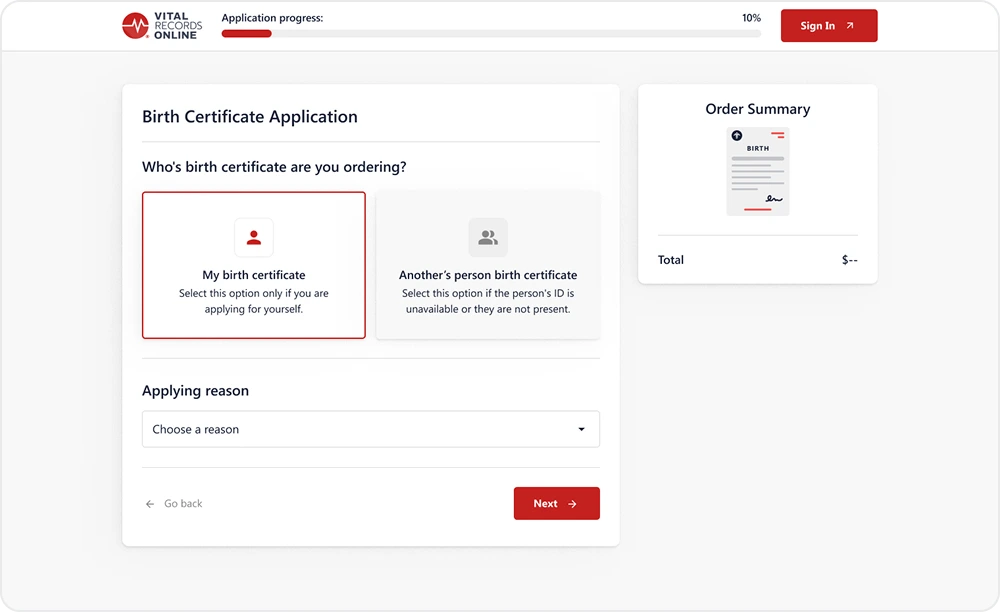
Fill out our secure form to request your divorce certificate or divorce decree. Be prepared to provide:
A divorce certificate is an official government document that provides legal proof that a marriage has been dissolved. Issued by the vital records office in the state where the divorce was finalized, it contains essential details including the names of both parties, the date the divorce was granted, the county and court where the decree was filed, and the certificate number.
Unlike a divorce decree - which is a detailed court order outlining the terms of the divorce (property division, child custody, alimony) - a divorce certificate is a shorter, standardized summary issued by the state's Department of Health or vital records agency. Both documents serve as proof of divorce, but a certificate is typically what you need for passport applications, Social Security name changes, and driver's license updates.
VitalRecordsOnline.com partners with government-authorized agencies to help individuals request certified copies of divorce certificates from all 50 states and Washington, D.C. Our service simplifies the process by providing pre-filled state-specific forms, identity verification, and direct submission to the appropriate vital records office - so you can get your document without navigating complex government websites or making in-person visits.
Divorce certificates are issued by the vital records office in the state where the divorce was finalized - not necessarily the state where you currently live. Depending on the state, the issuing agency may be the Department of Health, the Office of Vital Statistics, or a similar division. Most states also allow you to request a certified copy from the county clerk's office in the county where the divorce was granted.
You can typically request a divorce certificate by mail, online, or in person. Processing times vary: in-person requests may be fulfilled the same day, while mail orders often take 4-8 weeks. Online services like VitalRecordsOnline.com can expedite the process by ensuring your application is complete and submitted correctly the first time.
The state vital records office maintains a centralized database of all divorces filed within the state and can issue certified divorce certificates regardless of which county handled the case. The county clerk's office holds the original court records - including the full divorce decree - and may be your only option if you need the detailed court order rather than the summary certificate.
State office: Best for certified divorce certificates, especially if you're unsure which county filed the decree.
County clerk: Best if you need the full divorce decree, want same-day pickup, or if the divorce is very recent and hasn't been indexed at the state level yet.
Online through VitalRecordsOnline.com: Best for convenience - we route your request to the correct office automatically.
A divorce decree (sometimes called a "final judgment of divorce") is the court document that legally ends the marriage. It includes all the terms negotiated or ordered by the judge - property division, spousal support, child custody, and visitation schedules. A divorce certificate is a shorter document issued by the state's vital records agency that simply confirms the divorce happened, listing the parties' names, divorce date, and filing location.
For most purposes - remarriage, name changes, updating government IDs - a divorce certificate is sufficient. However, some situations (like enforcing custody agreements, modifying alimony, or certain immigration applications) may require the full divorce decree from the county court.
Remarriage: Most states require proof that a prior marriage was legally dissolved before issuing a new marriage license.
Name change: Updating your name on a Social Security card, driver's license, or passport after divorce typically requires a certified divorce certificate.
Financial matters: Banks, lenders, and insurers may request proof of divorce to update account holders, remove an ex-spouse from a policy, or process a property transfer.
Immigration: USCIS may require a certified divorce certificate when petitioning for a spouse or proving eligibility for certain visa categories.
Estate planning: Updating wills, trusts, and beneficiary designations after a divorce often requires documentation that the marriage was dissolved.
Tax filing: Your divorce status affects your federal and state tax filing status, and the IRS may request verification.
If you're updating your legal documents after a divorce, you may also need certified copies of other vital records:
Birth Certificates - Often needed alongside a divorce certificate for name changes or custody proceedings.
Marriage Certificates - Required in some states to prove the marriage existed before the divorce can be certified.
Death Certificates - If a former spouse has passed, a death certificate may be needed for estate or benefits claims.
VitalRecordsOnline.com can help you request any of these documents from all 50 states and Washington, D.C.
We use top-tier security and compliance standards to keep your personal information safe: PCI, HIPAA, and SOC 2 certified.

VRO holds a SOC 2 Type I attestation, independently validating the design of the controls that protect your data, and we continue to invest in our security and operational excellence.

Our commitment extends to complying with all relevant laws, including privacy and data protection regulations, upheld through various measures, practices, and policies.

Your personal information undergoes encryption to ensure secure transfer and storage of submission data. Employing high-grade RSA 2048 encryption at the user's end, followed by secure transfer and storage on our servers.

VRO ensures HIPAA compliance, ensuring the highest security standards for handling HPI data, both digitally and physically. Business Associate Agreements (BAAs) are available upon request for entities utilizing our services.

VRO adheres to PCI DSS Service Provider Level 1 standards, guaranteeing the highest security level for businesses handling payments and integrating with credit cards.

Our commitment extends to complying with all relevant laws, including privacy and data protection regulations, upheld through various measures, practices, and policies.

Users can restrict access and disable cloning, with submission access requiring login credentials, ensuring utmost data privacy.

We provide multiple options to protect forms from spammers, including limiting submissions per IP address or device and implementing form privacy settings to control access.

VRO maintains an uptime ratio of nearly 99.9%, ensuring uninterrupted access to your data. Our commitment at VRO is to uphold error response rates, resolution times, and uptime ratios synonymous with top-tier service providers.



You can request a certified copy of your divorce certificate from the vital records office in the state where the divorce was finalized. Most states offer mail-in, online, and in-person options. You'll typically need to provide the full names of both spouses, the approximate date of the divorce, and the county where it was filed.
VitalRecordsOnline.com streamlines this process - simply select your state, fill out the guided form, and we'll route your request to the correct agency. Processing times vary by state, but online orders are generally faster than mailing in a paper application.
Processing times depend on the state and how you submit your request. In-person requests at a county clerk's office can sometimes be fulfilled the same day. Mail-in requests typically take 4-8 weeks, while online orders through services like VitalRecordsOnline.com are usually processed within 2-4 weeks.
Some states offer expedited processing for an additional fee, which can reduce turnaround to 1-2 weeks. Rush or same-day options may be available at the county level for an extra charge.
The cost of a certified divorce certificate varies by state, typically ranging from $5 to $30 per copy. Additional fees may apply for expedited processing, shipping, or ordering through an authorized third-party service.
When you order through VitalRecordsOnline.com, the total includes the state filing fee, processing, and delivery. We display the full cost upfront before you submit your order - no hidden fees.
A divorce decree (also called a final judgment of divorce) is the court document that officially ends the marriage. It includes detailed terms like property division, child custody, spousal support, and visitation schedules. A divorce certificate is a shorter, standardized document issued by the state vital records office that confirms the divorce took place.
For most purposes - remarriage, name changes, updating IDs - a divorce certificate is sufficient. If you need the full decree (for enforcing custody terms, modifying support, or certain immigration filings), you'll need to contact the county clerk's office where the divorce was granted.
Yes. Most states allow you to order a certified copy of your divorce certificate online, either through the state vital records website or through an authorized processing service like VitalRecordsOnline.com.
Online ordering is often the fastest and most convenient option. You'll fill out an application, verify your identity, and pay the applicable fees. Your certified copy is then mailed directly to you.
Eligibility rules vary by state, but generally the following individuals can request a certified copy of a divorce certificate:
Either spouse named in the divorce
A legal representative or attorney acting on behalf of a named party
A parent or legal guardian of a minor named in the proceedings
A court-appointed representative
Government agencies for official purposes
Some states also issue informational (non-certified) copies to members of the public for genealogical or research purposes.
To request a certified copy, you'll generally need:
Full legal names of both spouses at the time of divorce
Date of the divorce (or approximate year)
County and state where the divorce was granted
Case number (if available - helpful but not always required)
Your relationship to the parties named in the record
A valid government-issued photo ID for identity verification
VitalRecordsOnline.com walks you through exactly what's needed for your specific state, so you don't have to guess.
If you've lost your divorce certificate, you can request a replacement certified copy from the vital records office in the state where the divorce was finalized. The process is the same as ordering a new copy - you'll need to provide identifying information and pay the applicable fee.
If you need a replacement divorce decree (the full court order), contact the county clerk's office or the court that issued the original decree. Court records are maintained separately from vital records, so the state health department typically cannot reissue a decree.
In most states, yes. When you apply for a new marriage license, you'll be asked to provide proof that any prior marriages were legally dissolved. A certified divorce certificate is the standard document used to satisfy this requirement.
Some states may also accept a certified copy of the divorce decree. If your former spouse has passed away, a death certificate may be accepted instead. Check with your local marriage license office for specific requirements.
An apostille is an international certification that authenticates a document for use in countries that are part of the Hague Apostille Convention. To get an apostille on your divorce certificate, you'll need to submit the certified copy to the Secretary of State's office in the state that issued the document.
The process typically involves mailing or hand-delivering the certified divorce certificate along with an apostille request form and a fee (usually $5-$25). Some states offer expedited apostille processing.
We recommend ordering at least 2-3 certified copies. Many agencies and institutions require an original certified copy (not a photocopy), and having extras avoids delays if you need to submit to multiple offices simultaneously.
Common situations where you may need to submit a certified copy include: applying for a new passport, updating your Social Security card, changing your name on a driver's license, remarrying, and updating financial or insurance accounts.
Yes. While having the case number can speed up processing, it's not required in most states. The vital records office can typically locate your record using the names of both spouses, the approximate date of divorce, and the county where the divorce was filed.
If you're unsure about any of the details, VitalRecordsOnline.com's guided form will help you provide the information needed to locate your record. In some cases, a broader search may take slightly longer, but your request can still be processed.
The sooner you apply, the sooner it's in your hands. Begin your secure application today.
Get Divorce Certificate