How President Trump’s Executive Order 14168 Impacts Gender Marker Changes and Vital Records

  1. Home
  2. Blog
  3. Vital Records
  4. How President Trump’s Executive Order 14168 Impacts Gender Marker Changes and Vital Records
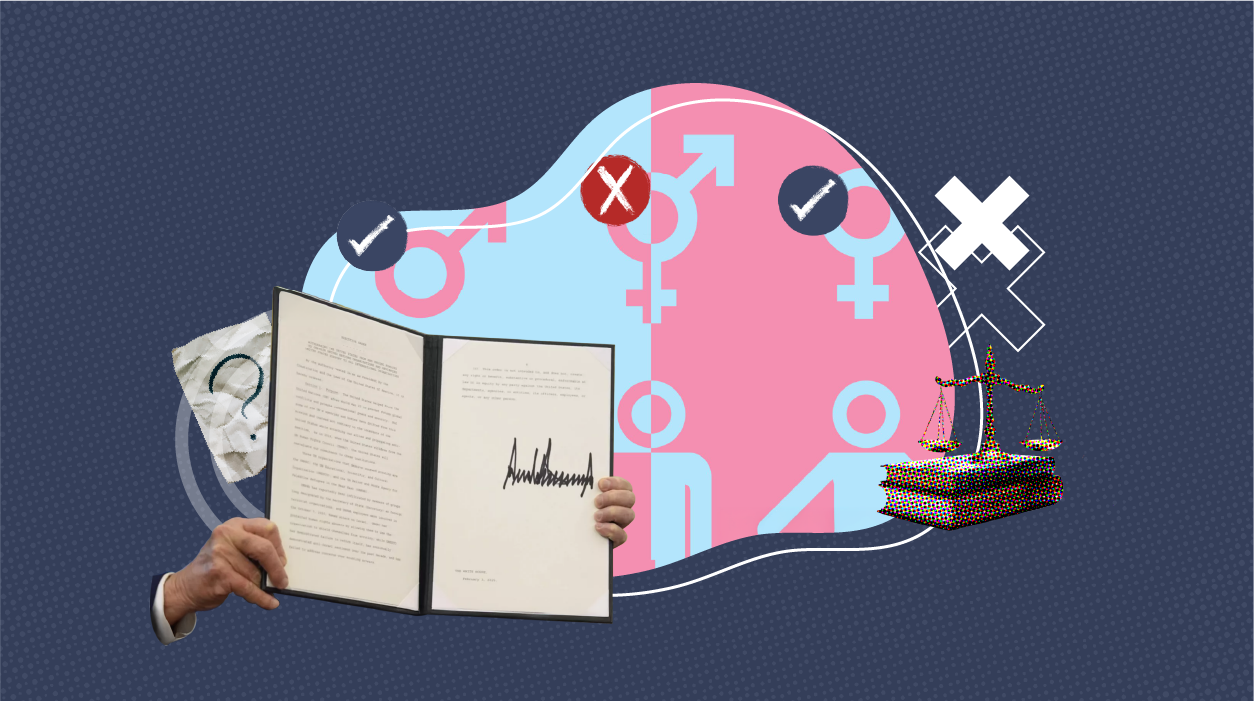
Illustration showing a person holding an open signed document in front of a background split into pink and blue with male and female gender symbols. Checkmarks and X marks appear above the symbols, representing approval or rejection. A scale of justice and a stack of books are placed on the right, symbolizing legal and gender-related policies.

What Is Executive Order 14168?

On January 20, 2025, President Donald Trump signed Executive Order 14168, titled “Defending Women From Gender Ideology Extremism and Restoring Biological Truth to the Federal Government.” This directive mandates that all federal agencies recognize only two sexes—male and female—based strictly on biological characteristics at birth. It also orders the removal of terminology and policies related to gender identity across federal documentation, diversity, equity, and inclusion (DEI) funding, and other government programs.

What’s Changing at the Federal Level?

The order explicitly directs federal agencies—including the Department of State—to require that passports, visas, and other government-issued identity documents reflect the holder’s biological sex at birth, rather than any self‑identified gender, and to discontinue issuance of the non‑binary “X” marker. Vital records—such as birth certificates, marriage certificates, and divorce certificates—are governed by state laws and are not directly affected by new federal policies, as they remain under the authority of individual state governments.

Passports and Federal IDs

The department has halted all applications requesting an “X” gender marker or a gender change that does not align with the applicant’s sex assigned at birth. While existing passports—including those with “X” markers or gender designations reflecting a person’s gender identity—remain valid until their expiration, all new passport applications and renewals must now list sex strictly as assigned at birth. Federal guidance issued shortly after the order’s signing confirms that this policy is not retroactive but applies to all documents issued from that point forward. Requests for gender markers inconsistent with birth-assigned sex are now either denied or placed on hold under the new regulations.

This shift has led to confusion and distress among transgender and nonbinary travelers. Some report being issued passports that conflict with previously approved gender markers. Others have had their applications placed on indefinite hold.

Social Security Records

The Social Security Administration (SSA) followed suit by suspending all gender marker updates in its NUMIDENT system—the central identity database used by many federal programs and employers.

This change may affect employment verification (e.g., through E-Verify) and eligibility for federal benefits, including Medicare and Social Security retirement or survivor benefits.

Employment Verification (E-Verify): Employers who use the federal E-Verify system to confirm a job applicant’s identity and work authorization may encounter mismatches between an individual’s gender identity on other documents (e.g., state-issued ID) and the sex listed in SSA records. These mismatches could delay or complicate hiring, especially for transgender and nonbinary individuals.

Medicare Enrollment: Since Medicare eligibility and enrollment are processed through SSA records, discrepancies between a person’s gender identity and the recorded sex could result in delays or denials of benefits. For example, systems that flag inconsistencies in personal data may require additional documentation or manual review, creating administrative barriers.

Social Security Retirement and Survivor Benefits: Eligibility for certain benefits, such as spousal or survivor benefits, may be affected if a person’s legal documents do not match the SSA’s records. For transgender individuals who have legally changed their gender marker in the past, this policy could force inconsistencies that create delays or challenges in accessing full benefits.

TSA, Global Entry, and Federal Benefits

The executive order also applies to all IDs used for TSA PreCheck, Global Entry, and other trusted traveler programs. These now require gender markers to match biological sex, which could pose issues at airport security if your federal ID conflicts with your lived identity or state-issued vital records.

What About State-Issued Vital Records?

State-held vital records—such as birth certificates, marriage and divorce certificates—can be affected by mismatches in gender markers, particularly when these records are used in conjunction with federal documentation. Federal policy does not supersede state laws regarding changes to gender markers.

States like California and Colorado continue to allow individuals to change the gender marker on their birth certificates and IDs to “M,” “F,” or “X,” while states like Oklahoma restrict such documents to binary sex designations only. Although a state-amended birth certificate remains legally valid within that state, it may not be recognized at the federal level under current policies.

What It Means for Vital Records

Are Birth Certificates Affected?

If you’ve updated your birth certificate to reflect your gender identity, your amended certificate remains legally valid under state law. However, it may now conflict with federal documents such as your passport, Social Security records, or federal employment files due to recent policy changes. These mismatches can affect travel and may be disrupted if your ID doesn’t align with TSA or airline records. Additionally, healthcare access, including Medicare and Social Security benefits, could be delayed. Furthermore, employment verification systems, such as E-Verify or I-9 forms, may flag discrepancies in gender data.

Each state continues to set its own rules for amending birth certificates, including whether and how gender markers can be changed. For example, Florida has quietly begun delaying and denying requests to update gender markers on Driver’s Licenses and birth certificates, aligning with the new federal executive order. For more information, click here.

Even though states retain control over their vital records, the federal government’s refusal to recognize gender markers that differ from the sex assigned at birth creates a growing conflict.

Are Certified Copies of Birth Certificates Still Valid?

Yes, even if your amended birth certificate lists your updated gender marker, it is still considered a certified legal document under state law. States maintain the right to issue and amend these records unless superseded by state legislation or court rulings.

What to Do Now

Next Steps for Individuals Affected:

  1. Check your state policies. You can still request a gender marker amendment to your birth certificate, driver’s license, or state ID where permitted. States, such as Florida, may be revising their existing policies to align with the new federal policy, so it’s essential to verify the current status before requesting an amendment.
  2. Secure all state-issued amended documents. Request several certified copies of your birth certificate and update your state-issued ID before any potential state policy changes.
  3. Act early on federal renewals. If your passport, Social Security card, or other federal documents are due for renewal, be prepared for the possibility that changes may be denied or reverted.
  4. Retain documentation. Keep certified copies, legal orders, and proof of past amendments in case future litigation reverses current policies.
  5. Stay informed. Multiple lawsuits are challenging Executive Order 14168. Several federal courts have already placed temporary injunctions on parts of the directive, and the legal situation is likely to evolve throughout 2025.

Your State-Amended Birth Certificate Still Holds Legal Weight

While the federal government now restricts gender recognition, your state-issued birth certificate remains valid for most personal, medical, and legal uses, but mismatches with federal records may cause complications.

This divergence between federal and state identity recognition places additional strain on transgender and nonbinary Americans, especially those who live abroad, travel frequently, or depend on federal programs.

Your amended state birth certificate remains a powerful legal document; however, it may no longer accurately reflect your federal records. Navigating this mismatch will require foresight, documentation, and potentially legal support.