Stillbirth Certificate vs. Fetal Death Certificate vs. Death Certificate: What’s the Difference?
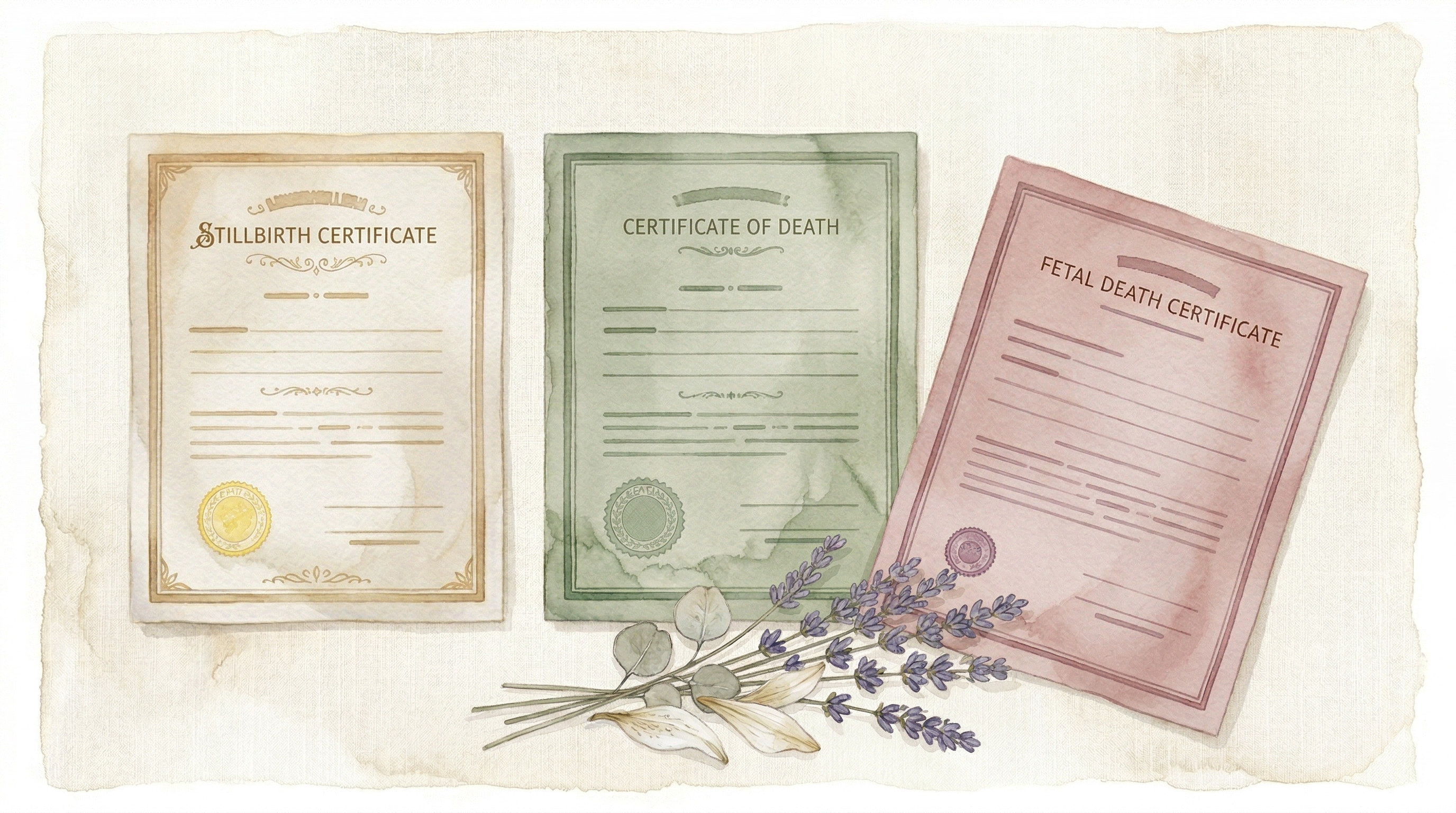
When a family experiences the loss of a baby — whether through stillbirth, neonatal death, or other circumstances — the question of which vital record applies can be deeply confusing. Terms like “stillbirth certificate,” “fetal death certificate,” and “death certificate” are sometimes used interchangeably, but they are actually three distinct documents with different purposes, legal standing, and eligibility requirements.
This guide breaks down the differences clearly so you know which document applies to your situation and how to obtain it.
Quick Comparison: Three Documents at a Glance
| Certificate of Birth Resulting in Stillbirth (CBRS) | Fetal Death Certificate | Death Certificate | |
|---|---|---|---|
| Also called | Stillbirth certificate, Certificate of Stillbirth | Fetal death report, Fetal death record | Certificate of death |
| Applies when | A baby is stillborn (typically 20+ weeks gestation) | A pregnancy loss occurs after the state’s gestational threshold (typically 20+ weeks) | A person who was born alive subsequently dies |
| Who files it | Parents request it from the vital records office | Hospital/healthcare provider files it with the state | Hospital/healthcare provider or medical examiner files it with the state |
| Automatic? | No — parents must request it | Yes — the hospital is required to file it | Yes — the hospital/facility is required to file it |
| Legal standing | Commemorative — generally not accepted for legal/financial transactions | Legal record — accepted for burial permits, insurance claims, and other official matters | Legal record — accepted for estate settlement, insurance, benefits, and all legal purposes |
| Available in | 43 states (as of 2026) | All 50 states + D.C. | All 50 states + D.C. |
| Baby was born alive? | No | No | Yes |
| State fee | Free to ~$25 (varies by state) | $5 to $35 (same as death certificates in most states) | $5 to $35 (varies by state) |
Certificate of Birth Resulting in Stillbirth (CBRS)
The Certificate of Birth Resulting in Stillbirth — often referred to simply as a “stillbirth certificate” — is a commemorative document created to give parents an official acknowledgment of their stillborn baby’s birth. It was developed through state legislation driven by bereaved parents and advocacy groups, and 43 states now offer it.
When it applies: The CBRS applies when a baby is stillborn — meaning the baby was delivered without signs of life after reaching the state’s gestational threshold (typically 20 weeks).
Key characteristics:
- Resembles a birth certificate in appearance and format
- Includes the baby’s name, parents’ names, date and location of delivery
- Is a commemorative document — not a legal record for financial or administrative transactions
- Must be requested by the parents from the state vital records office
- Many states allow retroactive applications for past stillbirths
For a complete guide to the CBRS, including which states offer it and how to apply, see our Certificate of Birth Resulting in Stillbirth: State-by-State Guide.
Fetal Death Certificate
The Fetal Death Certificate is the official legal record that is filed when a pregnancy loss occurs after the state’s gestational threshold. Unlike the CBRS, this document is not optional — the hospital or healthcare provider is legally required to complete and submit it to the state vital records office.
When it applies: A fetal death certificate is filed when a pregnancy loss occurs at or after 20 weeks of gestation (in most states) or when the baby weighs 350 grams or more. The specific threshold varies by state.
Key characteristics:
- The official legal record of the stillbirth — it has legal standing
- Filed by the hospital or healthcare provider, not the parents
- Includes medical details: gestational age, weight, cause of death (if determined), attending physician
- Used for burial permits, insurance claims, bereavement leave, and other legal matters
- Parents can request certified copies from their state’s vital records office
- Available in all 50 states and D.C.
For a step-by-step guide on obtaining certified copies, see our How to Get a Fetal Death Certificate guide.
Death Certificate
A standard death certificate is the official legal document that records the death of a person who was born alive. This is the document most people are familiar with — it’s used for estate settlement, life insurance claims, Social Security notifications, and many other legal and financial purposes.
When it applies: A death certificate is issued when a live-born person dies — whether as a newborn, infant, child, or adult. If a baby was born alive (even briefly) and then died, a birth certificate and a death certificate are both issued.
Key characteristics:
- Records the date, location, and cause of death
- Filed by the hospital, healthcare provider, or medical examiner
- Is the definitive legal record for all death-related legal and financial matters
- Required for estate settlement, insurance claims, property transfers, and benefits
- Available in all 50 states and D.C.
For information on requesting a death certificate, see our guides on who can request a death certificate and how to get a death certificate.
When Does Each Document Apply? Real Scenarios
Understanding which document applies can be confusing, especially during an emotional time. Here are some common scenarios:
Scenario 1: A baby is stillborn at 28 weeks
Documents issued: Fetal Death Certificate (filed by hospital). Parents can also request a Certificate of Birth Resulting in Stillbirth (if their state offers it). No birth certificate or death certificate is issued.
Scenario 2: A baby is born alive but dies shortly after birth
Documents issued: Birth certificate (recording the live birth) and a death certificate (recording the death). No fetal death certificate is issued because the baby was born alive.
Scenario 3: A pregnancy loss occurs at 15 weeks
Documents issued: Typically none from the state vital records office. Most states classify this as a miscarriage, which falls below the gestational threshold for fetal death reporting.
Scenario 4: A stillbirth occurred 10 years ago, and the parent wants a commemorative certificate
The parent can apply for a Certificate of Birth Resulting in Stillbirth retroactively in most of the 43 states that offer it. The parent can also request certified copies of the Fetal Death Certificate at any time.
Special Cases: Neonatal Death vs. Stillbirth
The distinction between neonatal death and stillbirth is critical for determining which documents are issued:
- Stillbirth — the baby shows no signs of life at delivery (no breathing, no heartbeat, no voluntary muscle movement). A Fetal Death Certificate is issued.
- Neonatal death — the baby is born alive but dies within the first 28 days of life. A birth certificate and a death certificate are both issued.
In some cases, the determination of whether a baby was born alive or stillborn may not be immediately clear. The attending medical professionals make this determination based on clinical signs of life.
Glossary of Key Terms
Stillbirth — The delivery of a baby who shows no signs of life after reaching the state’s gestational threshold, typically 20 weeks of gestation.
Fetal Death Certificate — The official legal record filed by a hospital or healthcare provider when a stillbirth occurs. Used for burial permits, insurance claims, and other legal purposes.
Certificate of Birth Resulting in Stillbirth (CBRS) — A commemorative state-issued document that recognizes the birth of a stillborn baby. Available in 43 states as of 2026.
Gestational Age — The age of a pregnancy measured in weeks from the first day of the mother’s last menstrual period. Most states require fetal death reporting at 20 or more weeks.
Miscarriage — A pregnancy loss occurring before the state’s gestational threshold (typically before 20 weeks). Generally not recorded by state vital records offices.
Neonatal Death — The death of a live-born baby within the first 28 days of life. Results in both a birth certificate and a death certificate being issued.
Certified Copy — An official copy of a vital record bearing a state or county seal, required for most legal and administrative purposes.
Vital Records — Official government records of life events including births, deaths, marriages, and divorces, maintained by state and local governments.
Related Guides
- Stillbirth Certificate: What It Is, How to Get One, and What Every Parent Should Know
- Do Stillborn Babies Get a Birth Certificate or Death Certificate?
- Certificate of Birth Resulting in Stillbirth: A State-by-State Guide
- How to Get a Fetal Death Certificate: A Complete Guide
How to Get the Document You Need
Regardless of which document you need, VRO can help:
- Need a Fetal Death Certificate? — Request through VRO. We handle the application for any U.S. state.
- Need a Death Certificate? — Request through VRO. We process death certificate requests from all 50 states.
- Need a Certificate of Birth Resulting in Stillbirth? — Contact your state’s vital records office directly or read our CBRS state guide for instructions.
- Need a Birth Certificate? — Request through VRO. Available for all 50 states.
We understand these requests come during some of life’s most difficult moments. VRO is here to make the process as clear and compassionate as possible.