How to Get a Fetal Death Certificate: A Complete Guide for Families
When a family experiences a stillbirth, the hospital or healthcare provider files a Fetal Death Certificate with the state’s vital records office. This is the official legal document that records the details of the loss, and it serves many of the same purposes as a standard death certificate — from arranging burial or cremation to filing insurance claims and requesting bereavement leave.
If you need a certified copy of a fetal death certificate, this guide walks you through the process step by step — including who can request one, what information you’ll need, and how to order copies from your state.
What Is a Fetal Death Certificate?
A Fetal Death Certificate is a vital record that documents a pregnancy loss occurring after a certain gestational age — in most states, 20 weeks of gestation or more. It is the legal equivalent of a death record for a stillborn baby and is issued by the state’s vital records office after the hospital or healthcare provider submits the required information.
The Fetal Death Certificate typically includes:
- The baby’s name (if one was given at the time of delivery)
- The sex of the baby
- The date and time of delivery
- The location (hospital, birthing center, or other location)
- The gestational age and weight of the baby
- The cause of fetal death (if determined — this is often listed as “unknown” or “undetermined”)
- The mother’s full legal name, date of birth, and residence
- The father’s full legal name (if provided)
- The name and credentials of the attending physician or midwife
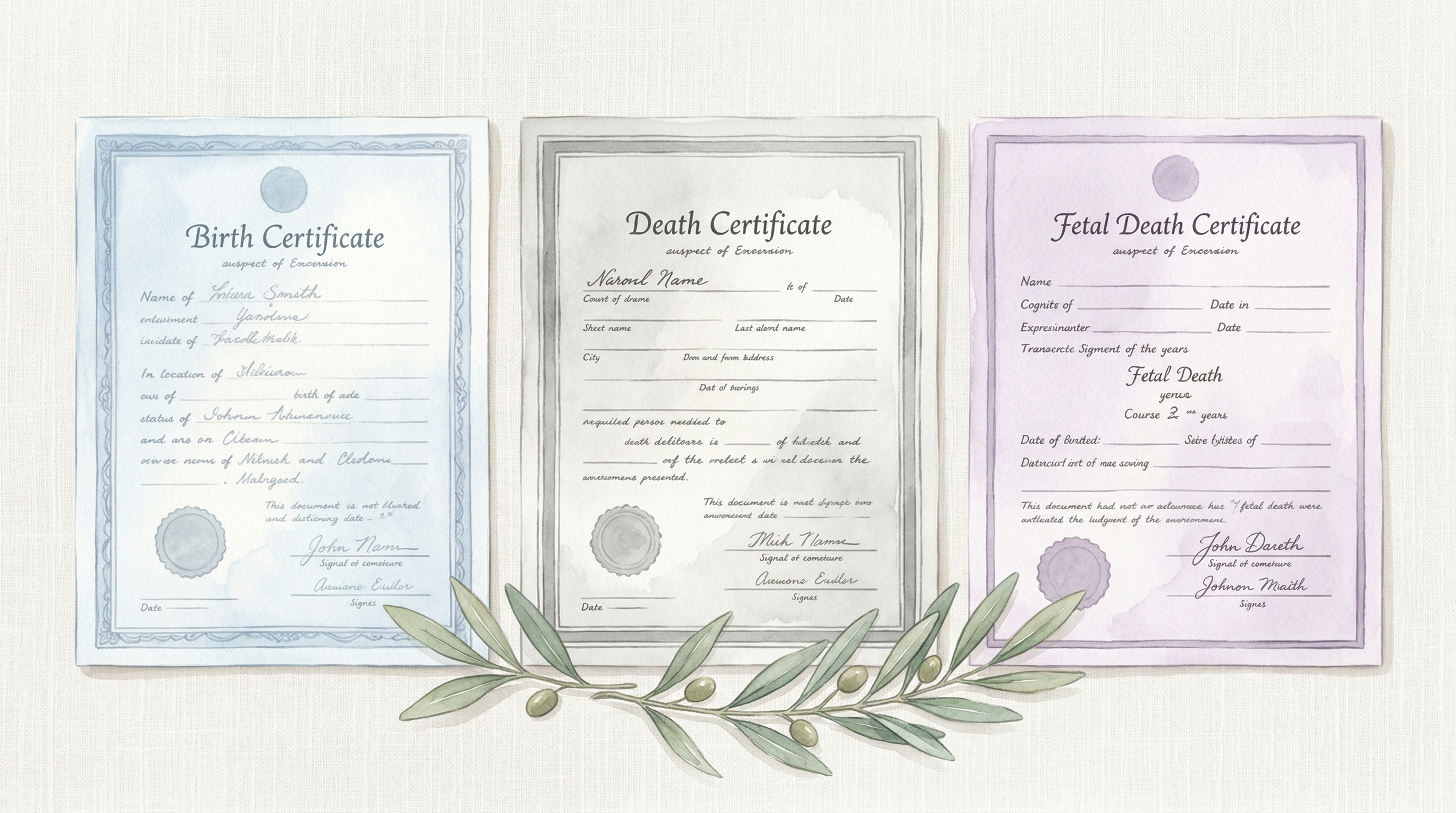
This document is distinct from a standard birth certificate or death certificate. A birth certificate records a live birth, and a death certificate records the death of someone who was born alive. The Fetal Death Certificate fills the gap for pregnancy losses that occur after the state’s gestational threshold.
When Is a Fetal Death Certificate Required?
Most states require a Fetal Death Certificate to be filed when a pregnancy loss occurs at 20 weeks of gestation or later and/or when the baby weighs 350 grams (about 12.3 ounces) or more. The specific threshold varies by state.
Pregnancy losses occurring before the state’s threshold are generally classified as miscarriages and are not reported to the state vital records office. No fetal death certificate is issued for these earlier losses in most states.
It’s important to note that the Fetal Death Certificate is filed by the hospital or healthcare provider, not by the parents. The medical facility is legally required to complete and submit this document to the state. Parents do not need to take any action to have the record created — but they do need to request certified copies if they need the document for legal, financial, or personal purposes.
Who Can Request a Fetal Death Certificate?
Eligibility to request a certified copy of a fetal death certificate is governed by state law. In most states, the following individuals may request a copy:
- The mother named on the record
- The father named on the record
- A legal representative of the parents (such as an attorney or court-appointed executor)
- A funeral director handling burial or cremation arrangements
- A government agency with a legitimate need for the record
- In some states, other family members (such as grandparents) with a documented relationship and legitimate reason
As with all vital records, you will need to prove your identity and your eligibility when requesting a certified copy. For more on eligibility requirements for death-related records, see our guide on who can request a death certificate.
How to Request Certified Copies
You can request certified copies of a Fetal Death Certificate through several channels:
Option 1: Through VRO (Recommended)
Vital Records Online can help you request fetal death records from many U.S. states. VRO guides you through the application, ensures your request is complete and accurate, and submits it to the correct vital records office on your behalf. This is especially helpful when you need a record from a state you don’t live in. Start your request here.
Option 2: Directly from the State Vital Records Office
Every state’s vital records office accepts requests for fetal death records. Methods include online ordering (in states that offer it), mail-in applications, and in some cases in-person requests. Contact the vital records office in the state where the stillbirth occurred — not where you currently live.
Option 3: Through the County Registrar
In some states, fetal death records are maintained at the county level. The county registrar or clerk’s office where the stillbirth occurred may be able to issue certified copies, sometimes faster than the state office.
What Information Do You Need to Request a Fetal Death Certificate?
When requesting a certified copy, you’ll typically need to provide:
- The baby’s name (if one was given) or “Baby [Mother’s Last Name]”
- The date of delivery
- The location of delivery (city, county, and state)
- The mother’s full legal name (including maiden name)
- The father’s full legal name (if known)
- Your relationship to the baby
- A valid government-issued photo ID
- The reason for your request
Common Reasons You May Need a Fetal Death Certificate
- Burial or cremation — funeral homes require a fetal death certificate to obtain a burial or disposition permit
- Health insurance claims — hospital and medical bills from the delivery may need to be accompanied by documentation of the fetal death
- Bereavement leave — employers may require official documentation when granting parental or bereavement leave after a stillbirth
- Short-term disability claims — mothers who file disability claims related to the delivery may need the record
- Applying for a Certificate of Birth Resulting in Stillbirth — many states require a copy of the fetal death certificate as a supporting document when applying for a CBRS
- Genealogy and family records — families maintaining historical records may want certified copies as part of their family documentation
- Future medical records — the fetal death certificate may be relevant for the mother’s medical history in subsequent pregnancies
Fees and Processing Times
Fees for certified copies of fetal death certificates are generally the same as for regular death certificates in each state, typically ranging from $5 to $35 per copy. Processing times vary by state from a few business days to several weeks.
Some states offer expedited processing for an additional fee. If you need the document urgently — for example, to arrange burial services — let the vital records office know and ask about expedited options.
What if the Record Can’t Be Found?
In rare cases, the vital records office may have difficulty locating a fetal death record. This can happen if:
- The hospital did not file the record with the state (uncommon but possible, especially for older records)
- The record was filed under a different name or with incomplete information
- The state’s records from the relevant time period were damaged or have not been digitized
If this happens, the vital records office may ask for additional information to help locate the record, or they may direct you to the county registrar’s office or the hospital where the delivery occurred.
Glossary of Key Terms
Stillbirth — The delivery of a baby who shows no signs of life after reaching the state’s gestational threshold, typically 20 weeks of gestation.
Fetal Death Certificate — The official legal record filed by a hospital or healthcare provider when a stillbirth occurs. Used for burial permits, insurance claims, and other legal purposes.
Certificate of Birth Resulting in Stillbirth (CBRS) — A commemorative state-issued document that recognizes the birth of a stillborn baby. Available in 43 states as of 2026.
Gestational Age — The age of a pregnancy measured in weeks from the first day of the mother’s last menstrual period. Most states require fetal death reporting at 20 or more weeks.
Miscarriage — A pregnancy loss occurring before the state’s gestational threshold (typically before 20 weeks). Generally not recorded by state vital records offices.
Neonatal Death — The death of a live-born baby within the first 28 days of life. Results in both a birth certificate and a death certificate being issued.
Certified Copy — An official copy of a vital record bearing a state or county seal, required for most legal and administrative purposes.
Vital Records — Official government records of life events including births, deaths, marriages, and divorces, maintained by state and local governments.
Related Guides
- Stillbirth Certificate: What It Is, How to Get One, and What Every Parent Should Know
- Do Stillborn Babies Get a Birth Certificate or Death Certificate?
- Certificate of Birth Resulting in Stillbirth: A State-by-State Guide
- Stillbirth Certificate vs. Fetal Death Certificate vs. Death Certificate
How VRO Can Help
VRO understands that requesting these records comes during one of the most difficult times in a family’s life. Our service is designed to simplify the process — we guide you through the application, ensure it’s complete, and submit it to the appropriate state office. We handle the details so you can focus on what matters most.
Start your fetal death certificate request through VRO today.