

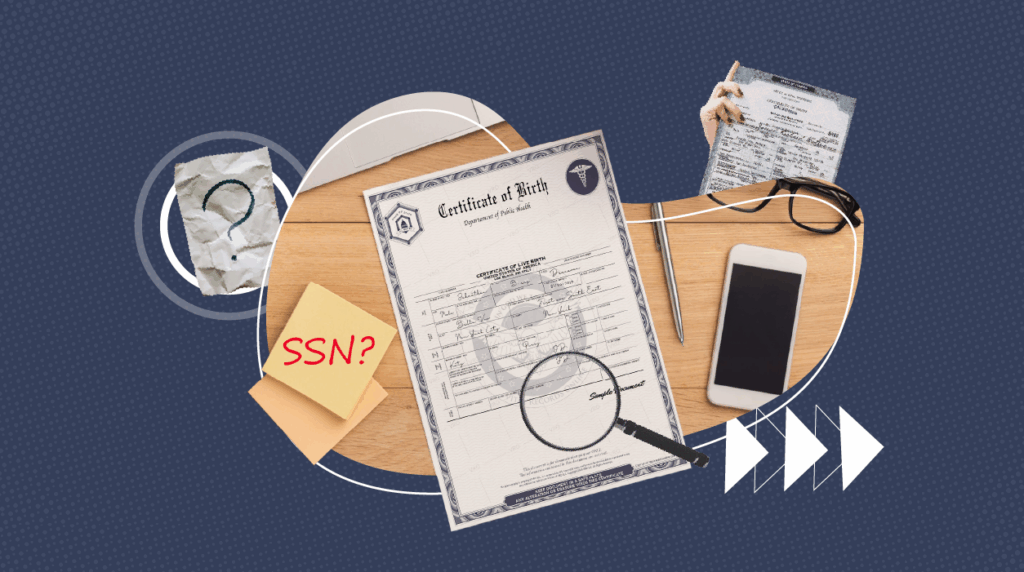
When handling official paperwork, whether you’re applying for a passport, enrolling a child in school, or verifying your identity, you may find yourself managing both a birth certificate and a Social Security number (SSN). A common question arises: Do birth certificates have SSNs on them?
The short answer is: No, birth certificates do not include Social Security numbers. These two vital records are separate documents with different purposes, though they are often linked during a newborn’s first weeks of life. In this blog, we’ll explain what’s included on a birth certificate and how it connects to the Social Security Administration (SSA).
What’s on a Birth Certificate?
A birth certificate is an official document issued by a state or local vital records office, serving as legal proof of a person’s birth. It typically includes the following information:
- Full legal name of the person
- Date and place of birth
- Sex assigned at birth
- Names of parent(s)
- Place of birth of each parent
- Official registration or certificate number
- Signature or seal from the registrar or vital records authority
It does not include a Social Security number (SSN), even though the SSN is often applied for soon after a child’s birth.
Why SSNs Are Not Printed on Birth Certificates
Social Security numbers are issued by the Social Security Administration (SSA)—a federal agency—while state governments issue birth certificates. Because these two systems are managed separately and have distinct legal functions, an SSN is not listed or stored on your birth certificate.
The Social Security Administration Is a Federal Agency
The SSA is an agency of the federal government, established in 1935. It is responsible for issuing Social Security numbers, maintaining earnings records, and administering programs such as retirement, disability, and survivor benefits.
State or Local Governments issue Birth Certificates.
Birth certificates are created and maintained by state-level or county-level vital records offices, not the federal government. Each state has its own format and requirements for what is included in the document, based on state laws and public health regulations.
Separation Is Based on Jurisdiction (Federal vs. State)
Because the SSA is a federal agency and birth certificates are issued by states, the two are managed by separate systems, with no automatic data sharing unless consent is given. This jurisdictional divide helps maintain privacy, data security, and state control over vital events.
Privacy and Identity Theft Prevention
Another primary reason SSNs are not printed on birth certificates is to protect personal information. Including an SSN on a widely used and easily shared document like a birth certificate would make it easier for:
- Identity thieves can access sensitive data
- Fraudulent applications to be submitted using stolen information
- Individuals unknowingly disclose their SSN
For that reason, federal and state policies strongly discourage printing SSNs on any document that might be widely shared, including vital records.
Different Legal Functions and Timelines
Birth certificates are primarily used to prove identity, age, parentage, and citizenship. SSNs are used for taxation, employment, banking, and government benefits.
These documents are often issued at different times: a birth certificate is typically created within days of birth. The SSN is applied for afterward, either simultaneously through Enumeration at Birth or later through the SSA. The fact that they are created for entirely different legal purposes further reinforces the need to keep them distinct.
The SSA Does Not Issue Vital Records
The Social Security Administration does not issue, store, or authenticate birth certificates. It requires a certified birth certificate when you apply for an SSN (especially for a newborn), but it does not alter or attach anything to the birth record. Likewise, state vital records offices do not assign or store SSNs.
SSN Application for Newborns: How It Works
When a baby is born in the U.S., parents are often given the option to apply for a Social Security number at the same time as the birth is registered. This process, sometimes referred to as “Enumeration at Birth,” streamlines the paperwork by combining birth registration with the SSN application.
Here’s how it works:
- Parents complete the birth certificate form at the hospital or birthing center.
- On that form, there is typically a section asking whether you want to request an SSN for your child.
- If you check “yes,” the state vital records office shares the birth information with the SSA, which then issues an SSN and mails the Social Security card to the parents.
Note: Even if you apply through the hospital, the SSN will be mailed separately—it will never appear on the birth certificate itself.
Birth Records and SSNs: How They’re Connected
While the birth certificate and SSN are separate documents, they are closely connected during identification processes. For example:
- When applying for a U.S. passport, you may need to submit both documents.
- When registering for school, healthcare, or government benefits, agencies may use your birth certificate to verify your identity and your SSN to verify your eligibility.
It’s common for agencies to request both documents, but they often do not contain the same information.
Birth Certificate and SSN: Two Separate Records
So, do birth certificates have SSNs on them?
No. A birth certificate does not include a Social Security number and has never included one. While the two documents are often issued around the same time and frequently used together for legal or identification purposes, they are separate records managed by different government agencies.
If you’re applying for a Social Security number or need a certified copy of your birth certificate, make sure you go through the proper channels:
- For SSNs: Visit the Social Security Administration at ssa.gov.
- For certified birth certificates: Use your state’s vital records office or a trusted service like Vital Records Online (VRO) for a secure, guided process.