Accents, Tildes and Hyphens: Why Your Name Is Different on Every Document You Own
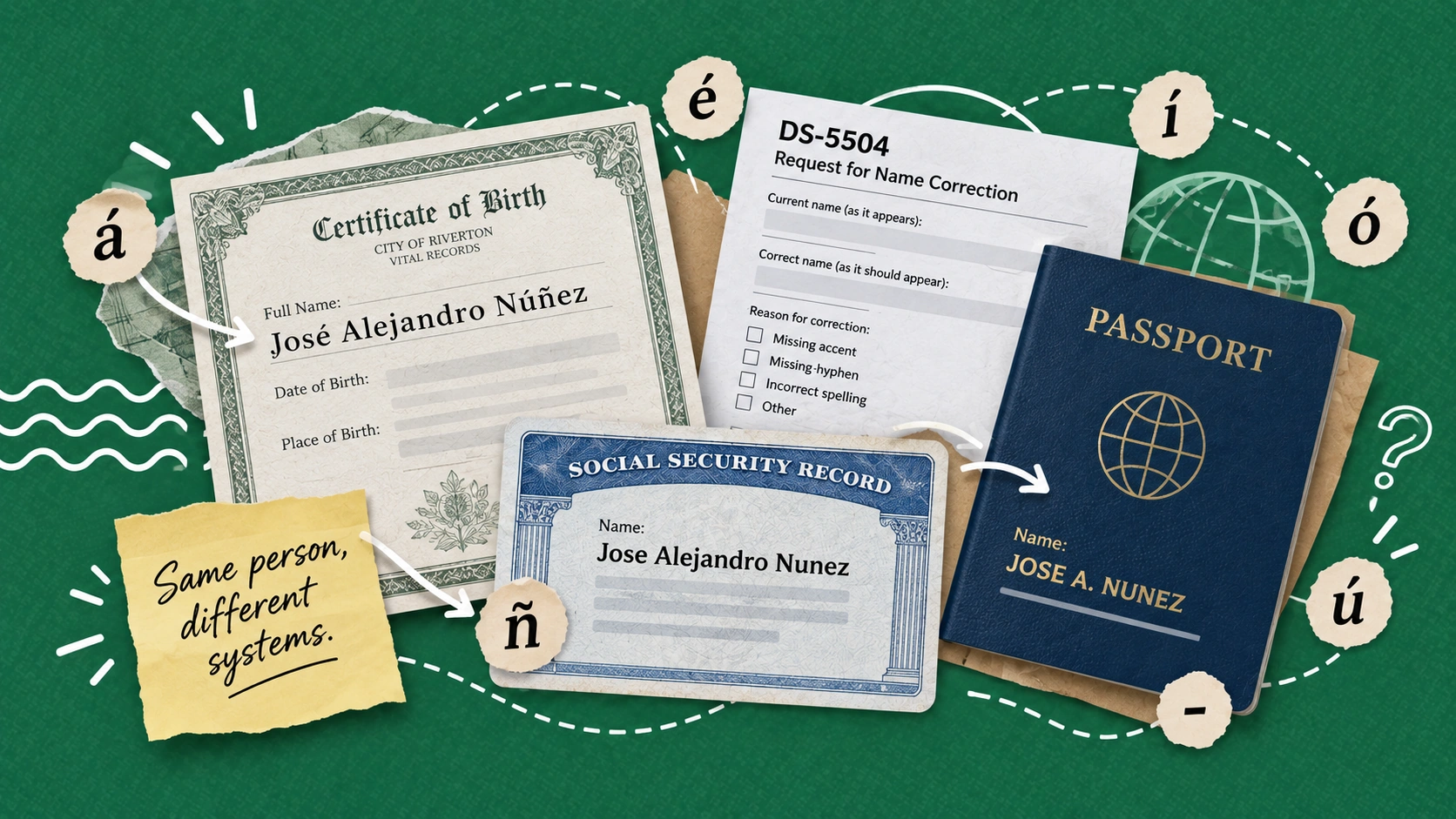
José on the birth certificate. Jose on the Social Security card. JOSE on the passport. Josè on a utility bill because someone guessed. Then a DMV clerk says the documents do not match, and you are standing there holding four versions of your own name, none of which you chose.
This is one of the most common documentary problems in the country and one of the least written about. This article covers why it happens, which mismatches agencies actually care about, and the order in which to fix them. It is not about changing your name. Your name never changed. Our name change resources cover that separate process.
Why Systems Drop the Marks
Two reasons, and neither is about you.
Machine-readable document conventions. The machine-readable zone on a passport, the two lines of characters at the bottom of the data page, uses a restricted character set. Names get transliterated into it, and diacritics are stripped in the process. That is a deliberate international standard for machine reading, not a judgment about your name.
Legacy databases. A great many government systems were built decades ago on character encodings with no room for á, ñ, ü or ç. When a clerk types your name into one, the mark has nowhere to go. Some systems drop it, some substitute a plain letter, and some refuse the character entirely.
The result is that the same person, doing everything correctly, accumulates a set of documents that disagree, and the disagreement was manufactured by the systems, not by any error the person made.
Hyphens and spaces produce the same effect. A hyphenated surname becomes one word in one database and two in another. Compound surnames get truncated to the last element, which is a particular problem for names following Spanish naming conventions, where the second surname often disappears.
Which Mismatches Actually Matter
Agencies are more pragmatic than the anxiety suggests. What matters is whether the documents plainly refer to the same person.
Usually tolerated:
- A missing accent or tilde where the letters are otherwise identical.
- All-capital versus mixed-case rendering.
- A hyphen present in one document and absent in another.
More likely to cause a problem:
- A different letter, not just a different mark: Nuñez versus Nunes.
- A missing name entirely, such as a second surname on one document and not another.
- Names in a different order.
- A mismatch combined with something else already flagged.
The rule of thumb: a stripped diacritic is usually a formatting difference, and a missing or different letter is a discrepancy. Which does not mean the first never causes trouble; it means the second reliably does.
Our FAQ on a name that differs between your birth certificate and Social Security card covers that specific pairing.
The One-Year Passport Rule Almost Nobody Knows
If your passport was printed with your name misspelled, this is the highest-value paragraph in this article.
A data or printing error on a passport is corrected using Form DS-5504, submitted with your current passport, one color photo, and evidence of the error: the State Department names a U.S. birth certificate showing the correct spelling as an example. There is no fee for correcting a printing or data error.
Here is the part with a deadline attached:
- Report within one year of the incorrect passport being issued, and the replacement is valid for the full ten years, or five years for children under 16.
- Report after one year, and the replacement carries only the remaining validity of the original book.
So a misspelling caught at month eleven costs you nothing and gets you a full-validity passport. The same misspelling reported at month thirteen gets you a corrected passport that expires when the flawed one would have. If you have a passport with an error in it, check the issue date today.
Fix the Source Record First
The order of operations matters, because every downstream agency wants to see the vital record as evidence.
Your birth certificate is the source document. Passports, Social Security records, driver's licenses and everything else are derived from it. So:
- Start with the birth certificate. Confirm what it actually says: pull it out and look, rather than relying on memory.
- Decide whether the source is right. If the birth certificate carries the correct spelling and the derived documents dropped a mark, the birth certificate is your evidence and nothing about it needs changing. If the birth certificate itself is wrong, that is what needs correcting first.
- Then correct downstream documents, presenting the certified birth certificate as evidence.
Correcting a passport before the underlying record supports the correction is how people end up making two trips. Our guide on making changes to your birth certificate or passport covers both processes.
If your birth certificate is from another country and in another language, translation requirements come into play: our FAQ on when a birth certificate needs to be translated covers that.
California Is Changing This
California has done something no other state has, and the detail matters because it is easy to overstate.
AB 64 (Chapter 662, Statutes of 2025) was approved on October 12, 2025. It allows diacritical marks on a certificate of live birth, fetal death, death, and on a marriage license and certificate or confidential marriage license and certificate. The law defines a diacritical mark to include accents, tildes, graves, umlauts and cedillas.
Two provisions are worth understanding precisely:
- The presence or absence of a diacritical mark does not make a document invalid. The law says so directly, which is useful the next time someone tells you a certificate without the accent is not really yours.
- An affidavit path to add marks to existing records begins July 1, 2026. The affidavit is made under oath and supported by one other person having knowledge of the facts, and the California Department of Public Health's vital records office begins amending records from that date.
Now the part that generic coverage gets wrong: the requirement that the State Registrar record diacritical marks going forward is not simply live. The bill ties it to an appropriation by the Legislature and provides that it begins no earlier than two years after that appropriation. So the amendment path and the recording requirement are on different timelines, and you should not assume a newly issued California certificate will carry your accent yet.
One more provision worth knowing: the law permits the State Registrar to remove diacritical marks before furnishing vital statistics data to federal, state or local government agencies. Which means even in California, the mark may not survive the trip into another agency's database: the underlying problem this article opened with.
If you are outside California, none of this applies to your state, and the practical approach remains the one above: work from the source record and use it as evidence.
Whatever you are correcting, the certified birth certificate is the evidence every agency asks for. You can order a certified copy from the state that issued it. Vital Records Online is a third-party service and not a government agency. Our FAQ on requesting a birth certificate in a different name than your ID covers ordering when your documents already disagree.
Frequently Asked Questions
Why does my passport spell my name without the accent? The machine-readable zone uses a restricted character set and diacritics are stripped in transliteration. Many legacy government databases also cannot store the characters.
Is a missing accent a legal name change? No. Your name did not change. This is a recording and formatting issue, and it is handled differently from a name change.
How do I fix a misspelling on my passport? Use Form DS-5504 with your current passport, one color photo and evidence of the error, such as a birth certificate showing the correct spelling. There is no fee for a printing or data error.
Why does the one-year mark matter? Report within one year of issuance and the replacement is valid the full ten years. After one year, it carries only the original book's remaining validity.
Can I get an accent added to a California birth certificate? California's AB 64 creates an affidavit path beginning July 1, 2026 for adding diacritical marks to existing records. Confirm the current procedure with CDPH before applying.