Annulments: Whether a Record Exists, and What You Can Actually Get a Copy Of
There is a belief about annulments that causes real problems: that because an annulment treats a marriage as though it was never validly formed, no record of it exists. People act on that belief, tell an agency they were never married, and then cannot explain the gap when the agency finds something.
A record exists. An annulment is a court judgment, and courts keep judgments. This article covers what that record is, who holds it, and which version an agency is actually asking for. It is a records article, not legal advice: grounds for annulment and whether annulment or divorce is the better path in your situation are questions for a family law attorney in your state.
What an Annulment Is, for Records Purposes
An annulment is a court order declaring that a marriage was not validly formed. That is the legal fiction, and it is genuinely different from a divorce, which ends a marriage that was valid.
But the fiction operates on the marriage, not on the paperwork. A court heard a case, made findings, and entered a judgment, and every step of that generated a document. Our annulment decree glossary entry defines the term.
The practical consequence: if an agency asks how a prior marriage ended, "it was annulled" is the accurate answer, and there is documentation to back it. Saying you were never married is the version that creates problems, because a marriage license was issued and a court file exists.
The Two-Document Structure
Where annulments are recorded at the state level, you are generally looking at two different documents, and knowing which one you need saves a wasted request.
Florida is the state we can describe precisely, because its Department of Health documents this clearly.
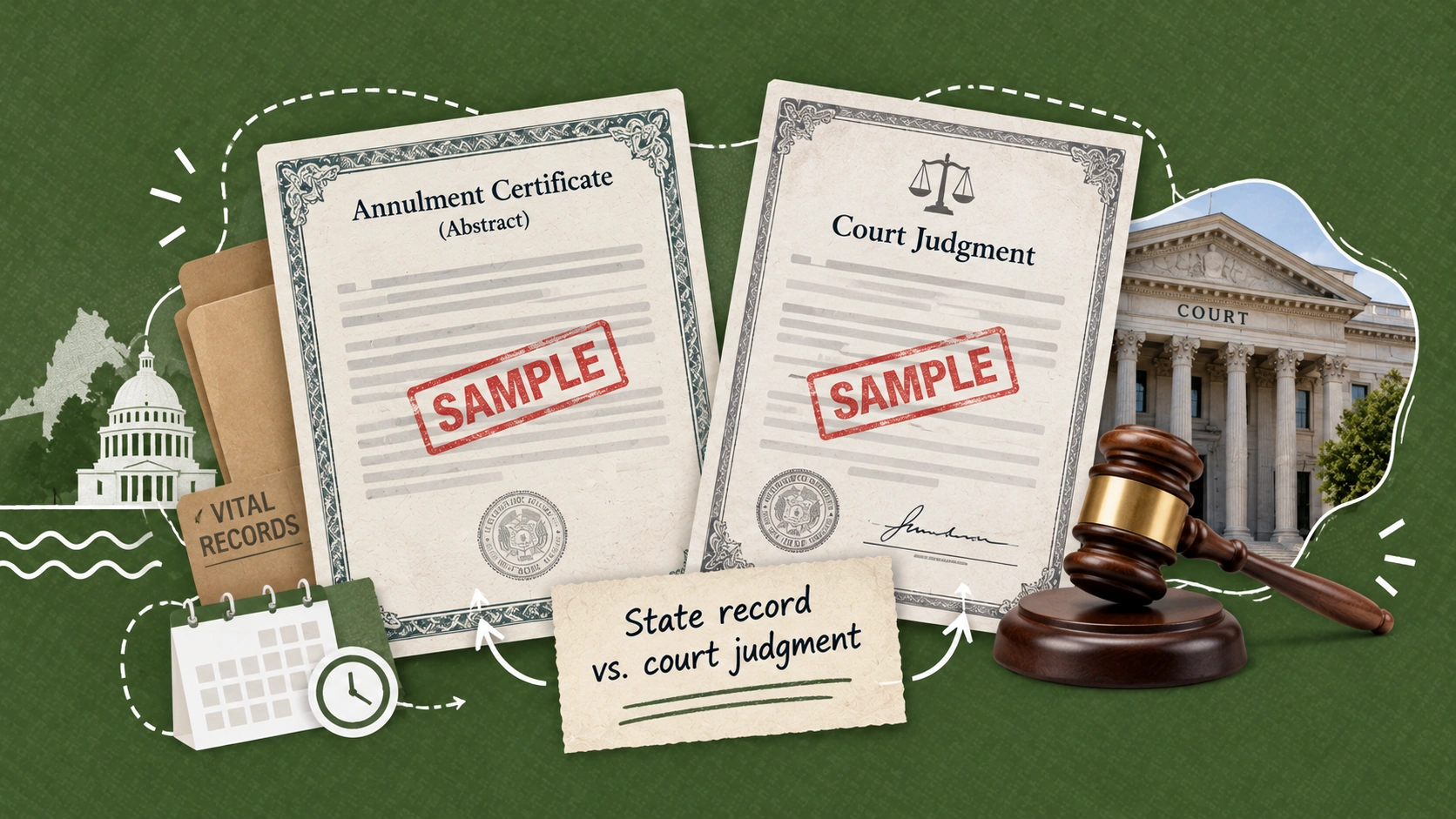
- The state certificate: Florida's Bureau of Vital Statistics issues divorce and annulment certificates for records from June 6, 1927 to the present that have been recorded by the clerk of court. Florida describes it as "issued as an abstract of the information taken from the judgment and is acceptable as evidence that a dissolution was finalized and granted."
- The court judgment: the actual ruling, with its terms and findings, must be obtained separately from the clerk of court in the county where the dissolution was granted.
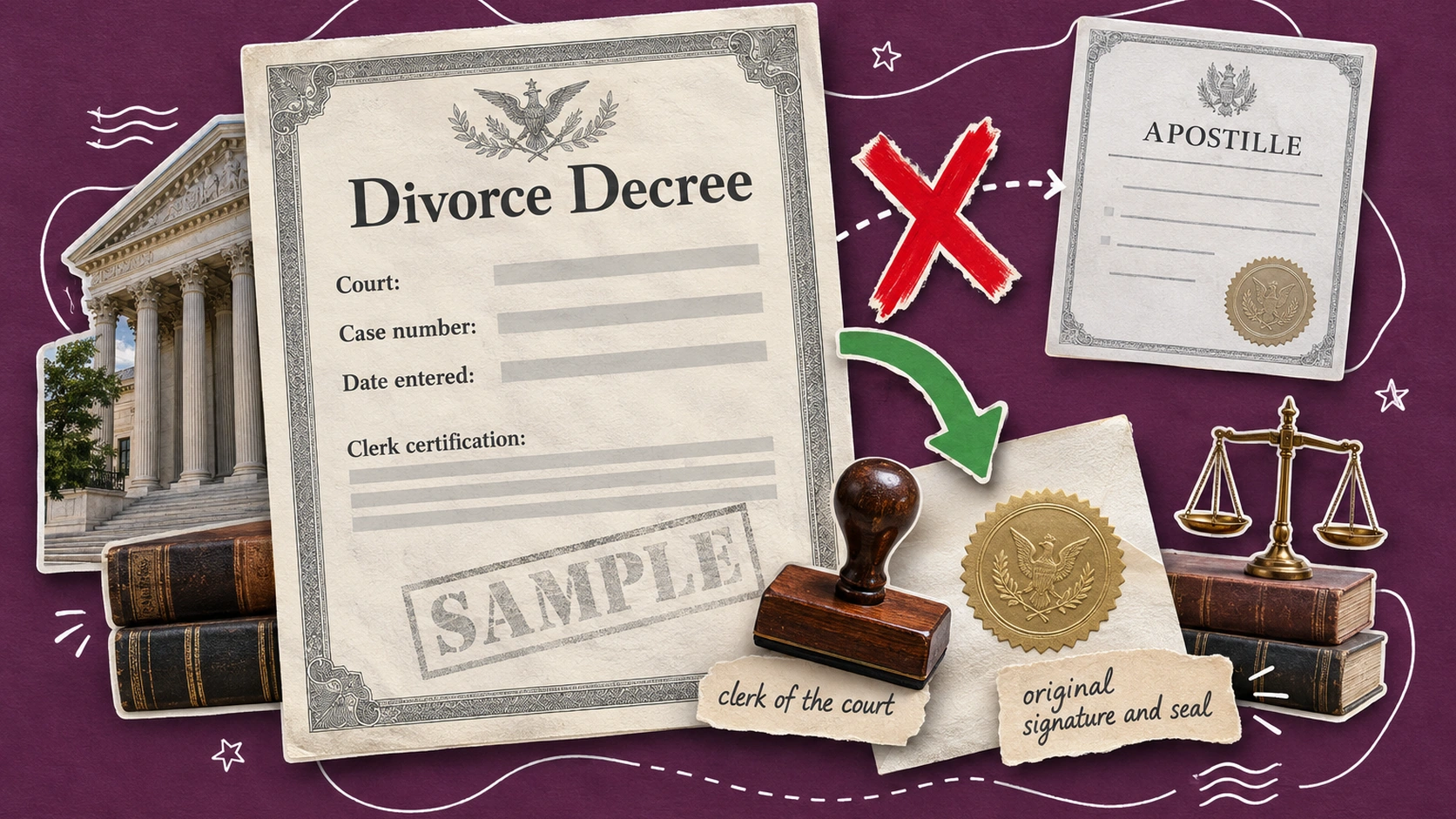
So the state document is a summary that proves the dissolution happened. The court document is the ruling itself. Which one you need depends on who is asking, and the same logic that governs divorce certificates versus divorce decrees applies here: our article on the difference between a divorce certificate and a divorce decree covers when each is appropriate.
The 60-Day Gap Nobody Warns You About
Florida notes roughly a 60-day lag between the clerk of court recording a dissolution and it reaching the state office. That means a recent annulment simply is not at the state yet.
If you need proof of a dissolution finalized less than 60 days ago, go to the county clerk of court rather than the state. Requesting from the state and receiving a "no record found" response is a common and entirely avoidable delay: the record is not missing, it is in transit.
Whether Your State Holds Annulments at All
Here is the part that has no national answer, and we are not going to manufacture one.
Whether a state vital records office records annulments alongside divorces is a state-by-state question. Some states record dissolutions of all kinds centrally. Some hold divorce records but treat annulments differently. In some, the only record is the one held by the court that entered the judgment, and there is no state certificate to order at all.
Florida is the only state whose treatment we verified for this article. Rather than assemble a list from secondary sources and have someone plan around a wrong entry, we would rather tell you the question to ask. Call or check the website of the vital records office in the state where the annulment was granted and ask precisely:
- Does this office hold annulment records, or only divorces?
- What years does the office cover?
- Is what you issue an abstract or the judgment itself?
- If you do not hold it, which court does?
That last question is the one that resolves the search, because if the state does not hold it, the county court that granted it certainly does.
Which Document the Agency Wants
Match the document to the request rather than ordering both by default.
- Confirming marital status: a marriage license clerk, a benefits examiner, or an employer usually needs proof the marriage ended, and a state abstract generally does that. Our FAQ on whether you need a divorce certificate to remarry covers what license clerks typically ask for.
- Anything turning on the terms: a court, an immigration officer, a title company, or a pension administrator deciding rights will generally want the judgment, with its findings.
- A recent annulment: go to the county clerk, because the state copy may not exist yet.
Ask before you order. "Do you need the state certificate or the court judgment" is a fifteen-second question that routinely saves two weeks.
If You Are Not Sure a Record Was Ever Created
Some people genuinely do not know whether a proceeding was finalized: a case filed decades ago, a marriage ended informally, a spouse who handled the paperwork alone. The search runs through the court in the county where the case was filed, and the clerk of court is the office that can tell you whether a judgment was entered.
Our FAQ on how to get a divorce certificate step by step covers the ordering process, and most of it applies to annulments in states that record them together.
Where a state vital records office holds the record, you can order a certified dissolution certificate through our service. Vital Records Online is a third-party service and not a government agency, and we cannot obtain court judgments; those come from the clerk of court that entered them.
Frequently Asked Questions
Does an annulment mean there is no record of the marriage? No. An annulment is a court judgment and a record exists. The marriage license was also issued and recorded.
Do all states issue annulment certificates? No. Whether a state vital records office records annulments is a state-by-state question. In some states the only record is the court judgment.
Does Florida issue annulment certificates? Yes. Florida's Bureau of Vital Statistics issues divorce and annulment certificates for records from June 6, 1927 to the present that have been recorded by the clerk of court.
My annulment was last month and the state has no record. Why? In Florida there is roughly a 60-day lag between the clerk of court recording a dissolution and it reaching the state office. Request from the county clerk instead.
Should I say I was never married? No. An annulment ends a marriage the law treats as never validly formed, but a license was issued and a court record exists. Answer accurately and provide the documentation.