Born in the Panama Canal Zone: The Birth Record No State Has, and the Citizenship It Doesn't Prove
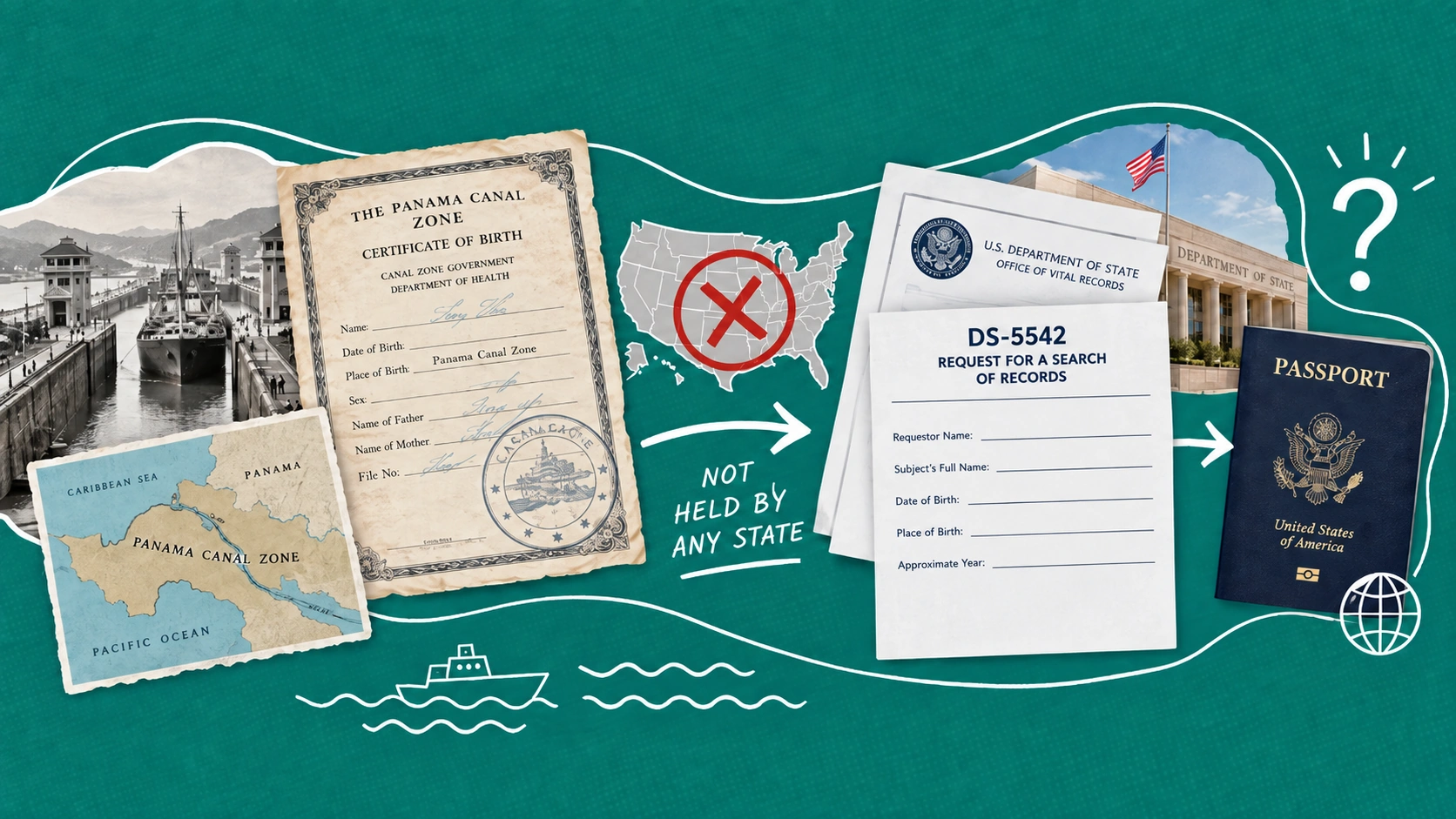
Somewhere between 47 and 122 years old, there is a group of people whose birth certificate cannot be ordered from any state, any county, or any foreign government, and whose search for it tends to end at a dead link. They were born in the Panama Canal Zone, the strip of territory the United States administered from 1904 until the Canal treaties took effect in 1979. The CDC's "Where to Write for Vital Records" directory still lists "Canal Zone" as a jurisdiction, which is how most people find out the record exists and then find out nobody they call has it.
One office does. This article explains which, how to order from it, how long it takes, and, the part that matters most and surprises most, what the record does and does not prove. It is not about births in a foreign country or on a U.S. military base abroad; that guide covers those. And it is not about Puerto Rico or the current territories, whose records are held by their own registrars; our Puerto Rico guide is the place for that. The Canal Zone is a former jurisdiction whose records are federal, and confusing it with a current territory is the mistake this article exists to prevent.
Why No State Has It
The custody story explains everything about the ordering process. The U.S. Department of State's page on Canal Zone records, last updated June 24, 2026, states: "The Panama Canal Commission kept the birth records of persons born in the Panama Canal Zone between 1904 and 1979," and "In December 1999, the Commission gave the records to the U.S. Department of State." The Department now issues copies of "birth and death records from the Panama Canal Zone that were issued between 1904 and 1979."
So the record was never a state record, never a Panamanian record, and after 1999 not a Commission record either. It sits with the same federal office that holds Consular Reports of Birth Abroad, and it is ordered the same way.
The Four Records the State Department Holds
It helps to see the Canal Zone record in its family. The Department's hub page for life-event records lists exactly four categories it can issue copies of:
- Consular Reports of Birth Abroad (CRBA);
- Consular Reports of Death Abroad filed in 1975 or after;
- Certificates of Witness to Marriage Abroad filed before November 1989; and
- Panama Canal Zone birth and death records, 1904–1979.
If the record you need is not one of those four, the Department does not have it, and the answer is a state, a county, or a foreign registrar. If it is one of those four, the answer is the Department and nowhere else.
How to Order
Requests go to the Department's Passport Vital Records Section, by mail, on a notarized Form DS-5542, the same form used for CRBA and consular death record requests. The Department's page gives the current mailing address; use the address on the page on the day you mail, not one copied from an older guide, because the section has moved before.
The verified specifics, from the Department's page as of its June 24, 2026 revision:
- Cost: $50 for each record.
- Processing: "4 to 8 weeks" after the Department receives the request.
- "We do not offer expedited service." There is no fee that makes it faster.
- Mailing time is extra: the Department says mailing "may add up to 4 weeks," and that time is not included in the processing estimate.
Put those together and the planning number is up to twelve weeks from the day you mail the form, with no way to shorten it. Anyone who needs this record for a passport appointment, a Social Security claim, or an estate deadline should order it before setting the date, not after.
Who can request it
Eligibility is limited to the person named on the record, a legal guardian, an authorized government agency, or a person with written permission from the person named. The Department also allows a third party to request on your behalf, its example is "a family member or friend who has known you for at least five years", with a notarized statement and copies of identification from both of you. For a genealogist requesting an ancestor's record, or an executor requesting a decedent's, read the Department's eligibility section closely and expect to document the relationship; the page sets the terms and we are not going to guess at them.
Apostilles on a Canal Zone record
The Department's page addresses apostilles for these records with a rule tied to the record's issue date, on a five-year boundary: a recently issued copy is treated differently from one issued more than five years ago, and in the latter case the page indicates a new record must be requested at the same $50 fee. If you need the record for use in another country, read that section of the Department's page in full before ordering, because it decides whether the copy in your drawer can be used or whether you are starting from the form.
What the Record Does Not Prove
This is the section that earns the article, and we are quoting the Department rather than paraphrasing it: "People born in the former Panama Canal Zone did not automatically get U.S. citizenship at birth."
That is the opposite of what most holders of these records assume, and the assumption fails at the worst possible moment: a passport application. The Department's page adds that passport applicants born in the Canal Zone must also submit evidence of their parents' U.S. citizenship to support the claim. The Canal Zone birth record proves the birth. It does not, by itself, prove that the person born was a U.S. citizen, because citizenship for Canal Zone births depended on the parents' status, under federal law that this article is not going to summarize, because getting it slightly wrong would tell a reader something false about their own status.
What that means in practice:
- If you were born in the Canal Zone and are applying for a U.S. passport, plan to document a parent's U.S. citizenship at the time of your birth, typically that parent's own birth certificate, naturalization certificate, or passport, alongside your Canal Zone record. Our glossary entry on proof of citizenship lists the general categories.
- If you have held a U.S. passport before, check the Department's citizenship-evidence page on whether a previous passport can serve as evidence in your case; it may spare you the parental documents.
- If your parents' status is unclear or you have never held a U.S. passport, the question of your citizenship is one for the Department of State (for passports) or U.S. Citizenship and Immigration Services (for a Certificate of Citizenship), and not for a vital-records article. Ask them, in writing, before you assume either way.
Where Vital Records Online Fits
Honestly: at the edges. Vital Records Online is a third-party service and not a government agency, and Canal Zone records are issued only by the Department of State, by mail, on its own form; there is no state office to order from. Where a service like ours is useful is with the other documents a Canal Zone birth usually pulls in: a parent's state-issued birth certificate to document that parent's citizenship, or for family history research, the records of relatives who were born, married, or died in a U.S. state. Our genealogy page covers that side, and our guide to finding grandparents' names is the starting point if the trail runs cold.
Frequently Asked Questions
Where do I get a birth certificate for someone born in the Panama Canal Zone? From the U.S. Department of State's Passport Vital Records Section, by mail, on a notarized Form DS-5542. No state, county, or Panamanian office holds these records.
What years of Canal Zone records does the State Department have? Birth and death records issued between 1904 and 1979, transferred from the Panama Canal Commission in December 1999.
How much does a Canal Zone birth record cost and how long does it take? $50 per record; processing is 4 to 8 weeks after receipt, with no expedited service, plus up to 4 weeks of mailing time.
Does a Panama Canal Zone birth certificate prove U.S. citizenship? Not by itself. The State Department states that people born in the former Canal Zone "did not automatically get U.S. citizenship at birth," and passport applicants must also submit evidence of their parents' U.S. citizenship.
Is the Canal Zone the same as a U.S. territory like Puerto Rico? No. Puerto Rico and the current territories have their own registrars that issue their own records. The Canal Zone is a former jurisdiction whose records are held federally by the State Department.