Does a REAL ID Prove Citizenship? What It Does and Doesn’t Show
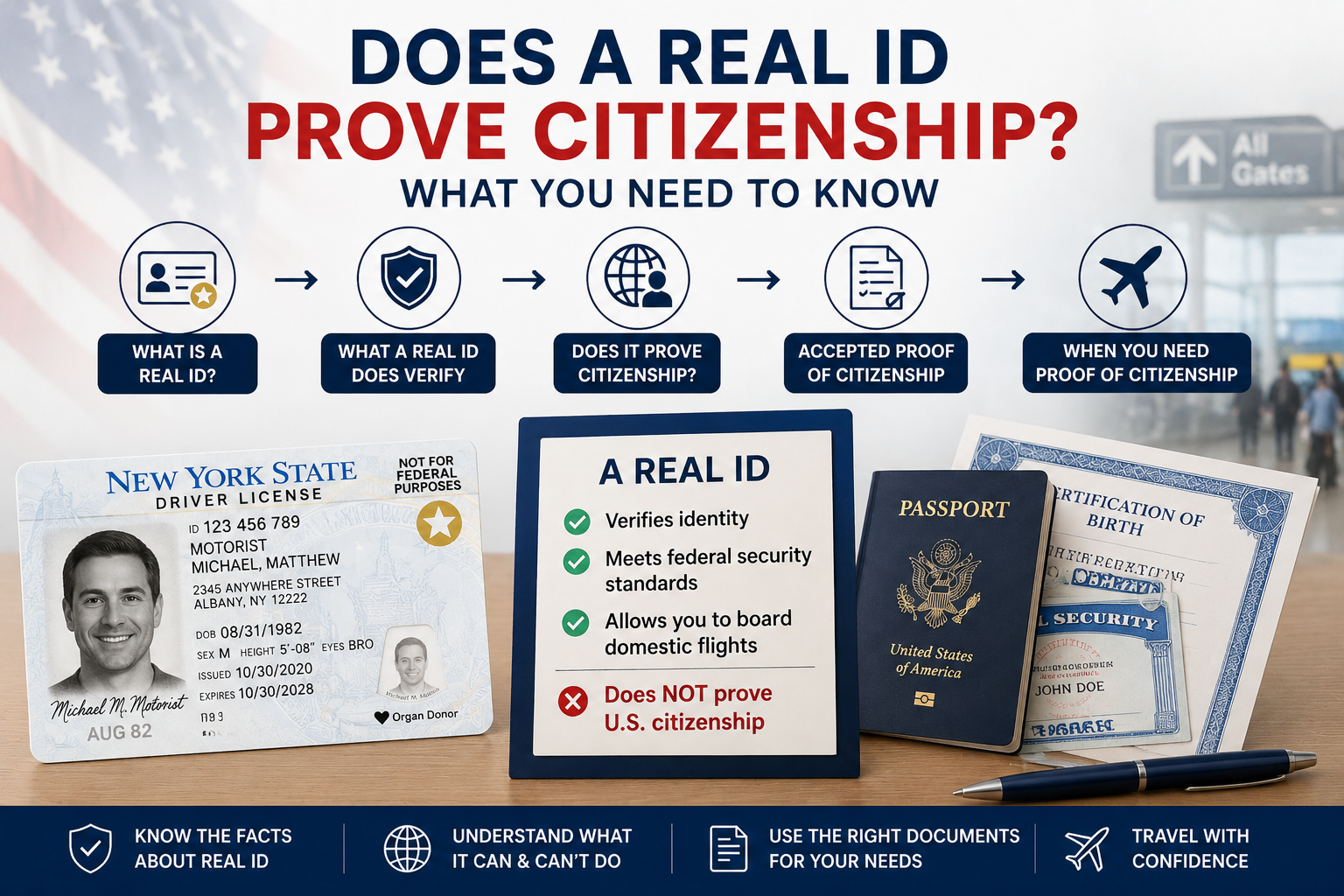
Since REAL ID enforcement began on May 7, 2025, millions of Americans have upgraded their driver’s licenses. That’s led to a common and important question: does a REAL ID prove citizenship? The short answer is no. A REAL ID confirms your identity and that you’re lawfully present in the United States, but it is not proof of U.S. citizenship. Here’s what that means in practice.
Does a REAL ID Prove Citizenship?
No. A REAL ID is a federally compliant form of identification, marked with a star in the upper-right corner, that meets enhanced security standards for boarding domestic flights and entering certain federal facilities. To get one, you verify your identity and lawful status, but the card itself does not certify that you are a U.S. citizen.
Why REAL ID Isn’t Proof of Citizenship
Both U.S. citizens and many lawful non-citizens, such as green card holders and certain visa holders, can qualify for a REAL ID. Because the card is available to people who are lawfully present but not citizens, it can’t serve as evidence of citizenship on its own. In other words, having a REAL ID tells an agency you’re you and that you’re here legally, not that you hold U.S. citizenship.
Identity vs. Lawful Presence vs. Citizenship
It helps to separate three different things a document can prove:
- Identity: that you are who you say you are (a REAL ID does this).
- Lawful presence: that you’re legally in the U.S. (a REAL ID confirms this at the time of issuance).
- Citizenship: that you are a U.S. citizen (a REAL ID does not do this).
Which Documents Actually Prove U.S. Citizenship?
When you need to prove citizenship for a passport, certain jobs, or voter registration under some state laws, you’ll typically need one of these:
- A certified U.S. birth certificate (for those born in the United States).
- A U.S. passport or passport card.
- A Certificate of Naturalization or Certificate of Citizenship.
- A Consular Report of Birth Abroad (for citizens born overseas to U.S. parents).
A certified birth certificate is the most common and widely accepted proof for people born in the U.S.
Why This Matters in 2026
With REAL ID now in effect and new state and federal rules around proof of citizenship for voting and other purposes, it’s easy to assume your enhanced license covers everything. It doesn’t. Keep a certified birth certificate or passport on hand for any situation that specifically requires proof of citizenship.
Frequently Asked Questions
Does a REAL ID prove citizenship?
No. A REAL ID proves your identity and lawful presence, but not U.S. citizenship, since non-citizens can also qualify for one.
Can non-citizens get a REAL ID?
Yes. Lawfully present non-citizens, such as permanent residents and certain visa holders, can obtain a REAL ID.
What document proves U.S. citizenship?
A certified U.S. birth certificate, U.S. passport, Certificate of Naturalization, or Certificate of Citizenship.
Is a birth certificate enough to prove citizenship?
For people born in the United States, a certified birth certificate is generally accepted as proof of citizenship.
Related Guides
- What Is a REAL ID? Requirements, Cost & How to Get One: Everything you need to apply.
- REAL ID vs. Passport vs. Passport Card: Which one you actually need.
- Do You Need a REAL ID to Fly?: What’s required at the airport in 2026.
Need proof of citizenship? Order a certified birth certificate online from Vital Records Online.