A Court Document Takes a Different Road to an Apostille Than a Birth Certificate
People sending documents abroad usually learn the apostille process through a birth certificate: order a certified copy from the state, send it to the Secretary of State, receive it back with a certificate attached. It is a clean two-step process and it works.
Then the same person needs a divorce decree apostilled, follows the same steps, and the package comes back rejected. Nothing was done carelessly. The document simply travels a different road, for a reason that is worth understanding once, because it generalizes to every court document you will ever need to send overseas.
This article assumes you know what an apostille is. If not, our guide to apostilles for U.S. vital records covers the framework, and our article on the objection rule covers why a valid apostille is occasionally refused by the destination country.
The Rule That Explains Everything
An apostille authority does not certify that a document is true. It certifies a signature it can verify against its own records: that the named official really holds that office, really signed, and that the seal is what it appears to be.
So the question is never "what kind of document is this." The question is "whose signature is on it, and does the apostille authority hold that signature on file?"
That is the whole mechanism. Once you have it, the routing follows automatically. A state Secretary of State holds specimen signatures for a defined set of officials: the State Registrar, county clerks, county recorders, notaries public. If your document is signed by someone on that list, it can be apostilled as it stands. If it is signed by anyone else, something has to happen first to get a qualifying signature onto it.
What That Means for a Divorce Decree
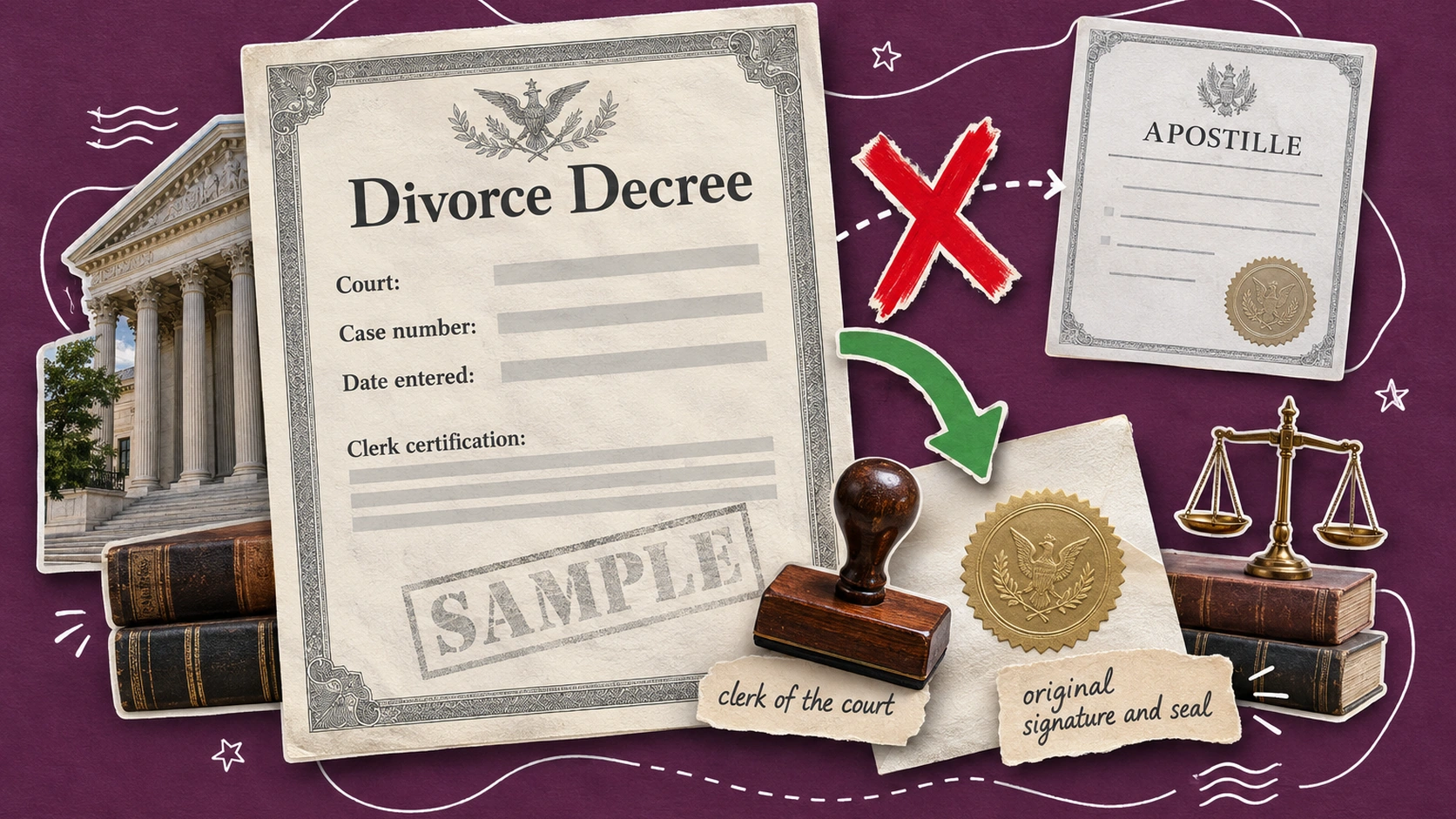
A divorce decree is a court document. It was signed by a judge, and a judge's signature is generally not what the Secretary of State holds on file. The intermediate step is the clerk of the court, who certifies that the copy is a true copy of what the court entered and applies the clerk's own stamp and seal. The clerk's signature is on the apostille authority's list.
Florida states this directly. Its Department of State will certify "Documents certified by a Clerk of Circuit Court from a county within Florida, such as a marriage license or a divorce document bearing the stamp and seal of the Clerk," and, separately, "Birth, Death and Marriage Certificates bearing the signature of the State Registrar." Two categories, two different signatures, one office issuing the apostille.
And Florida tells you where to go for the first one: "You must contact the Clerk of Circuit Court to obtain these documents."
Colorado describes the same architecture. Its Secretary of State notes that "Copies of marriage licenses, divorce decrees, or other court documents can be ordered from the County Clerk and Recorder or Clerk of the District Court where they were issued," and lists the three ways a document becomes eligible: it carries a Colorado notary public signature, it is certified by Colorado Vital Records, or it is certified by a county clerk's office in Colorado.
The Document That Will Not Work
This is the expensive mistake, and it is easy to make because the document looks right.
The state-issued divorce certificate is a vital record: an abstract from a state health department confirming that a divorce happened. It is a real certified document and it is the right answer for many purposes. It is not the decree, it does not carry the court's terms, and for a foreign authority that asked for the judgment it is the wrong document regardless of how it is authenticated.
So before ordering anything, find out which document the receiving authority actually wants. If it wants proof that the divorce occurred, the state certificate may be fine and can be ordered from the state that recorded it. If it wants the decree, only the court can supply it. Our glossary entry on the divorce certificate apostille covers the vital-record route, and the entry on the clerk of court covers the office that holds the other one.
A second rule catches people even when they have the right document. Florida: "Documents must be submitted with original signatures; a photocopy of an original cannot be authenticated." A scan of a clerk-certified copy is not a clerk-certified copy. Order a fresh one from the clerk rather than photocopying the one in your file.
The Fee Difference Is the Tell
Florida charges by category, and the prices make the distinction concrete: $10 per notarized document, $10 per document from the Bureau of Vital Statistics, and $20 per document for clerk-certified court records. The state treats court records as a separate product with a separate chain, and it prices them that way.
Florida also asks applicants to allow at least five working days, and Colorado's page carries a warning that it is experiencing longer than normal wait times. We are quoting one figure from one state as evidence of a structure, not publishing a price list. Colorado's apostille fee is set out in a separate schedule that we did not read, and we are not going to guess at it.
Neither state page we worked from carries a last-updated date, so confirm the current fees and timeframes on the issuing office's own site before sending anything. For how long the underlying records take to arrive in the first place, our state processing time page is the site's answer to that question.
The Same Logic, Other Documents
Once the signature rule is clear, the rest of the court-document category sorts itself out. Adoption orders, court-ordered name changes, letters testamentary and letters of administration, custody orders: all of them are court documents, none of them is a vital record, and all of them follow the same path. Get a certified copy from the clerk of the court that entered the order, then send that copy for authentication.
The practical sequence for any court document going abroad:
- Confirm which document the receiving authority wants, in writing if possible. This is the step that prevents the expensive version of this mistake.
- Order a certified copy from the clerk of the court that entered it. Not from the vital records office, and not from your own files.
- Check that the certification carries an original signature and seal, and that the signing official is one the apostille authority recognizes.
- Send it for the apostille, allowing for the office's stated turnaround and any backlog it has announced.
If the document you need authenticated is a vital record, our apostille service handles the state-level step for birth, death, marriage and divorce records. We want to be straightforward about the boundary: for a court document, Vital Records Online cannot obtain the underlying certified copy, because that comes only from the clerk of court. Vital Records Online is a third-party service and not a government agency; apostilles are issued by the state's competent authority, and the receiving country decides what it will accept.
Frequently Asked Questions
Can I get an apostille on a divorce decree? Yes, on a copy certified by the clerk of the court that entered it, bearing the clerk's stamp and seal. The apostille authority certifies the clerk's signature.
Why was my divorce certificate rejected for an apostille? Most often because the receiving authority wanted the court's decree rather than the state's vital-record abstract, or because a photocopy was submitted instead of an original certified copy.
Can a photocopy be apostilled? No. Florida states that documents must be submitted with original signatures and that a photocopy of an original cannot be authenticated. Order a fresh certified copy.
Why do court documents cost more to apostille in Florida? Florida prices clerk-certified court records separately from vital records, which reflects that they travel a different chain. Other states set their own fees.
Does this apply to adoption orders and name changes? Yes. Any court-issued document follows the same route: a certified copy from the clerk of the issuing court, then the apostille.