Found as a Baby: How the Law Builds a Birth Certificate When Nobody Knows Who You Are
Almost every birth record begins with someone who was present: a hospital, a midwife, a parent. The system assumes that at least one person knows who the child is.
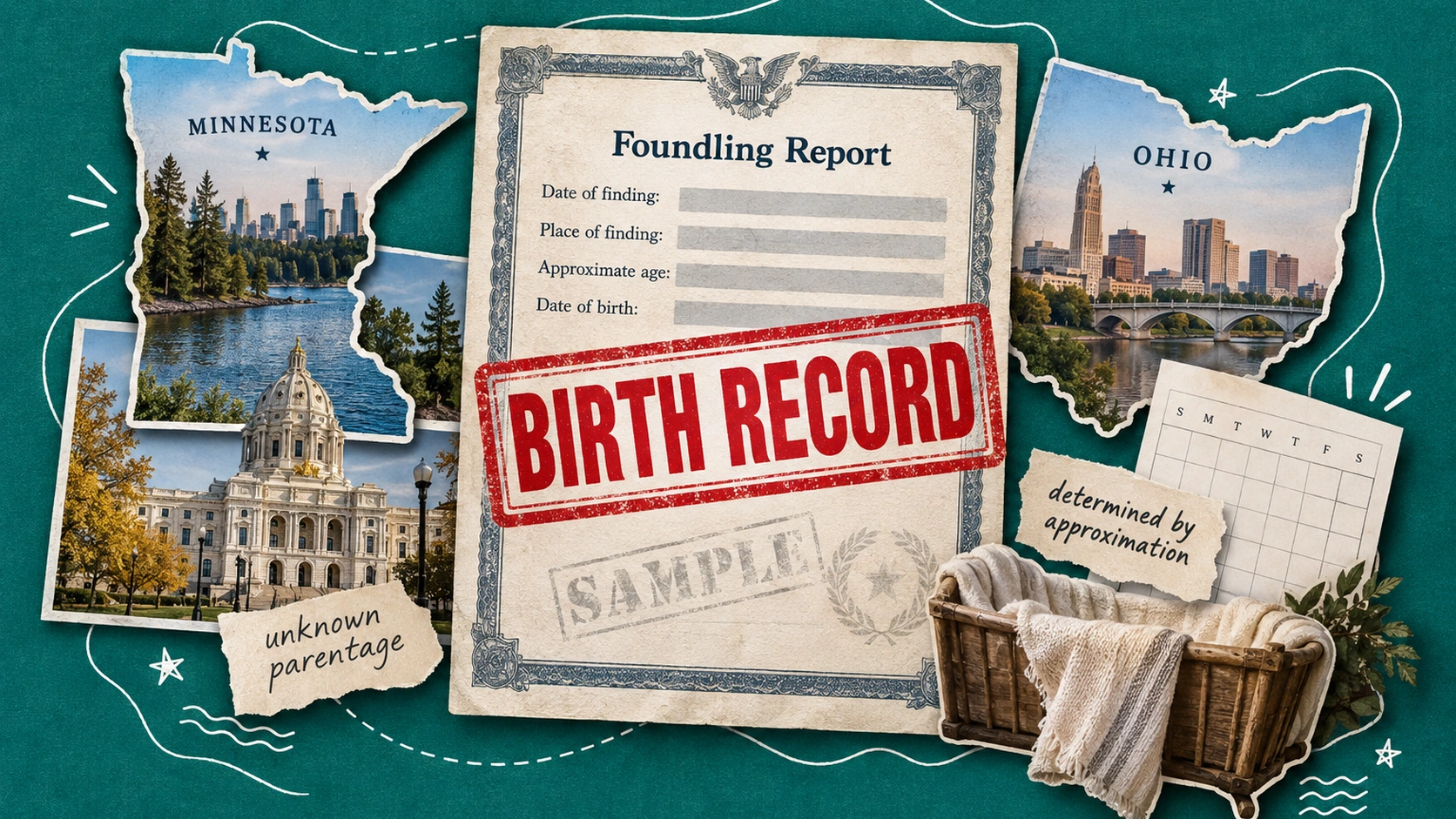
There is a category of record built for the case where nobody does. An infant is found, of unknown parentage, and the law has to produce a birth certificate for a person whose name, birthday, and origins are all unknown. It does this through a mechanism called a foundling report, and the person with the legal duty to file it is not a parent. It is whoever found the child.
This article explains how that works, using two states that do it differently, and what it means years later for the adult whose birth record began that way. It is not about delayed registration, which is a different process for a birth that was simply never recorded; our glossary entry on the delayed birth certificate covers that boundary. And it is not about adoption records: a foundling who is later adopted enters that system, and this article stops where that one starts.
The Finder Has the Duty
Both states we read put the obligation on the same person, in almost the same words.
Minnesota (Minn. Stat. § 144.216, subdivision 1): "Whoever finds a live born infant of unknown parentage shall report within five days to the Office of Vital Records such information as the commissioner may by rule require to identify the foundling."
Ohio (Ohio Rev. Code § 3705.11): "Whoever finds a living infant of unknown parentage shall immediately report such finding to the local registrar of vital statistics of the registration district in which the child is found."
Two things are worth noticing. The duty falls on a private person, which is unusual in vital records law, where the filer is normally an institution or a licensed professional. And the clocks differ: five days in Minnesota, "immediately" in Ohio. Neither is a casual instruction. This report is the only thing that will establish that the child exists as a legal person.
The Report Becomes the Birth Certificate
This is the mechanism that makes the whole thing work, and both states state it directly.
Minnesota: a report registered under subdivision 1 "shall constitute the record of birth for the child." Ohio: "The foundling report shall constitute the birth certificate for such foundling child," and the state's general birth-record provisions "shall apply in the same manner and with the same effect to such report."
Ohio also specifies what the report contains and how the unknowable facts are handled. The form states the date of finding, the place of finding, the sex of the child, the race of the child, the approximate age of the child, and the name and address of the person or institution with whom the child has been placed for care. Then: "The place where the child was found shall be known as the place of birth, and the date of birth shall be determined by approximation."
Read that sentence slowly, because it is the quiet heart of this subject. A person's legal birthplace becomes the doorway, the hospital entrance, the spot where they were found. Their birthday is an estimate made by officials. Both facts follow them for life, onto every form that asks where and when they were born.
Somebody Has to Name the Child
Ohio adds a step the other state does not. The person, superintendent, or manager of the institution with whom a foundling child is placed for care "shall give such child a name within ten days" and must promptly report that name to the local registrar.
That provision explains something people occasionally discover about their own documents: a first legal name chosen within ten days by a hospital administrator or an agency employee, because the statute required somebody to choose one and there was no one else to do it. If a name on an early record looks institutional or arbitrary, this is frequently why. Our guide to a birth certificate with no name on it covers the adjacent situation where no name was entered at all.
What Happens If the Child Is Later Identified
Here the two states diverge sharply, and the difference matters enormously to an adult trying to trace their own origins.
Minnesota seals. If the child is identified and a record of birth is found or obtained, the foundling report "shall be confidential" and "shall not be disclosed except pursuant to court order." The report still exists. It is closed, and a court can open it.
Ohio destroys. If a foundling child is later identified and an original birth record is found or obtained, the foundling report "shall cease to be a public record," is placed in a sealed envelope not open to inspection or copying unless ordered by a court, and then: "All copies of the foundling report in the possession of the local registrar or the probate court as well as any and all index references thereto shall be destroyed."
Index references destroyed is the phrase to sit with. In Minnesota a sealed record can be asked about. In Ohio the pointers that would let anyone know a foundling report ever existed are removed by law. For someone researching their own history decades later, that is the difference between a locked door and no door.
Ohio's section carries an effective date of March 16, 1989 and has not been amended since, so this is long-standing law rather than a recent change.
A Foundling Is Not a Safe-Haven Surrender
These two get conflated constantly, and they are handled under different provisions.
An infant of unknown parentage is found. A safe-haven infant is surrendered, deliberately, at a place the law designates. Minnesota now legislates them separately in the same statute: subdivisions added in 2024 cover newborns received by hospitals under the state's safe place law, requiring the hospital to report the birth to the Office of Vital Records within five days. Those records are confidential, and information from them is disclosed only to the responsible social services agency or pursuant to a court order, which is a tighter rule than the one applying to an ordinary foundling report before any identification occurs.
So: different trigger, different filer, different confidentiality regime. If you are dealing with a surrender rather than a finding, the safe-haven provisions govern, and they vary by state at least as much as foundling provisions do.
What This Means for Ordering a Record
The practical instruction is short, and it is deliberately cautious.
Ask the state registrar how that state treats a foundling registration. Do not assume the ordinary process applies. We read two states and found two different architectures, one sealing and one destroying, with different clocks and different content requirements. There are forty-eight more, and we are not going to guess at them or publish a count.
What generalizes is only this: the record that exists is the foundling report or whatever the state converted it into, it is a birth record for legal purposes, and the office that holds it is the state vital records office. If you need a certified copy of a birth record and the ordinary route is not working, a request can be made to the state that holds it, and explaining the circumstances to that office directly is usually faster than guessing at a form. Vital Records Online is a third-party service and not a government agency; certificates are issued by the state's vital records office, which also decides eligibility and how a record of this kind is handled.
For anyone researching family history where a foundling record is involved, our genealogy page and our glossary entry on birth records are the starting points. We are not going to offer advice on DNA testing or search strategy, which is outside what a vital records service can responsibly speak to.
Frequently Asked Questions
What is a foundling report? The report filed when someone finds an infant of unknown parentage. In the states we read, that report constitutes the child's birth record.
Who has to file it? The finder. Minnesota requires a report within five days to the Office of Vital Records; Ohio requires an immediate report to the local registrar.
What is recorded as the place and date of birth? Under Ohio's statute, the place where the child was found is treated as the place of birth, and the date of birth is determined by approximation.
What happens to the record if the child is later identified? It depends on the state. Minnesota makes the report confidential and disclosable only by court order. Ohio seals it and requires copies and index references to be destroyed.
Is a foundling report the same as a delayed birth certificate? No. A delayed registration is for a birth that was never recorded at the time. A foundling report is a record created promptly, by a finder, for a child whose parentage is unknown.