You Had a Passport Once and Can't Find It, and You Have No Birth Certificate Either
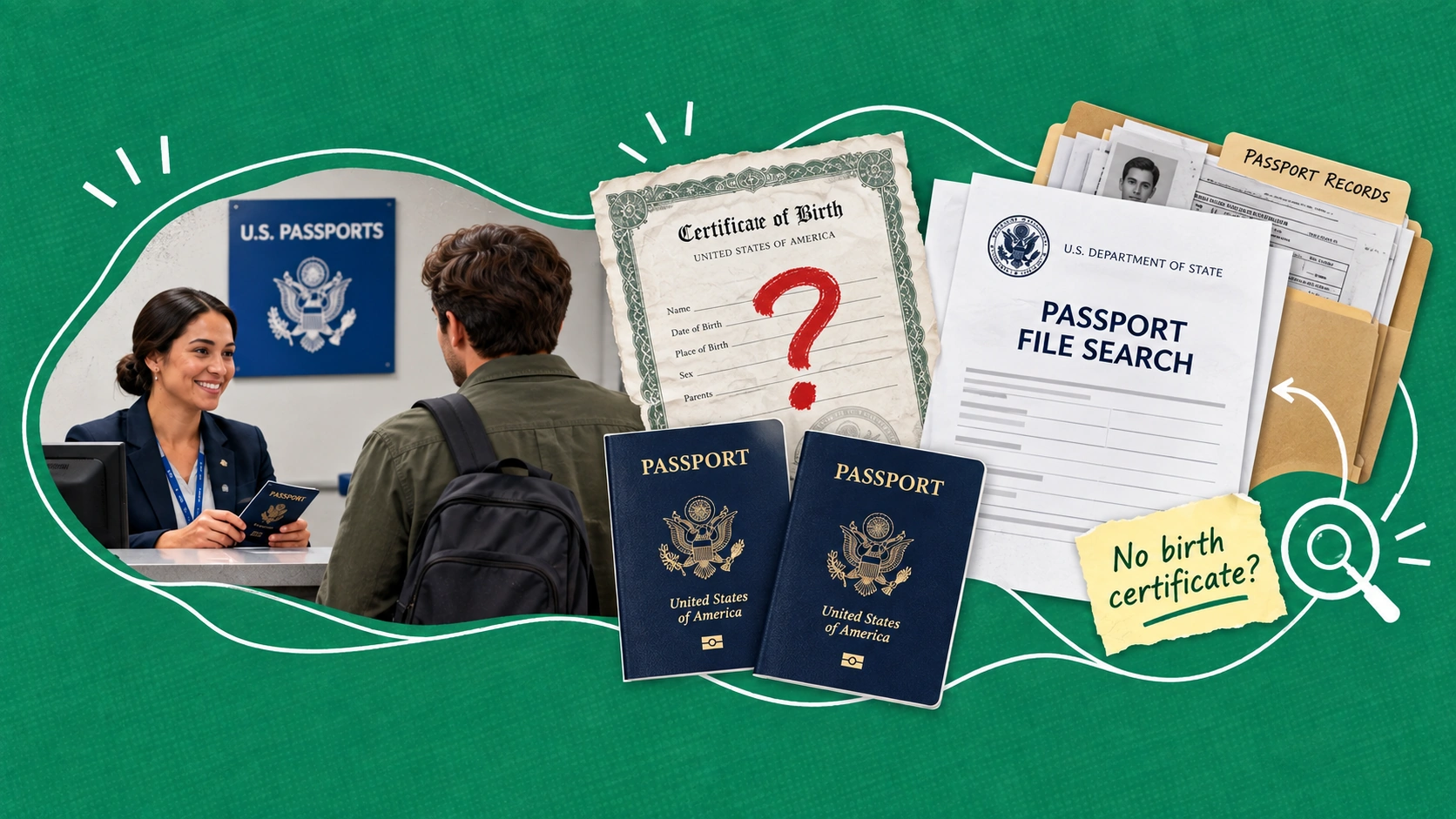
There is a specific dead end in the passport process that feels unsolvable when you hit it. You need to prove U.S. citizenship. The obvious document is a birth certificate, and you do not have one: it was never filed, it burned, the state has no record. The backup is your previous passport, and you cannot find that either. Every checklist you read assumes you have at least one of the two.
The State Department does not assume that. It has a remedy built for exactly this case, and almost nobody knows it exists: a search of the Department's own passport records. If it finds that you were issued a passport, that finding is itself evidence of citizenship, because the Department already made the citizenship decision once, when it issued the passport in the first place.
This article is about that file search. It does not repeat the general list of acceptable documents, which our guide to what you need for a passport and our FAQ on which birth certificate a passport requires already cover, and it is not the list of substitutes to use in place of a birth certificate; that guide exists too. It covers the one remedy neither of them mentions.
What a File Search Is
A file search is the Department searching its own records for a passport or a Consular Report of Birth Abroad previously issued to you. It is available where you previously held a U.S. passport or a Consular Report of Birth Abroad and cannot submit it with your application.
The logic is worth stating plainly, because it is what makes the remedy work. A passport is not just a travel document; it is a determination that the Department made about your citizenship. If the Department can confirm from its own files that it issued you one, it does not need you to re-prove the underlying facts with a birth certificate. The file search substitutes for the birth certificate rather than merely supporting it.
That is also why a file search is not a general-purpose fix. It only works if a record exists. If you have never held a U.S. passport or a Consular Report of Birth Abroad, there is nothing in the Department's files to find, and the answer is the secondary-evidence path instead.
The Fee Rule, Which Is Genuinely Counter-Intuitive
Here is the part that saves most people money, and the part almost every summary gets wrong. The fee depends on when the record you are looking for was issued:
- Records issued before 1994: $150. This is paid as part of the request.
- Records issued in 1994 or later: you do not pay up front. The Department searches its electronic database first. The fee may be requested later only if that electronic search fails.
Read that second line again, because the practical consequence is large. If your lost passport was issued in, say, 2009, you are asking the Department to look in a database, and unless that lookup comes back empty, the $150 never arrives as a bill. The people who most often assume a file search is unaffordable are the people least likely to be charged for it.
The 1994 boundary is about how the records are stored, not about who you are. Older records are paper, and searching them is the work the fee pays for. We are quoting the current published rule; it is the only passport fee this article names, and it is the subject rather than a price list.
When a Birth Certificate Is Still the Better Move
This section exists because the honest answer is not "always do the file search."
For most applicants, ordering a certified copy of a birth certificate is faster and cheaper than a file search, and it is the document the Department lists first. If your birth was registered and the state has the record, the ordinary route is the right one, even if the copy in your drawer is missing, damaged, or a hospital souvenir rather than a certified copy. Our guide to replacing a lost birth certificate covers that path, and a certified copy can be ordered from the issuing state. Vital Records Online is a third-party service and not a government agency; the certificate is issued by the state's vital records office.
The file search is for the case where that route is closed: the birth was never registered, the state searched and found nothing, or the record exists in a jurisdiction that no longer issues from it. That is a smaller group than the number of people who simply cannot find their paperwork today.
So the sequence to work through is:
- Can the state issue a certified copy of your birth certificate? If yes, order it. Done.
- If the state has no record, ask for what the Department calls a Letter of No Record, because the secondary-evidence path requires it.
- Did you ever hold a U.S. passport or a Consular Report of Birth Abroad? If yes, the file search is available and may cost nothing for a post-1994 record.
- If neither, the secondary-evidence path is the route.
If There Is No Record Anywhere: the Secondary-Evidence Path
Where no birth certificate exists, the Department sets out a separate route, and it is worth knowing the shape of it even though it is not this article's subject. It combines a delayed birth certificate or a Letter of No Record from the state with early public or private records from the first five years of your life. Records the Department names as examples: a baptism certificate, a hospital birth certificate, a U.S. Census record, early school records, a family Bible record, and a doctor's records of post-natal care. Where a private record is used, Form DS-10, the Birth Affidavit, is required.
Our guide to birth certificate alternatives for a passport goes through that path properly, including what makes an early record acceptable. The reason it appears here at all is that people confuse the two remedies: the file search looks for something the government already issued to you, while secondary evidence assembles proof from records the government never held.
What to Expect, and What Not to Expect
- No published processing time. The Department does not publish a turnaround for a file search, and we are not going to invent one. Treat it as additional time on top of normal passport processing, and do not book travel against it.
- It is requested with your application, not as a separate errand beforehand.
- A failed search is a real outcome. If the Department finds nothing, a common result when a passport was issued to a different name, or decades ago under a spelling variation, you are back to the secondary-evidence path. Bring every name variation you have used.
- A file search abroad is a different thing. If you are outside the United States and your passport was lost or stolen, the embassy or consulate has its own free file search as part of replacing it, which is a separate process from the one described here.
Before You Apply
Two things are worth doing before you fill in anything. First, check whether the state where you were born can actually issue a certified copy, a five-minute question that decides which route you are on. Second, if you are going to request a file search, write down every detail you can recall about the passport: approximate year of issue, the name it was issued in, and the city where you applied. The Department is searching for a record, and the details are what make it findable.
The figures above come from the State Department's Citizenship Evidence page. It moved to a new URL in the 2026 site redesign and its revision date has already changed once this year, so confirm the $150 figure and the 1994 split on the Department's citizenship evidence page before you send anything.
Frequently Asked Questions
What is a passport file search? A search of the State Department's own records for a passport or Consular Report of Birth Abroad previously issued to you, used as evidence of citizenship when you cannot submit the document itself.
How much does a passport file search cost? $150 for records issued before 1994. For records issued in 1994 or later you do not pay up front; the fee may be requested later only if the electronic database search fails.
Can I get a passport with no birth certificate at all? Possibly. If you previously held a U.S. passport, a file search may substitute. If not, the Department's secondary-evidence path combines a delayed birth certificate or Letter of No Record with early records from your first five years, plus Form DS-10 where a private record is used.
Is a file search faster than ordering a birth certificate? Generally no. For most applicants, ordering a certified copy from the state is faster and cheaper. The file search is for cases where the birth record genuinely does not exist.
How long does a file search take? The Department does not publish a processing time for it. Allow extra time beyond normal passport processing and do not plan travel around it.