Your Documents Are Perfect and State Can Still Refuse Your Passport
Almost everything written about passport applications is about documents. Bring the certified birth certificate, bring the right photo, do not sign the form early. That advice is good, and it answers the question most applicants have.
It does not answer the question an applicant has after a denial letter arrives. A complete, correct, perfectly documented application can still be refused, and the reasons are published in federal regulation where anyone can read them. This article is about that list: what is on it, which item behaves like a records problem, and how to tell the difference. It deliberately does not repeat the acceptable-documents checklist, which our guide to what you need for a passport already covers, and it is not about a birth certificate the agency would not accept, which is a different problem with its own guide.
The List Is Public, and That Matters
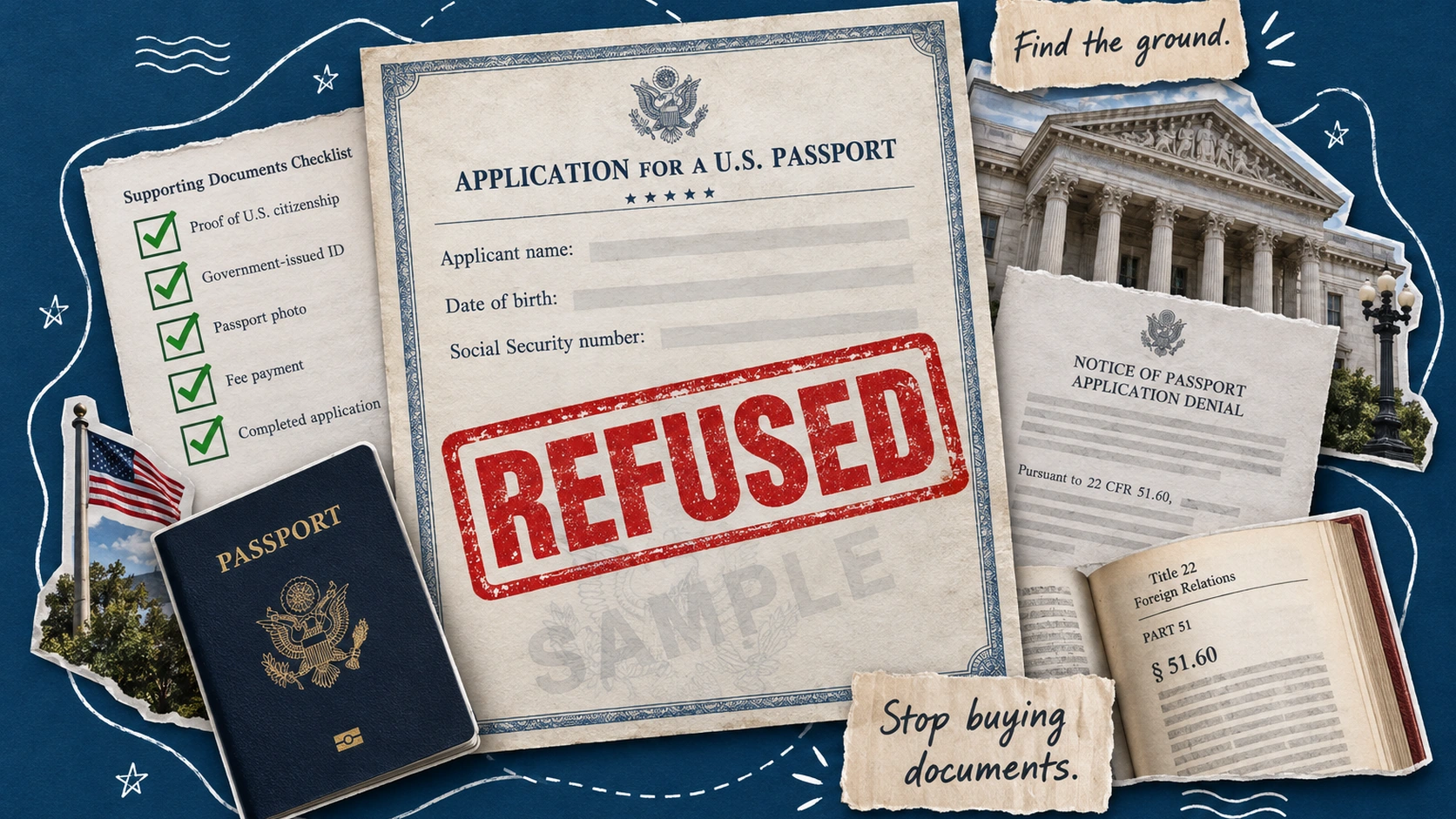
The authority is 22 CFR 51.60, "Denial and restriction of passports," current as of October 1, 2026. You can read it yourself, which is the single most useful thing to know when a letter arrives using language you do not recognize. The regulation separates grounds the Department may not issue on from grounds it may refuse on, and the distinction is real: the first group is mandatory, the second is discretionary.
A theme runs through the whole section. Nearly every ground is a status the Department is told about by someone else. The regulation repeatedly uses the phrase "determines or is informed by competent authority," which means another agency, a court, or a foreign government supplied the information. That is why the fix is almost never with the passport agency.
The Mandatory Grounds
Under paragraph (a), the Department may not issue a passport, except one for direct return to the United States, where:
- The applicant is in default on a repatriation loan received from the United States to return the applicant or immediate family from a foreign country.
- The applicant has been certified by the Secretary of Health and Human Services, as notified by a state agency, to be "in arrears of child support in an amount determined by statute."
- The applicant is a covered sex offender whose passport lacks the conspicuous identifier the Department is required to place on it.
Note what the child-support provision says and does not say. The regulation sets no dollar figure of its own; it points to an amount fixed by statute and certified by HHS. Figures circulate online for this threshold, and we are not repeating one here, because the number is set by the agency that certifies the debt rather than by the Department of State, and the page most often cited for it has not been updated in years. If a denial cites this ground, the agency to contact is the state child-support enforcement agency that reported the arrears, not the passport agency.
The Discretionary Grounds
Paragraph (b) lets the Department refuse where the applicant is:
- the subject of an outstanding federal warrant of arrest for a felony, including one issued under the Federal Fugitive Felon Act;
- subject to a criminal court order, condition of probation, or condition of parole forbidding departure from the United States, where violating it could produce a federal arrest warrant;
- subject to a court order committing him or her to a mental institution;
- legally declared incompetent;
- the subject of a request for extradition or provisional arrest submitted to the United States;
- the subject of a subpoena in a federal felony matter, or of military restraint or apprehension orders, or of a state or local felony warrant.
Further paragraphs cover unpaid emergency medical and repatriation assistance, a prior denial where circumstances have not changed, activity abroad causing or likely to cause "serious damage to the national security or the foreign policy of the United States," a warrant reported by a foreign government or international organization, and international child-abduction cases.
Paragraph (h) adds two more: certain convictions under 18 U.S.C. 2423 where a passport was used in committing the offense, and certification by the Secretary of the Treasury of a seriously delinquent tax debt.
The One That Is Actually a Records Problem
Here is the ground worth the most attention on a site about vital records. Paragraph (f): the Department may refuse a passport to an applicant who fails to provide a Social Security account number, or who "willfully, intentionally, negligently, or recklessly includes an incorrect or invalid Social Security account number."
That is the one item on the list that behaves like a paperwork problem, and it is the one most likely to surprise someone who did everything right. The usual cause is not a blank field. It is a mismatch: the name and number the applicant supplies do not line up with what the government already holds. For most people that traces back to two documents that disagree with each other, typically a birth certificate and a Social Security record that were never reconciled after a marriage, a divorce, an adoption, or a correction to a name spelled differently at birth.
If that is the ground cited, the fix runs through the Social Security Administration rather than the passport agency: get the Social Security record to match the name you use and the documents that support it. Our guide to changing your name with Social Security covers the mechanics, and the supporting document is usually a certified vital record. That is the point at which ordering a certified copy of a birth certificate genuinely helps. Vital Records Online is a third-party service and not a government agency; certificates are issued by the state's vital records office, and the Department of State alone decides a passport application.
Tax Debt, and the Clock That Comes With It
The tax ground has a published process, and it is worth knowing because it is the one with a deadline a traveler can act inside. According to the IRS, a seriously delinquent tax debt means legally enforceable, unpaid federal tax debt, including assessed penalties and interest, above a threshold the IRS publishes and adjusts. Once the IRS certifies that debt to the State Department, State will not issue a new passport and may revoke one already issued. The taxpayer gets a window, published by the IRS as 90 days, to resolve the matter before the application is denied.
Reversal happens when the debt is paid, ceases to qualify, or the certification turns out to be erroneous. The IRS also lists categories it does not certify at all, including taxpayers in bankruptcy, those with a pending identity-theft claim, those under a current installment agreement or an accepted offer in compromise, and accounts classified as currently not collectible for hardship.
Two cautions. The threshold figure and the timing above come from the IRS's own page and should be confirmed there before anyone plans around them, because the amount is indexed and the page is revised. And nothing published states how long the Department of State takes to act once a certification is reversed, so do not assume reversal and departure happen in the same week.
What to Do With a Denial Letter
The practical sequence is short:
- Find the ground. The letter will reference a reason. Match it against 22 CFR 51.60 rather than guessing from the summary language.
- Identify whose decision it actually was. On most of these grounds the Department was informed by someone else: a court, HHS, the IRS, a state agency, a foreign authority. That body is where the problem lives.
- Stop buying documents. This is the honest part. If the ground is a warrant, a court order, a child-support certification, or a tax certification, another certified copy of your birth certificate changes nothing. The only ground on the list that more or better records can resolve is the Social Security number mismatch.
- Get advice where the ground is legal. A warrant, a probation condition, a commitment order, or a competency declaration is a matter for a lawyer. Vital Records Online is not a law firm and this article is not legal advice.
One structural note worth carrying away: in appropriate circumstances the regulation allows the Department to issue a limited-validity passport good only for direct return to the United States. That provision exists for people who are abroad when a ground applies, and it is the reason several of the grounds above carry the phrase "except a passport for direct return to the United States."
Frequently Asked Questions
Where are the reasons for a passport denial published? At 22 CFR 51.60, "Denial and restriction of passports," in the Code of Federal Regulations. The section separates mandatory non-issuance grounds from discretionary refusal grounds.
Can unpaid child support stop a passport? Yes. The regulation makes non-issuance mandatory where HHS certifies that the applicant is in arrears in an amount determined by statute. The threshold is set outside the passport regulation, and the state child-support agency that reported the arrears is where it is resolved.
Can a wrong Social Security number get a passport refused? Yes. The Department may refuse where an applicant fails to provide a Social Security account number or includes one that is incorrect or invalid. A name-to-number mismatch is the common cause.
Will ordering another birth certificate fix a denial? Only if the ground was the Social Security number mismatch or a document problem. For a warrant, a court order, a child-support certification, or a tax certification, no amount of additional records will change the outcome.
What is a limited-validity passport for direct return? A passport the Department may issue, in appropriate circumstances, that is valid only for returning to the United States. Several grounds in the regulation are written to allow it even where a full passport is refused.