Proving Your Social Security Number at the DMV: The Second Document That Gets REAL ID Applications Rejected
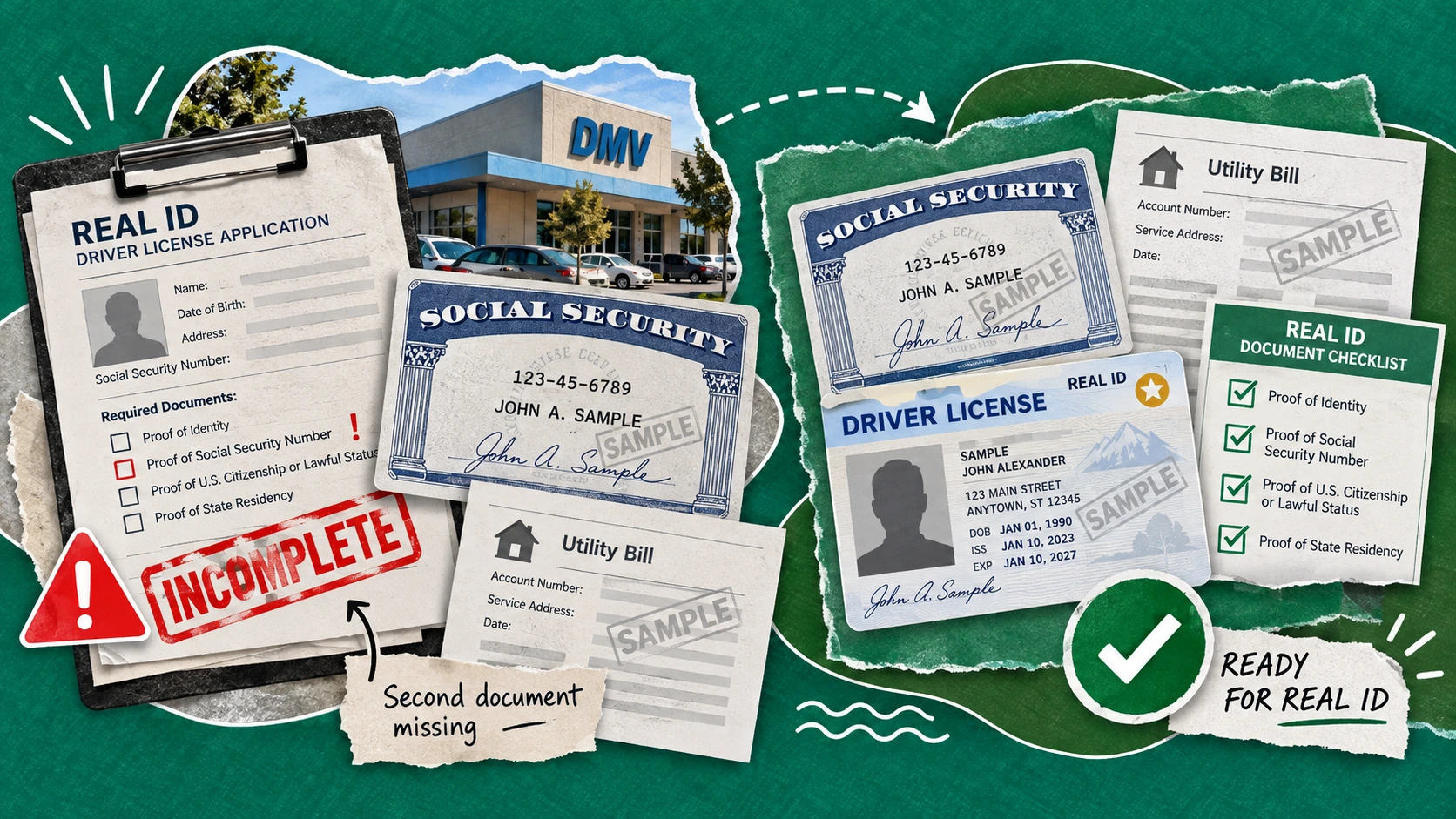
The applicant did everything right. Certified birth certificate, current passport, two proofs of address, an hour in line. The clerk looks up and asks for proof of the Social Security number. The applicant offers a laminated card, or a bank statement with the last four digits, or a phone screenshot, and is sent home. REAL ID runs two independent document tests, and passing the identity test says nothing about the second one.
This article is about that second test. It does not explain what REAL ID is or why the deadline matters; what is a REAL ID and our REAL ID birth-certificate FAQ cover that. It also does not cover the name-change document chain, which has its own guide.
Two Tests, Not One
The federal REAL ID regulation, at 6 CFR 37.11, lists what an applicant must present. Identity and date of birth are one requirement, satisfied by a birth certificate, passport or similar document. The Social Security number is a separate requirement, in its own paragraph, with its own list of acceptable evidence.
That structure is the whole point. The birth certificate proves who you are and when you were born. It does not carry your Social Security number, so it cannot prove that. The DMV needs a second document for the second fact, and the two lists do not overlap.
What the Federal Rule Accepts
The regulation names the Social Security card first. Then it does something most applicants do not know about: it names substitutes for when the card is unavailable. Under 6 CFR 37.11(e)(1), if a Social Security card is not available, the applicant may present one of the following, bearing the applicant's name and Social Security number:
- A W-2 form.
- An SSA-1099 form, the annual Social Security benefit statement.
- A non-SSA-1099 form: a 1099 from a bank, brokerage, or other payer.
- A pay stub showing the applicant's name and full Social Security number.
Two things follow from that list. First, the physical card is not always required. An applicant who cannot find the card but has last year's W-2 in a tax folder can clear the test without a trip to the Social Security office. Second, the document has to show the full number and the applicant's name. A statement with the last four digits does not qualify, and neither does anything without the name on it.
The regulation also requires the DMV to verify the number with the Social Security Administration before issuing the card (§37.13). The document gets you to the counter; the electronic check is what actually passes you. If the name on your identity document and the name in SSA's records do not match, the check fails regardless of what you brought, which is where the name-change chain comes in.
States Add Their Own Rules
The federal list is a floor. The regulation lets states impose additional requirements, and the accepted-document lists at individual DMVs vary in wording and in what they add. Three examples, from the agencies' own published lists, show the range.
- New York DMV lists the Social Security card, and as alternatives an SSA-1099 or a 1098 or 1099 form, and a W-2, each showing the full number and your name.
- Florida HSMV lists the card, a W-2, a 1099, or a paycheck stub showing the full number.
- Michigan Secretary of State lists the card, an SSA-1099, a non-SSA 1099, and a pay stub with your name and number.
Those three are examples, not the rule. Your state's list is the one that governs, and it may be narrower or accept something these do not. Read it before you go, and read it for the SSN line specifically, because most people read only the identity section.
The Laminated-Card Problem
A laminated Social Security card is the classic failure. The Social Security Administration itself advises against laminating the card because lamination can prevent the security features from being seen, and DMVs commonly refuse laminated cards for that reason. If your card is laminated, treat it as unavailable and bring a W-2, 1099 or pay stub instead, or order a replacement card.
The Ordering Problem
Here is the sequence that traps people who are missing both documents.
A replacement Social Security card is itself gated behind proof of identity. The Social Security Administration will not issue one without an acceptable identity document, and for many applicants the identity document it wants is the same one the DMV wants: a birth certificate, a passport, or a driver's license. Someone who has none of those cannot get the card, and without the card or a substitute cannot get the REAL ID.
The way out is to start at the beginning of the chain rather than the end.
- Get the birth certificate first. It is the one document in the chain that does not depend on the others; the state that recorded your birth issues certified copies on its own eligibility rules.
- Check whether a substitute already exists before ordering a new Social Security card. A W-2, 1099 or full pay stub in a file at home may make the card unnecessary for REAL ID purposes.
- If you do need the card, apply with the birth certificate in hand. Our guides on getting a new or replacement Social Security card and replacing a Social Security card cover that step.
- Then go to the DMV with the identity document and the SSN document as separate items, and read your state's list one more time.
If the birth certificate is the missing link, you can order a certified copy from the state that recorded your birth; our driver's license and REAL ID page explains how the documents fit together. Vital Records Online is a third-party service and not a government agency; Social Security cards are issued only by the Social Security Administration, and REAL IDs only by your state's licensing agency. The federal document list is at 6 CFR 37.11.
Frequently Asked Questions
Do I need my actual Social Security card for a REAL ID? Not necessarily. The federal rule accepts a W-2, an SSA-1099, a non-SSA 1099, or a pay stub showing your name and full Social Security number when the card is unavailable. Check your state's list, which may differ.
Can I use a document that shows only the last four digits? No. The accepted documents must show the full number and your name.
Will the DMV accept a laminated Social Security card? Often not, because lamination can hide the card's security features. Bring an accepted substitute or order a replacement card.
I have no birth certificate and no Social Security card. Where do I start? With the birth certificate. A replacement Social Security card requires proof of identity, so the birth certificate has to come first.
What if my name on my birth certificate differs from SSA's records? The DMV's electronic check with SSA may fail. See our guide to the REAL ID name-change document chain.