Born in Guam, the U.S. Virgin Islands, or American Samoa: Which Birth Record You Get and What It Proves
People born in a U.S. territory get asked a question that people born in Ohio never hear: is your birth certificate a U.S. document? It is. Guam, the U.S. Virgin Islands, the Northern Mariana Islands and American Samoa are U.S. jurisdictions with their own registrars, and the certificate each one issues is a U.S. vital record, not a foreign one, and not a consular report of a birth abroad.
What that certificate proves about citizenship is a second question, and for one of those four jurisdictions the answer is different from the other three. That difference is the reason this article exists. It is a companion to our Puerto Rico birth-certificate guide, which is about a different problem, and it does not cover births outside U.S. jurisdiction; that guide does.
Territories Are Not "Abroad"
The confusion starts with geography. Guam is closer to Manila than to Honolulu; American Samoa is in the southern hemisphere. Forms that ask "born in the United States?" leave people from these islands unsure which box to tick.
For vital records, the answer is clean. A birth in a territory is registered by that territory's own vital statistics office, in the same way a birth in Texas is registered by Texas. The record is a U.S. birth certificate. No consular report is involved, because no consulate is; there is no U.S. embassy in Guam for the same reason there is none in Hawaii.
What the Certificate Proves: Four Territories
For a person born in Guam, the U.S. Virgin Islands, the Northern Mariana Islands, or Puerto Rico, birth in the territory confers U.S. citizenship at birth, under the citizenship provisions of the Immigration and Nationality Act that apply to each (with a date after which the provision applies, which for the CNMI depends on its Covenant with the United States). The U.S. Department of State's Foreign Affairs Manual and USCIS's Policy Manual both treat birth in these territories, on or after the applicable date, as acquisition of citizenship at birth.
The practical consequence is the one people want: a birth certificate from these territories is accepted as proof of U.S. citizenship the same way a state birth certificate is: for a passport, for a federal job, for REAL ID, for Social Security. Our FAQ on birth certificates as proof of citizenship covers the general rule; these certificates fall inside it.
What the Certificate Proves: American Samoa
Here the answer changes, and we verified it carefully because getting it wrong would tell readers something false about their own status.
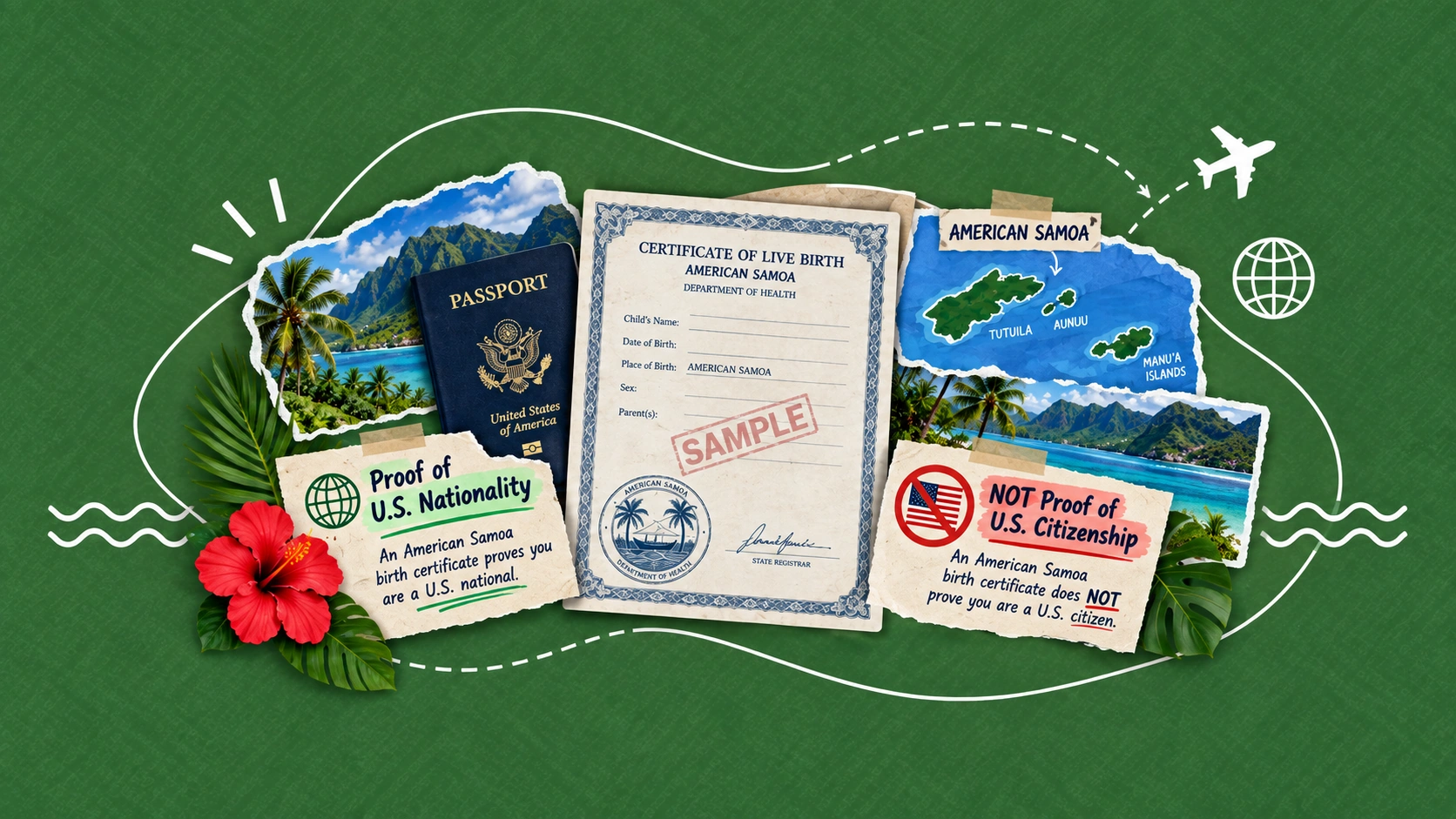
Under section 308 of the Immigration and Nationality Act, a person born in American Samoa or Swains Island is a U.S. national at birth, but not a U.S. citizen. The State Department's Foreign Affairs Manual (8 FAM 308) and USCIS's Policy Manual both state this. American Samoa is the only permanently inhabited U.S. territory where this is the case.
What a U.S. national is, in practice:
- A U.S. national owes allegiance to the United States and is not an alien. A non-citizen national can live and work anywhere in the United States without immigration status, and can obtain a U.S. passport.
- The passport says so. A passport issued to a non-citizen national carries an endorsement stating that the bearer is a U.S. national and not a U.S. citizen.
- Citizenship requires a further step. A non-citizen national who wants U.S. citizenship applies for naturalization through USCIS, under provisions that treat nationals more favorably than other applicants but still require an application.
So an American Samoa birth certificate proves birth in a U.S. jurisdiction and, with it, U.S. nationality. Presented as proof of citizenship for a job that requires citizenship, for voting in a state, for a federal benefit limited to citizens, it does not establish that, because the person is not a citizen unless they have naturalized. A naturalized person's Certificate of Naturalization or Certificate of Citizenship is the document that proves citizenship in that case. Whether any of this should change is a live question in the courts and Congress; what it is, today, is what the statute and the manuals say.
Ordering the Record
The mainland rule, order from the jurisdiction where you were born, holds. What changes is that the office is harder to find and its procedures are its own.
- Each territory runs its own vital statistics office, generally under its health department or an equivalent agency, with its own application form, its own eligibility rules for who may request a certified copy, its own fee, and its own turnaround.
- Eligibility rules vary by territory, as they do by state. Do not assume the rule from the state where you now live applies.
- Turnaround is the territory's, and mail to and from the Pacific territories in particular adds transit time on both ends. Order well ahead of a passport appointment.
- The CDC's "Where to Write for Vital Records" directory lists each territory's office with its current address and fee, and is the authoritative starting point when the office's own site is hard to locate.
Puerto Rico has a specific replacement history of its own, and our Puerto Rico guide covers it. We are deliberately not repeating it here.
Presenting the Certificate
- For a passport, a certified birth certificate from Guam, the USVI or the CNMI is primary evidence of citizenship. From American Samoa, it is evidence of nationality; the passport issued reflects that. Our passport services page covers the general process.
- For an employer or agency that asks "U.S. citizen?", a person born in American Samoa who has not naturalized should answer accurately, U.S. national, and expect the form to have a category for it. Many federal forms do.
- For anything that requires citizenship specifically, a non-citizen national needs the naturalization document, not the birth certificate.
If you were born in a U.S. state and need a certified copy for the same purposes, you can order one from the issuing state; for a territorial birth, the territory's own vital statistics office is the issuer, and the CDC directory above will point you to it. Vital Records Online is a third-party service and not a government agency; nothing here is immigration or legal advice, and questions about nationality or naturalization belong to USCIS and the State Department. The statute is at INA § 308 (8 U.S.C. § 1408), and the CDC directory is at Where to Write for Vital Records.
Frequently Asked Questions
Is a birth certificate from Guam or the U.S. Virgin Islands a U.S. document? Yes. Each territory registers births through its own vital statistics office, and the certificate is a U.S. vital record, not a foreign one.
Does a territorial birth certificate prove U.S. citizenship? For Guam, the U.S. Virgin Islands, the Northern Mariana Islands and Puerto Rico, birth there confers citizenship at birth, and the certificate is accepted as proof. For American Samoa and Swains Island, birth confers U.S. nationality, not citizenship.
What is a U.S. national who is not a citizen? A person who owes allegiance to the United States, is not an alien, can live and work in the U.S. and hold a U.S. passport, but is not a citizen unless they naturalize. Persons born in American Samoa are the main example.
Can Vital Records Online order a certificate from a territory? Territorial certificates are issued by each territory's own office. Check the territory's vital statistics office or the CDC directory for how to request one.
What about Puerto Rico? Puerto Rico has a specific replacement history covered in our Puerto Rico guide.