Your U.S.-Born Child's Passport Now Asks About Both Parents: What Executive Order 14418 Changed
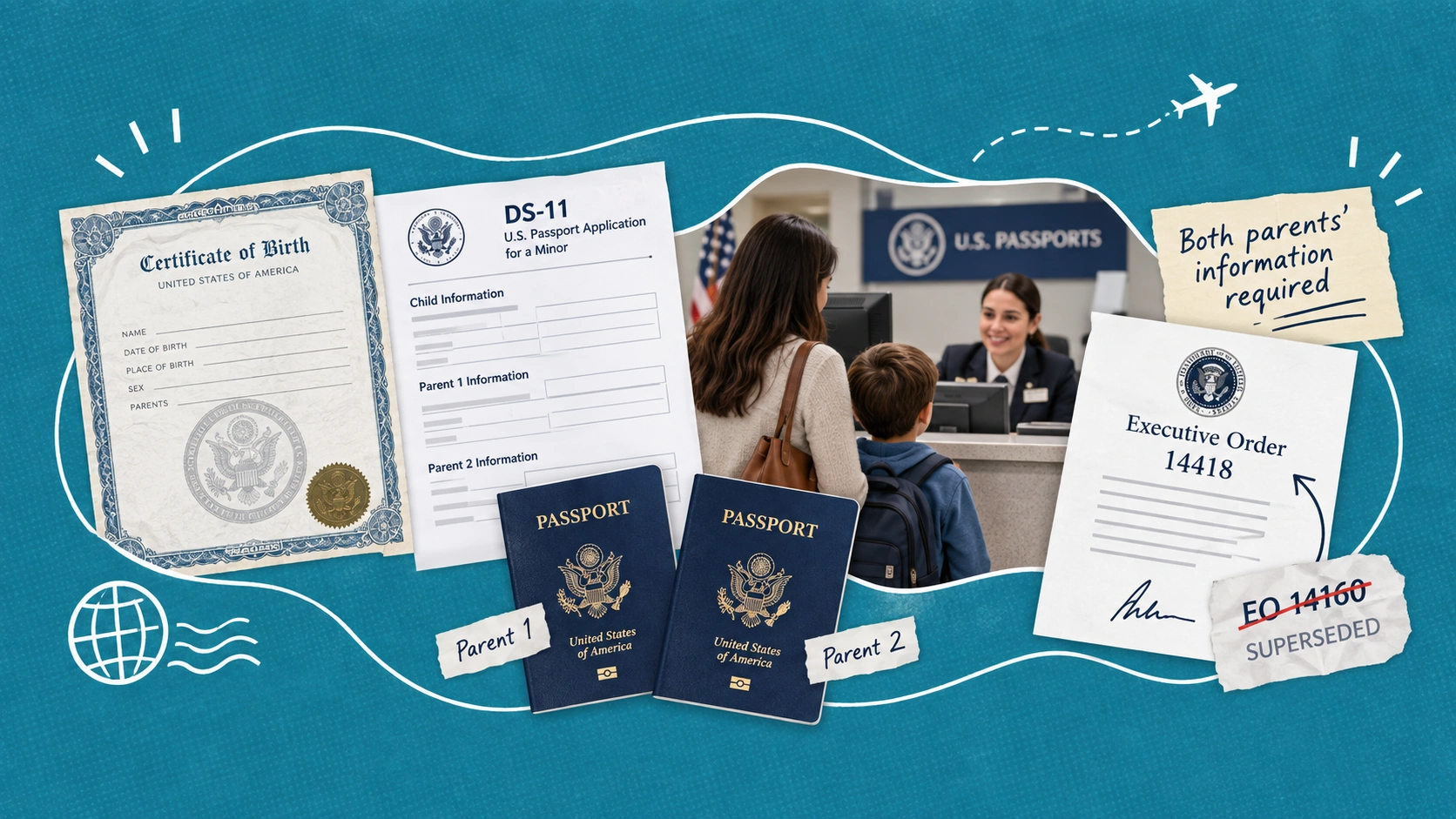
If you have read that a U.S.-born child now needs something new to get a passport, here is the short version before the long one. The document requirement for the child has not changed. The birth certificate you would have brought last year is the birth certificate you bring now. What the State Department's new plan adds is a statement about the parents, asked of a narrow group of applicants, and it does not replace anything on the existing evidence list.
The rest of this article explains what was superseded, what the plan actually says, who it applies to, and what the honest status of that plan is. It does not cover the constitutional debate or the litigation; our earlier article on proposed birthright-citizenship limits was written before this order existed and covers that ground.
What Was Superseded, and When
The State Department's page on Executive Order 14160 now opens with a banner: "Executive Order 14160 Superseded by Executive Order 14418." The page states that on August 6, 2026 the President signed EO 14418, which superseded EO 14160, and directs readers to the newer order for current guidance.
That matters for one practical reason: any explainer published before August 6, 2026, including most of what you will find by searching, describes an order that is no longer the operative one. If a page tells you what "the executive order" requires and does not name 14418, it is out of date in its first sentence.
The Document That Governs: the Implementation Plan
The operative document for passport applicants is the State Department's EO 14418 Implementation Plan. Two things about it belong at the top of any summary, because they frame everything else.
First, the Department labels it its "proposed Implementation Plan." It states: "Because the EO is prospective only, this guidance is prospective only and will become effective upon publication subject to any legal obligations," and closes with "This guidance may be subject to further modification." We are quoting rather than paraphrasing because the wording is the point: this is guidance the Department itself describes as proposed and subject to change.
Second, the plan describes conditions under which, unless one parent is a U.S. citizen, no executive agency would issue documents recognizing U.S. citizenship to a child born in the United States. Those conditions are:
- Either parent is an "alien enemy," defined by reference to designated Foreign Terrorist Organizations under 8 U.S.C. 1189 and Specially Designated Global Terrorists.
- Either parent is a foreign government employee: accredited diplomats, embassy and consular staff, persons employed by a foreign government in an official capacity, and employees of international organizations with immunity. The plan expressly excludes personal employees of officials, employees of state-owned enterprises, third-country nationals, contractors, and foreign government employees present in a personal capacity, subject to individualized assessment.
- Either parent engaged in a commercial transaction to purchase or access birthright citizenship, including a transaction to ensure the mother or a surrogate is present in the United States to give birth.
- The person was born in a U.S. territory or territorial waters "where citizenship is not conferred by Federal statute."
Read the list again and notice how narrow it is. The plan applies these conditions only where neither parent is a U.S. citizen, and even then only where one of four specific circumstances exists. That is a much smaller group than the number of parents currently worried they are in it.
What Happens at the Counter
Here is the one procedural fact a parent needs, stated as the plan states it. The acceptance agent, the clerk at the post office, library, or county office where you submit a child's application, requires the applicant, parent, or legal guardian to complete the parental information on Form DS-11 and submit all required documentation, "including the applicant's birth certificate."
Then the sentence that explains why the clerk cannot answer your questions: "Adjudicative decisions are not made during the acceptance process." The acceptance agent checks that the packet is complete and witnesses the signature. Passport agency staff, later, review each parent's citizenship status using the existing parental data fields on Form DS-11, the submitted documents, and government records.
That split, acceptance at the window, adjudication at the agency, is not new. Form DS-11 has asked for both parents' names, dates and places of birth, and citizenship for years. What the plan does is tell the adjudicator what to do with answers that fall into the four categories above.
The New Item: a Parental Attestation
The plan's new requirement, quoted exactly: if neither parent of a minor applicant is a U.S. citizen, "an attestation from each parent, under penalty of perjury, must be submitted." The plan warns that misrepresentation "could subject the individual(s) to legal liability, including potential federal criminal prosecution."
Two practical details follow. If the attestation is not filed with the application, "it will be requested once an application is reviewed", so an application is not rejected at the window for lacking it. And if the answers confirm that none of the four conditions is met, "the Department will continue adjudication of the passport."
Because the attestation is signed under penalty of perjury and touches the parents' immigration circumstances, this is the point where a family with any uncertainty about its own situation should talk to an immigration attorney before signing. That is not a formality. This article explains the process; it does not and cannot advise you on what an attestation means for your family, and neither can the acceptance agent.
What Has Not Changed: the Child's Documents
The State Department's public Citizenship Evidence page, the page that tells applicants which documents to bring, was last updated July 31, 2026, after EO 14418 was signed. It does not mention EO 14160, EO 14418, parental attestations, or parents' immigration status. No document on the published evidence list has changed. That is the most reassuring fact available, and it is more reassuring than a stale page would have been: the Department revised this page after the order and left the applicant's document requirements alone.
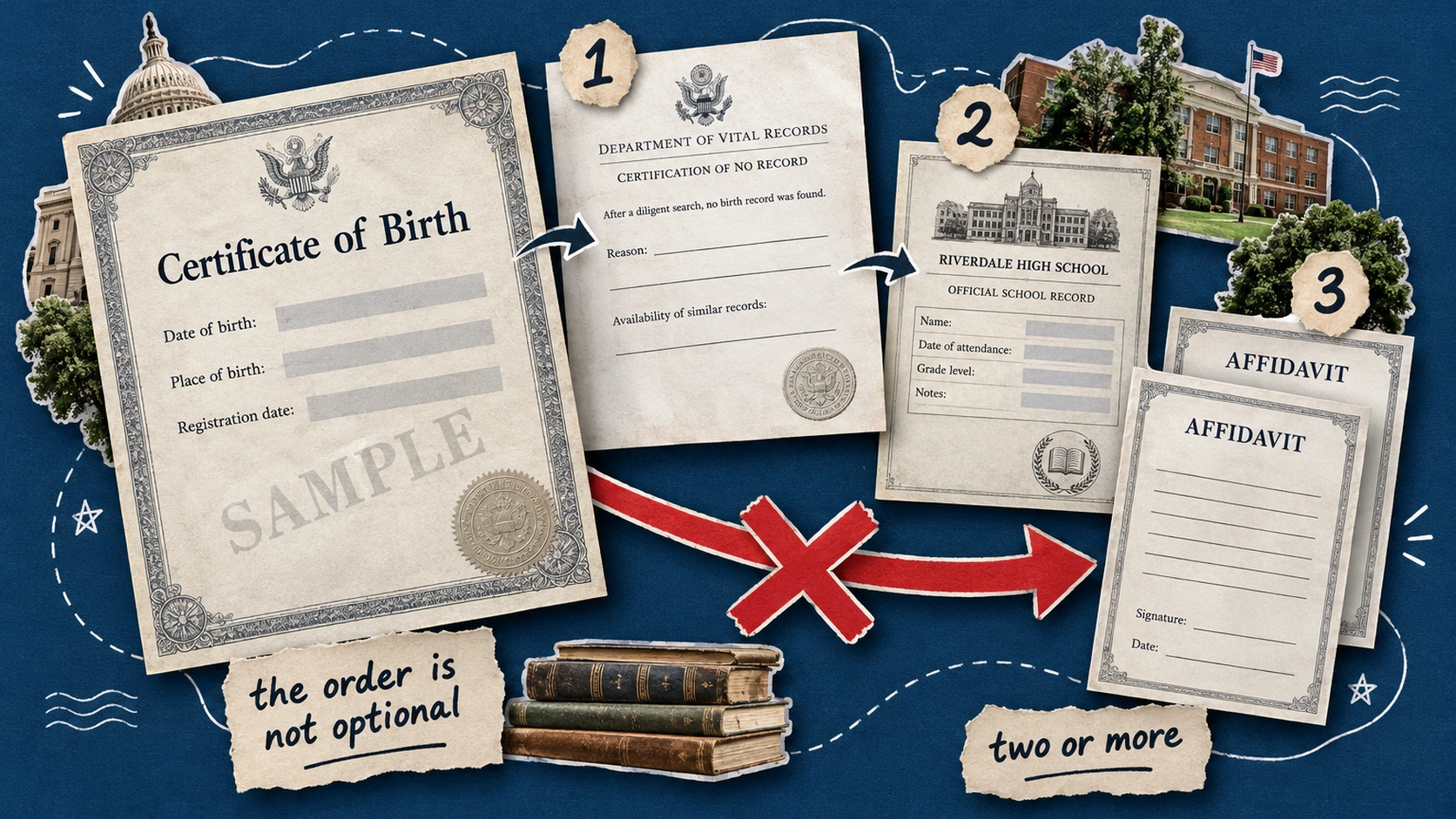
For a child born in the United States, that means the primary evidence is what it has always been: a U.S. birth certificate that shows the city, county, or state where the applicant was born, or a full-validity U.S. passport. A certified birth certificate carries the registrar's seal and signature. The same page states that you cannot submit an electronic or mobile birth certificate. If you do not have a certified copy, or the one you have is a hospital keepsake or a photocopy, ordering a certified copy of the child's birth certificate from the issuing state is the step to take before the appointment; that requirement predates the order and survives it. Vital Records Online is a third-party service and not a government agency, and does not adjudicate passport applications.
Our general guide to a child's passport application covers the rest of the packet: photos, parental consent, and fees, and none of that has changed either.
The Honest Status Line
Here is what can be said with confidence, and what cannot.
What can: EO 14418 was signed August 6, 2026 and superseded EO 14160. The State Department has posted an implementation plan it calls proposed, prospective only, effective upon publication, and subject to modification. The plan asks a parental attestation of minor applicants where neither parent is a U.S. citizen. The published evidence list for the child has not changed.
What cannot: the State Department's pages say nothing about whether EO 14418 is subject to any court order, and we are not going to guess. The injunction language on the Department's site is attached to the superseded order, not this one. Before your appointment, confirm on the Department's passport news page that the plan is still posted and still described the same way, because the Department has said it may change.
Frequently Asked Questions
Does my U.S.-born child need a new document to get a passport? No. The published citizenship-evidence list has not changed; the certified birth certificate is still the primary evidence. The new item is an attestation from the parents, and only where neither parent is a U.S. citizen.
I am a U.S. citizen and my spouse is not. Does this apply to us? The plan's attestation requirement applies where neither parent of the minor applicant is a U.S. citizen. If one parent is a citizen, the plan's conditions do not apply.
Will the clerk at the acceptance facility decide whether my child qualifies? No. The plan states that adjudicative decisions are not made during the acceptance process. The clerk takes a complete packet; agency staff review it later.
What if I do not include the attestation with the application? The plan says it will be requested once the application is reviewed. Filing it up front avoids that delay.
Is Executive Order 14418 in effect? The State Department describes its plan as proposed and effective upon publication, and says nothing about litigation status for EO 14418. Check the Department's site on the day you apply; this article does not make claims about enforceability.