When Does a Vital Record Become Public? State Access Windows for Family Researchers
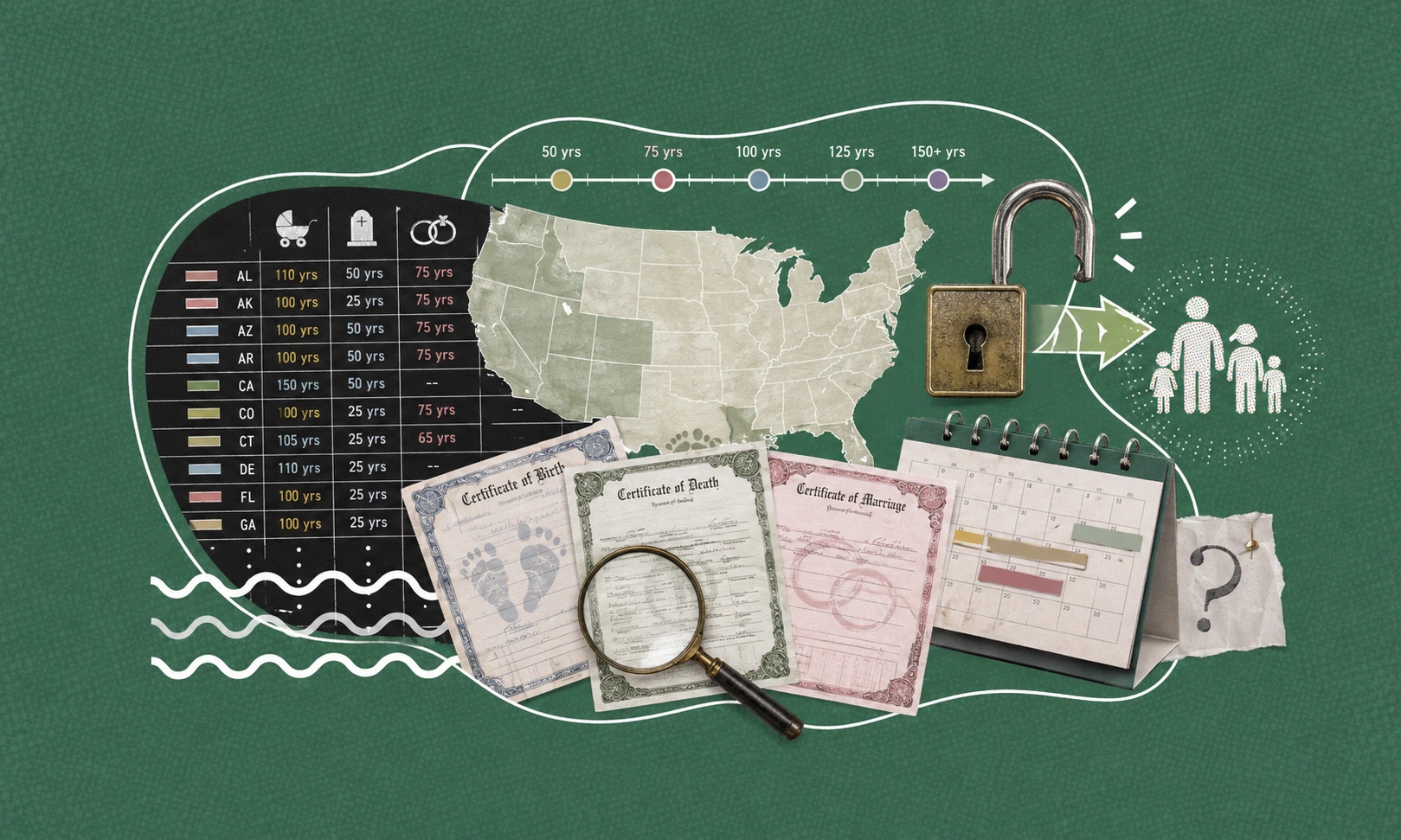
Researchers hit this wall constantly: a record clearly exists, the state clearly has it, and the state will not hand it over. The natural question is how long until it opens. The answer is that "when does it become public" has three genuinely different answers depending on which state you are asking, and in some states the question does not apply at all.
This article explains the models and gives verified examples. It is a reference for understanding access, not an ordering guide, if you already know a record is available and you want to obtain it, our genealogy records service is the place for that.
A note on scope, stated plainly: the table below is partial. These states were verified against state sources or statute on August 31, 2026. States not listed were not verified for this article, and we would rather leave a row out than fill it with a number we cannot stand behind. Access rules also change, so confirm with the state before relying on any of it.
Model One: A Fixed Number of Years
The model most researchers expect. State law sets a term, and once a record passes it, the record becomes public. What surprises people is how far apart the terms are, and that births and deaths almost never share one.
- Texas. Under Texas Government Code § 552.115, birth records are public on and after the 75th anniversary of the date of birth, and death records are public on and after the 25th anniversary of the date of death. Within 75 years, birth records are restricted to qualified applicants.
- Arizona. Under A.R.S. § 36-351(B), birth records become available for genealogy 75 years after the date of birth and death records 50 years after the date of death. The state runs an online genealogy search covering births from 1855 to 1945 and deaths from 1870 to 1970, and notes the images are not certified copies.
- Indiana. Birth records are not available to the public for 75 years.
Notice the death figures: 25 years in Texas, 50 in Arizona. Two states with an identical 75-year birth rule differ by a factor of two on deaths. That is the single most useful thing to know about this model: learning one state's birth window tells you nothing about its death window, and nothing about the state next door.
Florida Shows How Far the Range Goes
Florida is worth its own paragraph because it stretches the model in both directions.
Birth certificates less than 125 years old may only be issued to specific eligible individuals under section 382.025, Florida Statutes. That is the longest window in this article by a wide margin, and it means a Florida birth from the 1930s is still restricted while a Texas birth from the same year opened years ago.
Florida's deaths run the opposite way, and with a twist: death records are public and anyone may obtain a certified copy without the cause of death, while the cause of death itself is confidential until 50 years after the date of death.
That is the sharpest illustration of a point worth carrying into any state: the embargo can apply to part of a record rather than the whole thing. "Is this record public" and "is all of it public" are different questions.
Model Two: Two Tiers, No Clock
Some states do not run a timer. They split records by copy type instead, and the split is available immediately.
- Washington. Records can be obtained as certified copies for legal purposes or as noncertified informational copies for genealogical or other personal use. The state holds birth and death records from July 1, 1907 forward. The restriction attaches to the certified copy, not to the information.
- Minnesota. All Minnesota death records are public, and anyone may buy a noncertified informational record. Birth records are mixed: some are public and available to anyone as a noncertified copy, and some are confidential with more restricted availability.
For a family researcher this model is usually good news, because what you want is the information, not a legally valid certificate. Asking "when does this open" in Washington is the wrong question: an informational copy is available now, and the certified copy is restricted regardless of age.
If the difference between those two document types is unfamiliar, our glossary entries on non-genealogical vital records and the genealogical birth record define what each one is and is not good for.
Model Three: Interest-Based, With or Without Age Relief
The third model does not open records by age at all. Access turns on your relationship to the record or your stake in it.
Missouri is the clear example. Vital records there are not open to the general public, and state law allows a certified copy to be issued only to a person with a direct and tangible interest in the record, on a notarized application with the required search fee and, where applicable, documentation of that interest. Age relief exists but through a different door: death records over fifty years old can be searched through the Secretary of State's Missouri Digital Heritage resource and are exempt from certain identity requirements.
"Direct and tangible interest" is a legal standard rather than a plain-English one, and it is the concept doing the work in a large number of states. Our article on tangible interest versus public access explains what it means and how offices apply it.
How to Find the Rule for a State Not Listed Here
Because the models differ, the question you ask matters as much as who you ask.
- Ask about the record type, not "vital records." Births, deaths, and marriages routinely have different rules inside the same state.
- Ask about the copy type. "Can anyone get an informational or genealogical copy" often has a different answer than "can anyone get a certified copy."
- Go to the state vital records office or the statute. The rule is set by state law, so the state's own site or its code is the source.
- Check the state archives separately. Older records are frequently transferred to an archive or historical society operating under different access rules than the health department.
- Treat national directories as routing only. The CDC's "Where to Write for Vital Records" is useful for identifying which agency holds what, but its index has not been updated recently enough to rely on for a current rule or fee. Use it to find the office, then confirm at the office.
That last point is worth emphasizing because it is the most common way researchers end up with stale information: a directory tells you the agency, and the researcher assumes it also told them the rule.
What an Open Record Does and Does Not Get You
A record outside its window is usually available as an informational or genealogical copy, enough to confirm names, dates, and parentage, which is what research needs. It is generally not a legally usable certificate. Arizona says so explicitly about its genealogy images, and Washington draws the same line by copy type.
So if your goal is a family tree, an open record is exactly what you want. If your goal is proving citizenship or claiming an estate, an informational copy will not do the job no matter how old the record is.
Our guides on researching family history and the paused Census age search service cover the other records researchers lean on when a vital record is closed.
Frequently Asked Questions
Is there a national rule for when vital records become public? No. Vital records are administered by the states, and each sets its own access rules by record type.
Do births and deaths open at the same time? Usually not. Texas opens births at 75 years and deaths at 25; Arizona opens births at 75 and deaths at 50.
Which state in this article has the longest birth record window? Florida. Birth certificates less than 125 years old may only be issued to specific eligible individuals under section 382.025, Florida Statutes.
Can I get a certified copy once a record becomes public? Not necessarily. Many states release older records as informational or genealogical copies that are not valid for legal purposes.
Why isn't my state listed? Only states verified against a state source or statute for this article are listed. Rather than guess, we left unverified states out. Check with that state's vital records office directly.