Your Baby's First Year of Paperwork: Birth Certificate, SSN, and Passport in Order
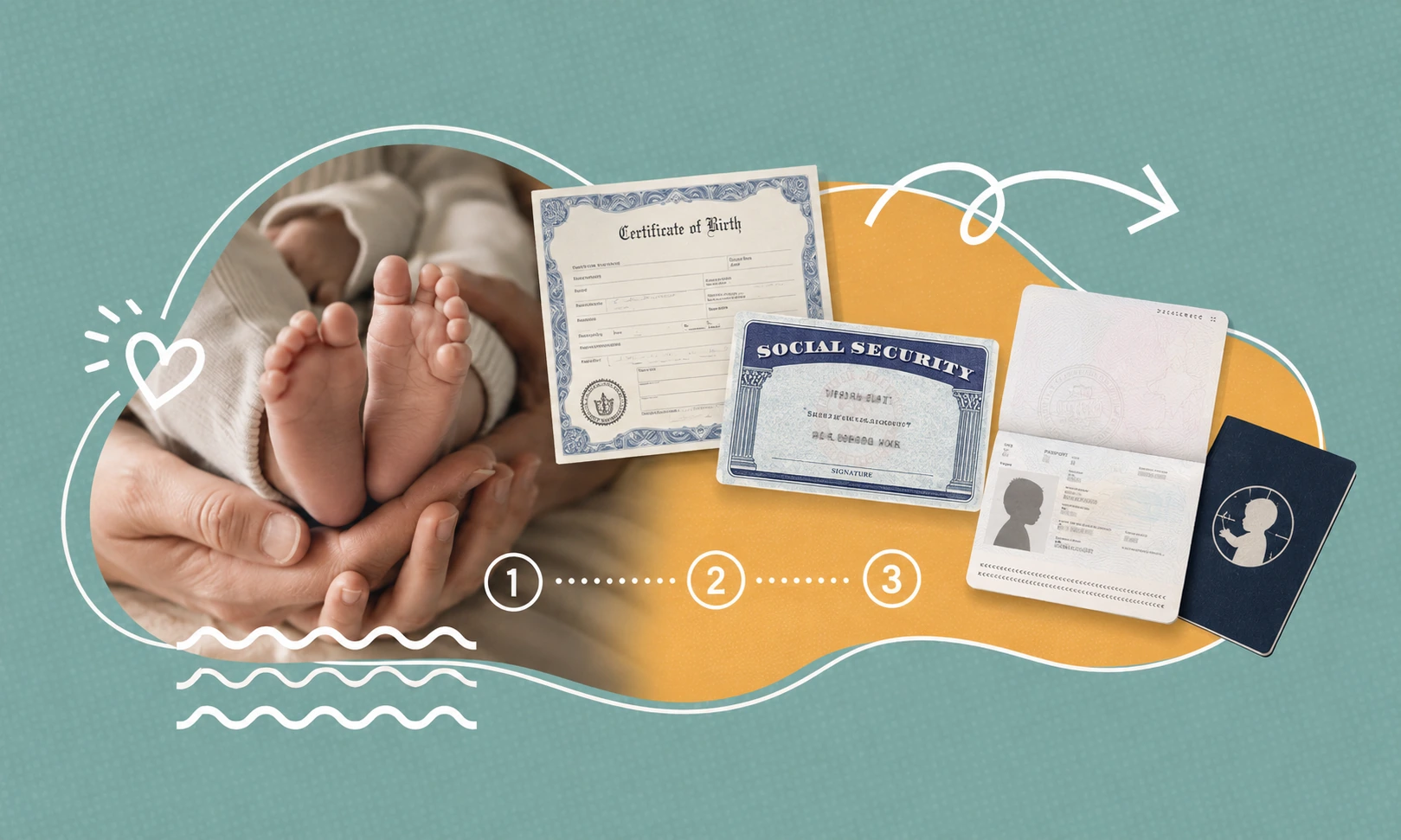
Nobody hands new parents a schedule. The birth certificate, the Social Security number, the insurance enrollment, and eventually a passport all arrive as separate errands, and it is rarely obvious which one has to happen first. They are not independent tasks. They form a chain, and almost every one of them waits on the birth being registered with the state.
This is a timeline rather than a how-to. It shows what unlocks what and which deadlines are real, so you can tell the difference between something that needs attention this week and something that can wait until spring.
At the Hospital: One Form Starts Everything
Before you leave, someone will bring you a worksheet for the birth certificate. It collects the baby's legal name, date and place of birth, and parents' information, and it is the source document the hospital uses to file the birth with the state's vital records office.
Two things about that worksheet deserve more care than they usually get.
- The name you write is the legal name. Changing it later means a formal amendment, not a phone call. States also have rules about characters, length, and formatting that surprise people. Our guide to birth certificate naming rules covers what states will and will not accept.
- Check the spelling of everything. Parents' names, dates, and the baby's name all propagate from this form into the birth record, and every downstream document inherits whatever is here.
Request the Social Security Number on the Same Form
The same worksheet normally asks whether you want a Social Security number for the child. Say yes. This is the Enumeration at Birth program, and it lets you request the SSN during birth registration instead of gathering documents and visiting a Social Security office later.
The bureaus of vital statistics send the birth registration information to Social Security electronically, and the agency assigns the number and issues the card. About 99 percent of SSNs for infants are assigned this way, which tells you how strongly the system expects you to use it. If you decline at the hospital, you are choosing the slower manual path with Form SS-5 and original documents.
Weeks One Through Four: Registration and the SSN Card
The hospital files the birth with the state. How long the state takes to register it and make certified copies available varies, which is why a friend in another state may have had a very different experience from yours.
On the Social Security side, the national average processing time for Enumeration at Birth cases is about two weeks, and parents may wait up to another two weeks for the card to arrive in the mail. So roughly a month from birth to card in hand is normal, and there is nothing to chase before then.
Health Insurance Has the First Real Deadline
This is the one date in the first year that genuinely has consequences. A birth is a qualifying life event, and it opens a 60-day special enrollment period beginning the day of the child's birth. Coverage is typically backdated to the date of birth, so enrolling on day 55 still covers the delivery-week pediatrician visits.
Miss the window and you may be waiting for open enrollment. Note also that plans commonly ask for a copy of the birth certificate as documentation, which is one of the earliest points where you actually need the certified copy in hand. Our guide on adding a new baby to health insurance covers the enrollment process itself.
Weeks Four Through Eight: The Certified Copy
Once the state has registered the birth, certified copies become orderable. This is the document nearly everything else depends on, and the point where most parents realize they need more than one.
Common early uses include health insurance enrollment, adding the child as a dependent, daycare and preschool registration, and later a passport application. Because several of these want their own copy rather than a photocopy, ordering two or three at the outset is usually cheaper in time than reordering twice.
Note that the hospital's decorative certificate with the footprints is not the same thing. It is a keepsake, not a legal document, and no agency will accept it.
Once the state has registered the birth, you can order certified copies of your baby's birth certificate for the enrollments and applications that follow.
Months Two Through Twelve: Everything That Follows
With the birth certificate and SSN in hand, the remaining items are unlocked and can be handled in whatever order your family actually needs.
- Dependent tax claims. Claiming the child on a return requires the SSN, which is one reason not to postpone the Social Security step.
- Financial accounts. A 529 plan, a custodial account, or savings bonds in the child's name generally require the SSN.
- Life insurance and benefit designations. Adding the child as a beneficiary usually requires the SSN and sometimes the birth certificate.
- Pediatric records and immunization registries, which often reference the birth record.
- A passport, if international travel is anywhere on the horizon.
The Passport Has Requirements Worth Knowing Early
A child's first passport is not a form you mail in. Children under 16 apply in person on Form DS-11, with both parents or guardians present, and the passport is valid for five years rather than the ten an adult passport carries.
The document requirement is the part that catches families the week before a trip. The child's citizenship evidence must be an original or certified copy; photocopies and notarized copies are not accepted. The certified birth certificate also does double duty here, since a certificate naming both parents establishes both the child's citizenship and the parental relationship the application requires.
If travel is even a possibility in the first year, treat the passport as a months-ahead task rather than a weeks-ahead one. Our guide on applying for a passport for a child covers the appointment and consent requirements in detail.
The Sequence in One View
- At the hospital: complete the birth certificate worksheet carefully and request the SSN on it.
- Roughly weeks 2 to 4: the SSN is assigned and the card arrives.
- Within 60 days of birth: enroll the child in health coverage. This is the deadline that matters.
- Once the state registers the birth: order certified copies of the birth certificate, more than one.
- Any time after: dependent tax claims, financial accounts, beneficiary designations.
- Well before any travel: apply for the passport in person with both parents.
Frequently Asked Questions
Do I have to apply separately for my baby's Social Security number? Usually not. You can request it on the birth certificate worksheet through the Enumeration at Birth program, which is how about 99 percent of infant SSNs are assigned. Declining means applying manually later with Form SS-5.
How long does the Social Security card take? The national average processing time for Enumeration at Birth cases is about two weeks, plus up to two more weeks for the card to arrive by mail.
How long do I have to add my newborn to health insurance? A birth opens a 60-day special enrollment period starting the day of the birth, and coverage is typically backdated to the date of birth.
Is the hospital's certificate with the footprints a birth certificate? No. It is a keepsake. Only a certified copy issued by the state vital records office is a legal document.
Can I mail in my baby's first passport application? No. Children under 16 must apply in person on Form DS-11 with both parents or guardians present, and the passport is valid for five years.