Vietnam Joins the Apostille Convention on September 11: What Changes for U.S. Documents
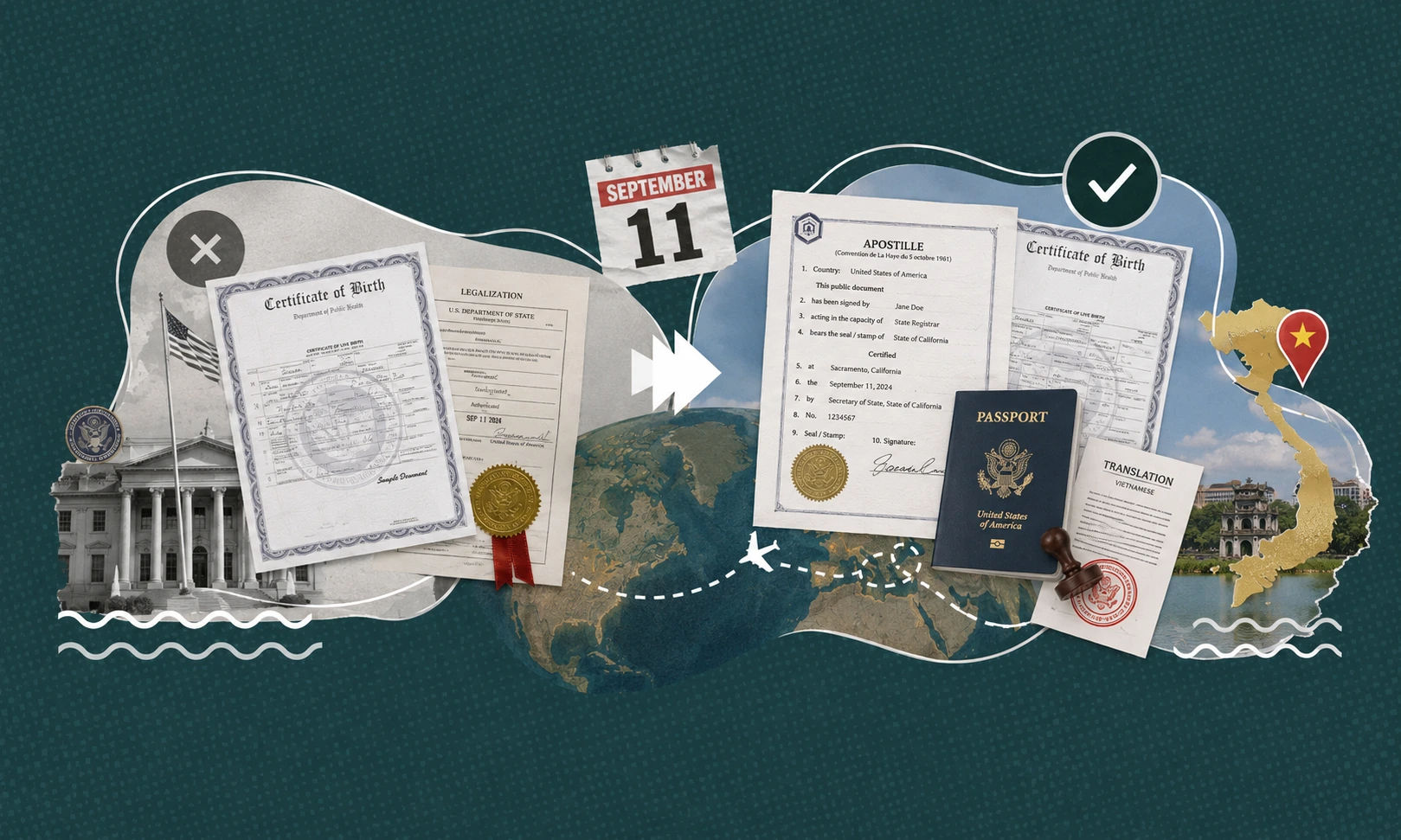
If you are sending a U.S. birth, marriage, or death certificate to Vietnam, the route changes on September 11, 2026. That is the date the Hague Apostille Convention enters into force for Viet Nam, which replaces consular legalization with a single apostille for documents the Convention covers.
This article assumes you already know what an apostille is and how the Hague framework works. If you do not, start with our guide to apostilles for U.S. vital records used abroad and the Hague Apostille Convention glossary entry. What follows is only what is specific to Vietnam.
Dates below were verified against the HCCH status table on August 31, 2026. Treaty status changes, so confirm the current position before you rely on it.
The Dates That Matter
Viet Nam acceded to the Convention on 31 December 2025, and the Convention enters into force for Viet Nam on 11 September 2026. The gap between those two dates is normal: accession starts a waiting period, and the Convention only takes effect after it runs.
Two other recent changes are worth knowing if your documents are headed elsewhere in the same region or continent:
- Algeria acceded on 5 November 2025, and the Convention entered into force there on 9 July 2026.
- Thailand acceded on 30 June 2026, with entry into force on 28 February 2027. Thailand is not yet covered, so documents for Thailand still follow the legalization route today.
What Actually Changes on September 11
Before that date, a U.S. vital record destined for Vietnam generally goes through consular legalization: authentication in the United States followed by certification at a Vietnamese embassy or consulate. It is a multi-stop process, and the consular step is the slow one.
On and after September 11, for documents the Convention covers, that consular step is replaced by a single apostille issued in the United States. The Vietnamese embassy or consulate is no longer part of the chain for those documents.
The practical sequence for a state-issued vital record becomes:
- Order a certified copy of the record from the vital records office of the state that issued it. An uncertified or informational copy generally cannot be apostilled.
- Obtain the apostille from that state's competent authority, which for state vital records is normally that state's Secretary of State. Some states require a county clerk or the state registrar to certify the signature first.
- Arrange a certified Vietnamese translation if the receiving party requires one.
The Translation Is a Separate Requirement
An apostille authenticates a signature and seal. It does not translate anything, and it does not carry a translation requirement of its own. Whether you need a certified Vietnamese translation, and what form it must take, is set by the Vietnamese authority receiving the document, not by the Convention and not by the U.S. office issuing the apostille.
Ask the receiving party what they require before you pay for a translation, because the answer varies by what the document is for. Our FAQ on when a birth certificate needs to be translated covers how translation requirements usually work.
The Objection Wrinkle Most Guides Miss
Accession to the Convention is not automatically universal. Under Article 12, existing member states have a window in which to object to a new country's accession, and an objection means the Convention does not enter into force between the objecting state and the acceding one.
Three states filed objections to Viet Nam's accession: Germany (20 May 2026), Austria (19 June 2026), and Czechia (2 July 2026). The Convention will not enter into force between Viet Nam and those three countries, so documents moving between Vietnam and Germany, Austria, or Czechia still require legalization rather than an apostille.
The United States did not object. For U.S. documents going to Vietnam, and Vietnamese documents coming to the United States, the Convention applies from September 11.
Algeria drew objections from Germany, Austria, and Greece on the same basis. The pattern is worth remembering generally: when a country joins, check whether the specific pair of countries your document travels between is actually covered, rather than assuming membership alone settles it.
If Your Document Is Already in Process
A document legalized before September 11 does not stop being valid because the rules changed; legalization was the correct process at the time it was done. The question is what the receiving authority in Vietnam will accept, and that is a question for them.
If you have not started, and your deadline allows it, waiting until on or after September 11 means one authentication step instead of two. If your deadline is sooner, the legalization route is still the route today.
What This Does Not Change
- You still need a certified copy first. The apostille attaches to a current certified record from the issuing state, not to a photocopy or an old family copy.
- The competent authority is still the state's. For a state-issued vital record, the apostille comes from that state, not from a federal office.
- Vietnam's own document requirements are unchanged. The Convention governs authentication, not what documents a Vietnamese authority asks you to produce or what it does with them.
We cannot tell you which Vietnamese ministry, court, or office will accept a given document for a given purpose. That is a receiving-country rule, and the authority asking for the document is the only reliable source for it.
If you need the underlying record and the authentication, you can order a certified U.S. vital record and use our apostille services to prepare it for use in Vietnam. Vital Records Online is a third-party service and not a government agency; apostilles are issued only by the competent government authority, and you may work with that office directly if you prefer.
Frequently Asked Questions
When does Vietnam join the Apostille Convention? The Convention enters into force for Viet Nam on 11 September 2026. Viet Nam acceded on 31 December 2025.
Do I still need to go to the Vietnamese embassy? For documents the Convention covers, no. From September 11 an apostille issued in the United States replaces the consular legalization step for those documents.
Does the apostille include a Vietnamese translation? No. An apostille authenticates a signature and seal only. Any translation requirement comes from the Vietnamese authority receiving the document.
Which countries objected to Vietnam's accession? Germany, Austria, and Czechia. The Convention does not enter into force between Viet Nam and those three states. The United States did not object.
What about documents going to Thailand? Thailand acceded on 30 June 2026 but the Convention does not enter into force there until 28 February 2027, so documents for Thailand still follow the legalization route today.