Two Name Changes, One REAL ID: Building the Document Chain the DMV Will Accept
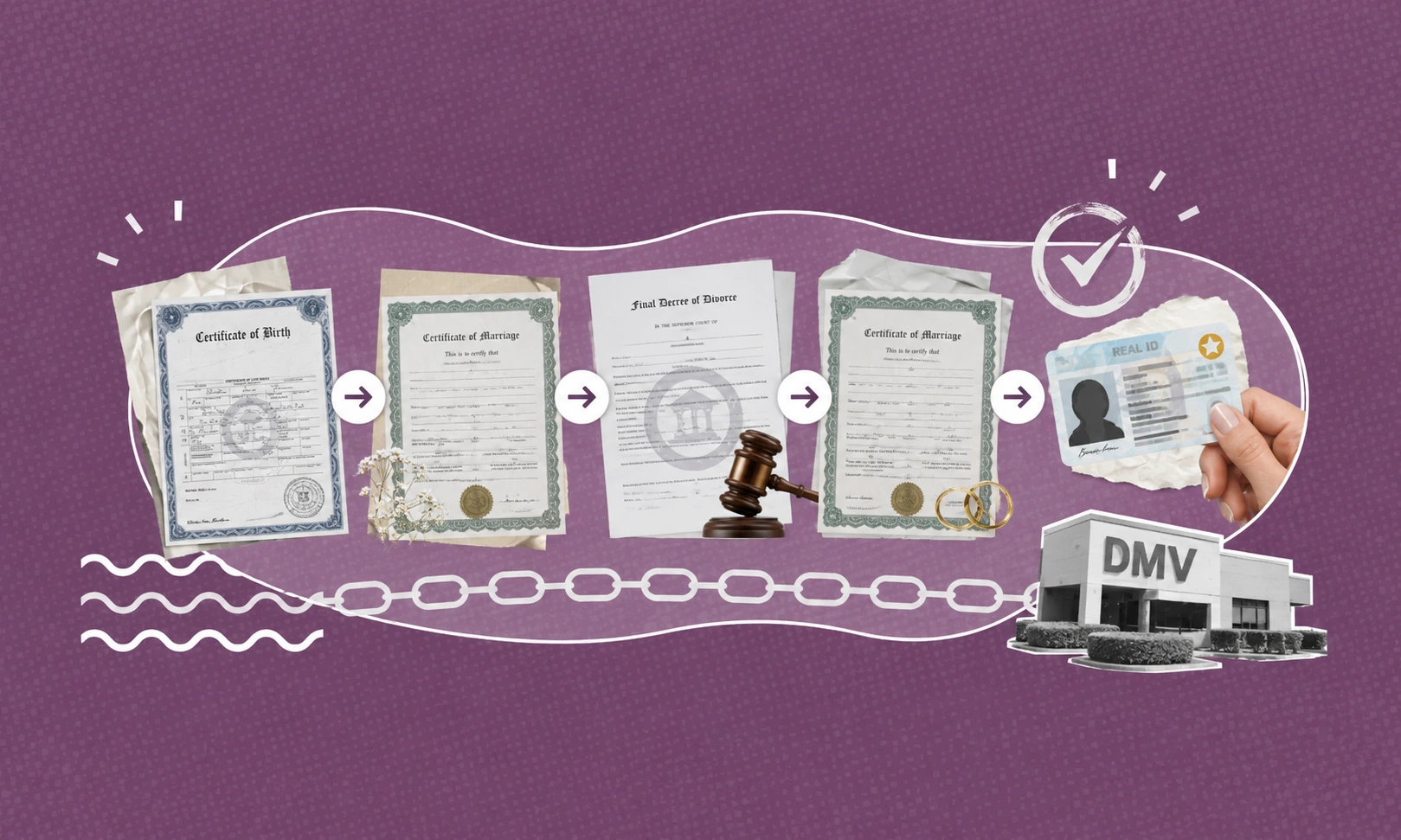
You bring your birth certificate to the DMV, you bring your current marriage certificate, and you get turned away. The problem is almost never the documents you brought. It is the gap between them: the name change in the middle that you did not document.
DMVs do not just check that you have a birth certificate and that you have a current name. They check that every step between the two is accounted for. This article is about building that chain. It is not an explainer on what a REAL ID is or the general document checklist: what a REAL ID is, how to obtain one, and the FAQ on whether you need a birth certificate cover that.
The Chain Rule
Here is the principle in one sentence: you need a linking document for every legal name change between the name on your proof of identity and the name on your application. Not the most recent one. Every one.
The federal framing is straightforward. If the names on your documentation do not match, you must provide a photo ID with your current legal name plus name-linking documentation: an original or certified copy of a name change document such as a marriage certificate or a divorce decree.
The simple case is one change. Someone born Maria Reyes, married once, now Maria Delgado: birth certificate plus one marriage certificate, and the chain is closed.
Where It Actually Breaks
Now take a common history. Born Maria Reyes. Married, became Maria Delgado. Divorced and restored Reyes. Remarried, now Maria Whitfield.
That is three name changes, and the chain needs all three documented:
- Reyes to Delgado: the first marriage certificate.
- Delgado back to Reyes: the divorce decree, if the decree is what restored the former name.
- Reyes to Whitfield: the second marriage certificate.
Bringing only the current marriage certificate leaves the clerk looking at a birth certificate saying Reyes and a marriage certificate saying Reyes to Whitfield, with an unexplained Delgado somewhere in the middle of the applicant's records. The chain has a hole, and the application stops.
The counterintuitive part is that a divorce can be a link. If the decree is what restored your former name, it is documentary proof of a name change and belongs in the stack. If you never changed back, it may not be a link at all. What matters is whether that step altered your legal name.
What Counts as a Link, and What Does Not
Not every document that shows a name is a name-change document.
- Marriage certificates are the most common link. They must include a government seal; the celebrant's keepsake certificate from the ceremony is not the record.
- Divorce decrees work when the decree restored a name. When submitting one, expect to include the first page, the page showing the name change, and the signature page.
- Court-ordered name changes cover changes made outside marriage or divorce. Our name change certificate glossary entry explains the terminology.
- Amended birth certificates may apply if the name on the birth record itself was changed. Our guide on what to do when you have changed your birth certificate name covers that case.
Two documents people reach for do not work: a Social Security card is not acceptable as a name change document, and neither is a hospital-issued birth certificate. The Social Security card shows a current name without evidencing the change; the hospital certificate is a keepsake and was never a government record.
Originals or Certified Copies Only
Linking documents have to be originals or certified copies from the issuing authority. A photocopy of a certified copy is not a certified copy, and a notarized photocopy is not either: a notary attests to a signature, not to the authenticity of the underlying record.
This is the point where a chain built from a folder of old paperwork usually fails. Documents that have been folded in a drawer for twenty years are often photocopies, or so worn that a clerk cannot read the seal.
The Federal Baseline Is Not the Whole Answer
REAL ID's documentary standards come from federal rules, but the credential is issued by your state's DMV, and states administer these requirements with real variation. Which linking documents a state accepts, whether it wants certified copies of every intermediate step or only the ones affecting the current name, and how it handles unusual histories are state-level questions.
Do not treat one state's published list as universal, including a list you found on another state's site. Check your own DMV's requirements before you assemble the folder, and if your history is complicated, call and describe it rather than guessing. Fifteen minutes on the phone is cheaper than a second appointment. Our driver's license documents guide covers what these applications typically require.
When a Link Is Missing
The usual reason a link is missing is that the document was issued in a state the applicant no longer lives in, sometimes decades ago. That is an ordering problem, not a dead end.
- A marriage certificate is held by the state or county where the ceremony took place, not where you lived then or live now.
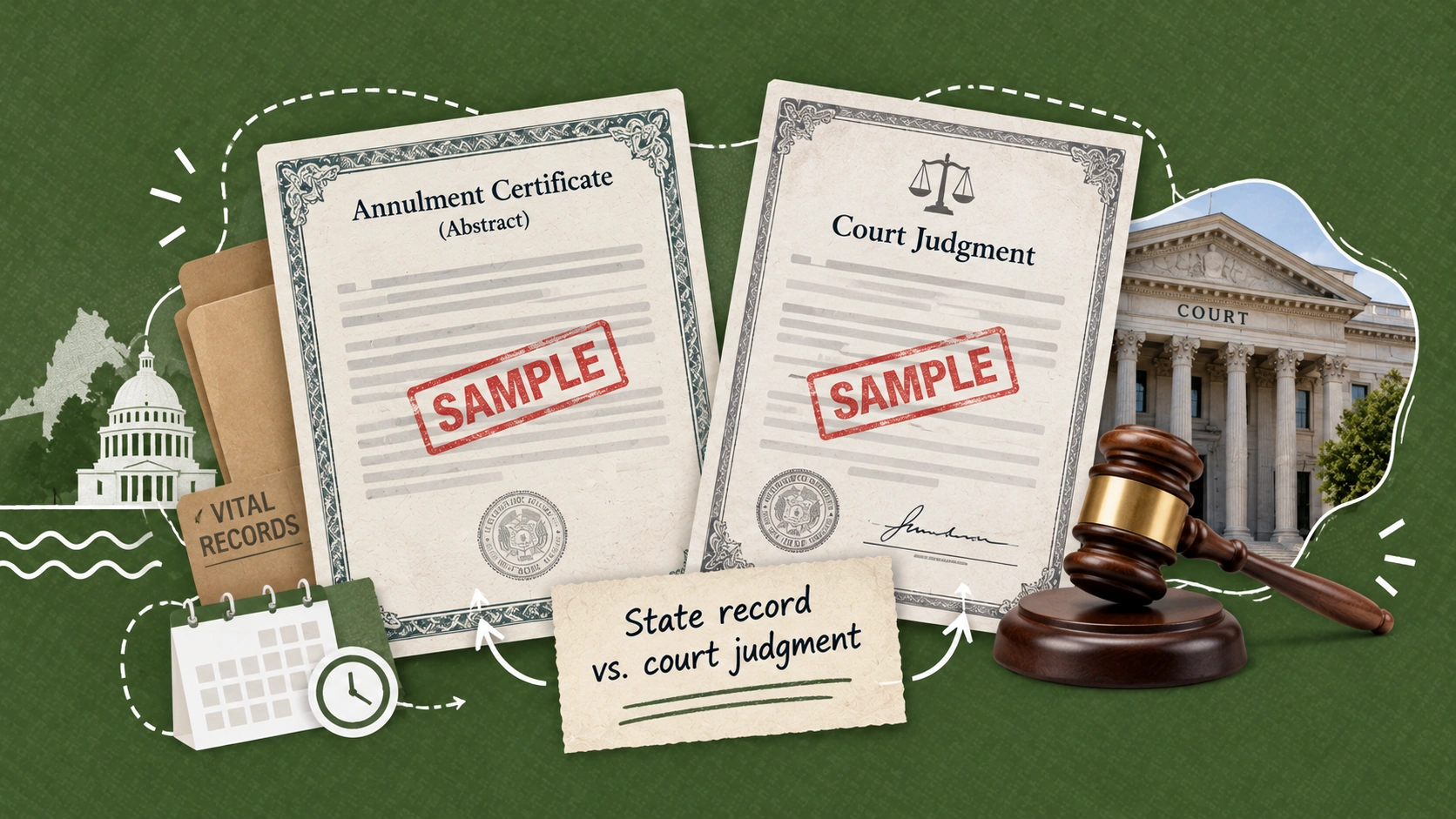
- A divorce decree is held by the court that granted the divorce. Many states never issue a separate divorce certificate at all, and the certified decree from the court is the document that exists. Our article on the difference between a divorce certificate and a decree explains which to request, and the FAQ on getting a divorce certificate from another state covers ordering across state lines.
- A court-ordered name change is held by the court that entered the order.
Order the missing links before you book the DMV appointment, not after. Processing times vary by state and by court, and an appointment you cannot complete is worse than one you have not booked.
Assemble It in Order
Write your names down in sequence, from the one on your birth certificate to the one you use now, and put a document against each arrow. Any arrow without a document is what you need to go get. Do this on paper before you go, because it is the same check the clerk will run, and doing it first turns a rejected appointment into a completed one.
If a marriage certificate is the missing link, you can order a certified copy from the state where the marriage took place. Vital Records Online is a third-party service and not a government agency; you can also apply directly to the issuing office, and our name change documents guide covers the records these situations tend to require.
Frequently Asked Questions
Do I need every old marriage certificate, or just the current one? Every name change between your birth certificate and your current name needs a linking document, so a twice-married applicant generally needs both marriage certificates.
Is a divorce decree a name change document? It is when the decree restored your former name. If your name did not change at the divorce, it may not be a link in your chain.
Can I use my Social Security card to prove a name change? No. A Social Security card is not acceptable as a name change document, and neither is a hospital-issued birth certificate.
Do photocopies work? No. Linking documents must be originals or certified copies from the issuing authority. Notarized photocopies are not certified copies.
What if my documents are from several different states? That is common and fine. Each document is ordered from the jurisdiction that issued it: the state or county of the marriage, or the court that granted the divorce or entered the name change.