You Got Married Abroad: Why There Is No U.S. Marriage Record, and What to Use Instead
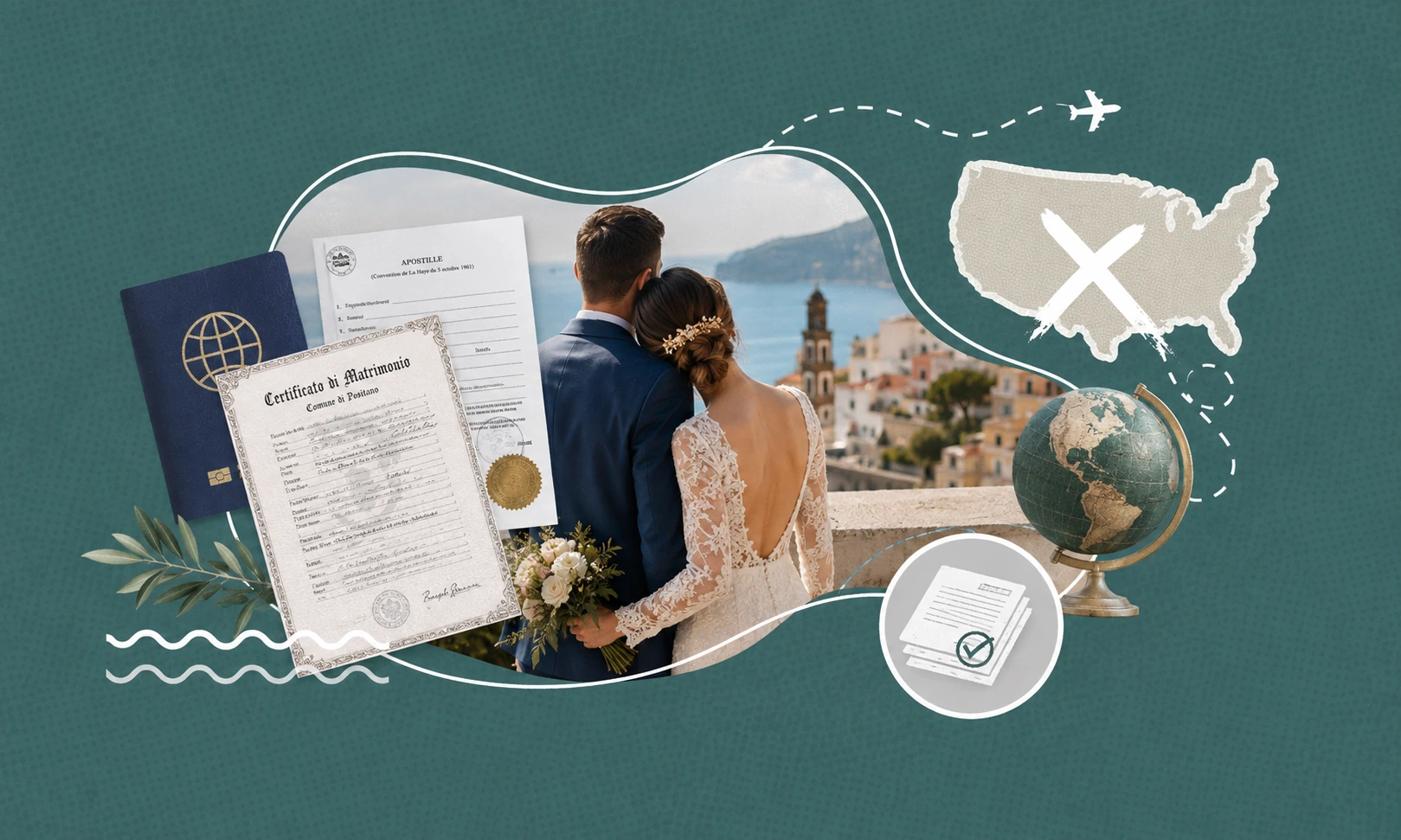
An agency asks for your marriage certificate. You were married in Lisbon, or Manila, or Oaxaca. You call your home state's vital records office and they have no record of you being married at all. That is not an error, and your marriage is not in question. No U.S. state or federal agency registers a marriage performed in another country, so there is genuinely nothing for them to send you.
This article covers where the record actually lives and how to make it work here. It does not cover the step before the wedding, proving you were free to marry, which is in our guide to the single status affidavit. It also does not cover the immigration evidence path, which the FAQ on marriage certificates for immigration and our article on U.S. residency through marriage already handle.
Your Marriage Is Valid. There Is Just No U.S. Paper.
Start with the reassuring part, because people arrive at this question worried they are not really married. In general, marriages that are legally performed and valid abroad are also legally valid in the United States.
What does not exist is a U.S. record of it. There is no federal marriage registry, and states register the marriages performed within their own borders. A wedding in Portugal was registered in Portugal, and that is the only place it was registered.
The U.S. Department of State is explicit that it does not have marriage documents from other countries or territories. To get a certified copy of a foreign marriage document, you contact the embassy or consulate of that country.
Validity Questions Go to a State, Not to Washington
If the question is not "where is my document" but "is my marriage recognized here," that is a state law question. Marriage and divorce are matters of state law and the rules differ from state to state, and the State Department directs those inquiries to the attorney general of the state where the parties live.
In the ordinary case this never comes up. It surfaces when something turns on validity: a benefits claim, an estate, an immigration petition. In those situations the answer comes from the state, not from a federal office.
The Document Chain That Actually Works
Since no U.S. copy exists, what you present is the foreign record, made usable. That normally means three things.
- Get a certified copy from the foreign civil authority. The record is held by whichever registry, civil office, or ministry recorded the marriage in that country. The commemorative certificate handed to you at the ceremony is usually not that document. The country's embassy or consulate can point you to the right office.
- Have it authenticated in the issuing country. If that country belongs to the Hague Apostille Convention, this means an apostille issued by its competent authority. If it does not, the route is consular legalization instead.
- Get a certified translation into English if the record is in another language. Requirements for who may translate and how the translation must be certified are set by whoever is receiving the document.
Note the direction of travel. This is authentication running into the United States, which is the mirror image of the process most apostille guides describe. Our FAQ on apostilling a marriage certificate covers the mechanics, and our guide to apostilles for U.S. vital records used abroad covers the outbound direction.
Ask the Requesting Institution First
Before spending money on any of this, ask whoever wants the certificate what they actually require. Institutions vary widely: some accept the foreign certificate with a translation, some insist on authentication, and some want the whole chain. Ordering the full package for an agency that would have accepted a translated copy is a common and avoidable expense.
The Consular Exception Worth Checking
There is one narrow case where a U.S. document may exist. U.S. consular officers formerly issued a Certificate of Witness to Marriage Abroad, and the State Department holds those filed before November 9, 1989. Consular officers no longer perform or witness marriages, so nothing has been created since.
If you or a relative married abroad before that date and a consular officer was involved, a copy is obtainable from the State Department's Passport Vital Records Section. This matters most for older marriages, estate work, and genealogy. For anyone married after 1989, this exception does not apply, and the foreign record is the only record.
How to Request the Certificate
The request goes to the Passport Vital Records Section by mail, on a notarized Form DS-5542, the same form used for a Consular Report of Birth Abroad or a Consular Report of Death Abroad. The Department states the cost as $50 for each record, processing as 4 to 8 weeks after it receives the request, and adds that mailing "may add up to 4 weeks" on top. "We do not offer expedited service." Plan on roughly three months end to end, which matters if a probate deadline depends on it.
Eligibility is limited to the married individual or individuals named on the document, a legal guardian, or a person with their written permission. The Department also allows a third-party requester described as a family member or friend who has known you for at least five years, with signed permission, a notarized statement, and ID copies from both people, which is often the practical route for an adult child or an estate representative. Requesters living outside the United States have the record sent to the nearest U.S. embassy or consulate.
One apostille detail worth knowing before you order: a certificate issued within the last five years can be apostilled without an additional apostille payment, while an older one requires a new $50 copy. If the certificate is going to a foreign authority, order the copy and the authentication together rather than sequentially. These figures were taken from the Department's page in September 2026; confirm them before sending payment, since the page moved URLs in the 2026 redesign.
Where the U.S. Documents Do Come In
Most situations built on a foreign marriage still require U.S. records alongside it: your own birth certificate, a prior spouse's death certificate, or a divorce decree ending an earlier marriage. Those are ordinary U.S. vital records and are ordered the normal way.
If the foreign country needs any of those U.S. documents authenticated for its own file, that is the outbound apostille process, and our guide to needing U.S. vital records internationally covers when it comes up.
To be straightforward about what we can and cannot do: Vital Records Online cannot obtain a foreign marriage record. That document exists only with the authority that issued it, and no U.S. service can order it for you. What we can help with is the U.S. side of the file, if a document in your chain needs authentication for use abroad, our apostille services can prepare it.
Frequently Asked Questions
Is my foreign marriage valid in the United States? In general, marriages legally performed and valid abroad are also legally valid in the United States. Questions about a specific marriage's validity go to the attorney general of the state where you live.
Can I register my foreign marriage with my state? States register marriages performed within their own borders. There is no general process for adding a foreign marriage to a U.S. state registry.
Where do I get a copy of my foreign marriage certificate? From the civil authority in the country where you married. The State Department does not hold marriage documents from other countries; contact that country's embassy or consulate for guidance.
Does the U.S. embassy have a copy of my marriage? Only in one narrow case: Certificates of Witness to Marriage Abroad filed before November 9, 1989. Consular officers no longer witness marriages.
Do I need an apostille on my foreign marriage certificate? Often yes, if the receiving institution requires authentication. An apostille applies when the issuing country is in the Hague Apostille Convention; otherwise the document goes through legalization.