When the Birth Certificate Does Not Exist: What USCIS Accepts Instead
An immigration filing asks for a birth certificate. The record does not exist, or the office that would hold it will not produce it, or the country it was born in has no such document for that time and place. This is common, and the federal rule that governs it is precise, published, and quotable.
It is also routinely explained wrong, usually in a way that costs people months. This article sets out the rule itself and what each step actually requires. It is not immigration advice, it does not address eligibility or how to respond to a specific notice, and it is not a substitute for a lawyer, which anyone facing this should have.
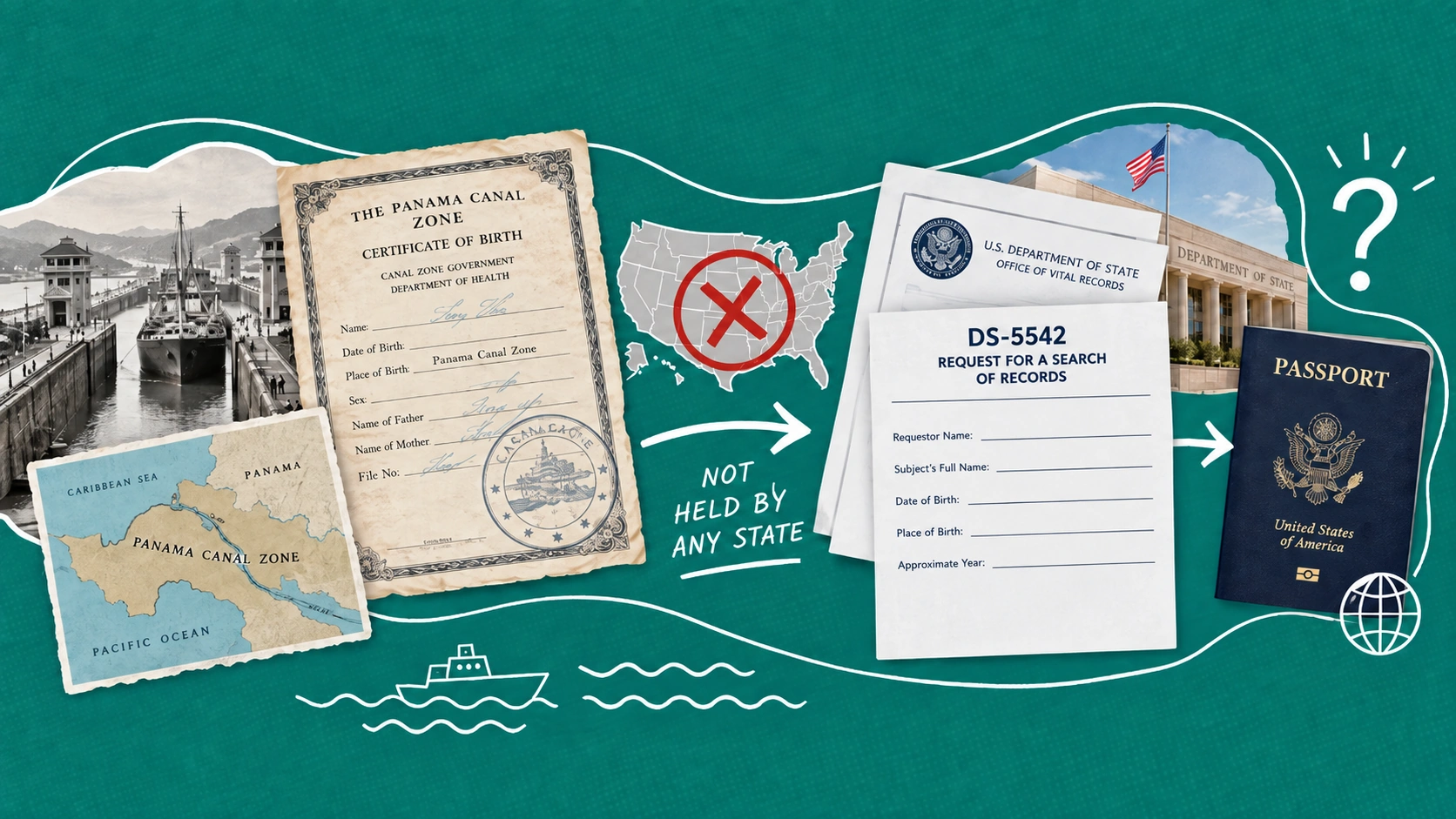
One boundary worth drawing up front: this is about USCIS. If your problem is a birth certificate that a passport agency rejected, that is a different agency applying a different rule, and our guide to a birth certificate rejected for a passport covers it. If you previously held a U.S. passport and cannot find it, the State Department's file search is a separate remedy again. Do not mix the three.
Start With the Presumption
The rule opens with a sentence that sets the tone for everything after it: "The non-existence or other unavailability of required evidence creates a presumption of ineligibility."
That is the starting position. A missing document does not create a neutral gap to be filled in later; it creates a presumption working against the applicant, and the rest of the rule is the mechanism for overcoming it. Understanding that explains why the process is as demanding as it is.
The Three Rungs, in Order
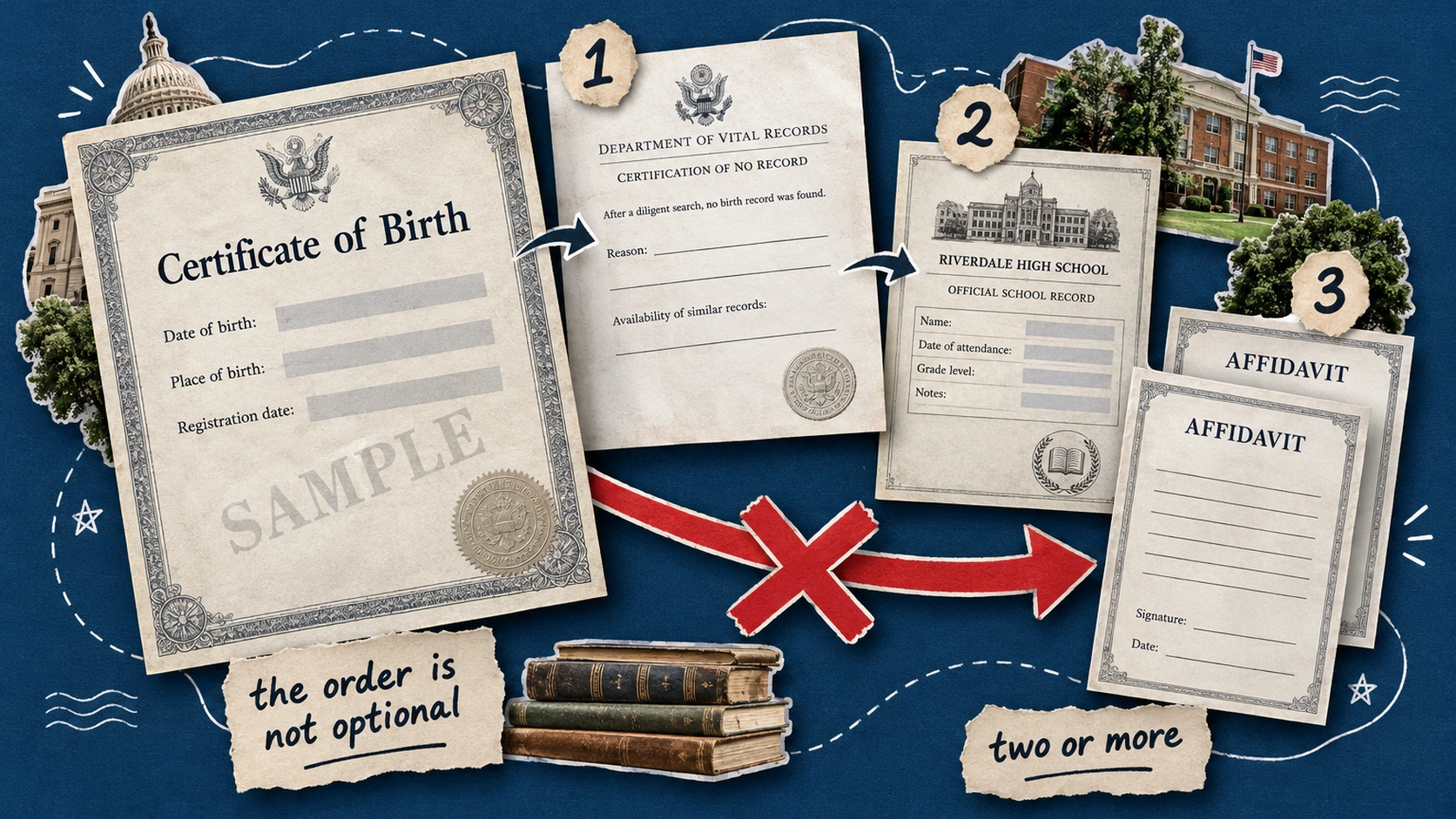
The regulation builds a ladder, and the order is not optional.
Rung one: the required document. The birth certificate, the marriage certificate, whatever the form asked for. If it exists and can be obtained, nothing else is relevant.
Rung two: secondary evidence. If a required document "does not exist or cannot be obtained," the applicant "must demonstrate this and submit secondary evidence, such as church or school records, pertinent to the facts at issue."
Rung three: affidavits. If secondary evidence "also does not exist or cannot be obtained," the applicant must demonstrate the unavailability of both the required document and relevant secondary evidence, and submit "two or more affidavits, sworn to or affirmed by persons who are not parties to the petition who have direct personal knowledge of the event and circumstances."
And then the sentence that makes the hierarchy binding: "Secondary evidence must overcome the unavailability of primary evidence, and affidavits must overcome the unavailability of both primary and secondary evidence."
The common failure is jumping from rung one to rung three. A family cannot obtain a birth certificate, so they gather affidavits from relatives, because that is the intuitive response. The filing then lacks any showing that secondary evidence was unavailable, and the affidavits are from the wrong people. Both problems are built into the attempt.
"Demonstrate" Is Where the Records Work Lives
The verb doing the heaviest lifting in this rule is demonstrate. Unavailability is not asserted. It is proved, and the regulation says what the proof looks like.
Where a record does not exist, the applicant "must submit an original written statement on government letterhead establishing this from the relevant government or other authority." That statement "must indicate the reason the record does not exist, and indicate whether similar records for the time and place are available."
Both halves matter. A bare "no record found" slip may not satisfy a rule that asks for the reason and for whether similar records exist.
For a U.S.-born applicant, that statement comes from the state registrar, and the document is generally what states issue when a search fails. Our glossary entry on the certificate of no public record explains what that is. Before concluding a record does not exist, it is worth confirming that it was searched for correctly: under the right name spelling, the right date range, and the right jurisdiction. A search request to the state that would hold the record is the step that produces either the certificate or the statement. Vital Records Online is a third-party service and not a government agency; certificates and no-record statements are issued by the state's vital records office, and USCIS alone decides what satisfies its rule.
For a foreign-born applicant there is a named exception worth knowing: "a certification from an appropriate foreign government that a document does not exist is not required where the Department of State's Foreign Affairs Manual indicates this type of document generally does not exist." So where the Foreign Affairs Manual already records that a country does not produce that document for that period, the applicant is not sent chasing a statement no office will write.
The rule also addresses the uncooperative-authority case: an applicant who has been unable to acquire the necessary document or statement from a foreign authority "may submit evidence that repeated good faith attempts were made." But USCIS may still require the document where it finds such documents are generally available. Keep records of the attempts: dates, offices, letters, fees paid.
Who Can Swear an Affidavit, and Who Cannot
This is the requirement that disqualifies the affidavits families file first, and it is worth quoting again: affidavits must be sworn or affirmed by "persons who are not parties to the petition who have direct personal knowledge of the event and circumstances."
Two tests, both of which must be met.
Not a party to the petition. The petitioner and the beneficiary are out. In a family filing, that usually rules out the people most willing to sign.
Direct personal knowledge of the event and circumstances. Not belief, not family understanding, not what someone was told. For a birth decades ago, the people with direct personal knowledge are a shrinking group: an attending midwife, an older relative who was present, a neighbor who was there. That is exactly why the regulation puts affidavits last.
And note the plural: two or more. One affidavit, however detailed, does not meet the rule. Our glossary entry on the affidavit of birth covers the document type.
One narrow exception exists in the same regulation for self-petitions filed by a spouse or child of an abusive citizen or lawful permanent resident, where USCIS will consider any credible evidence and the self-petitioner is not required to demonstrate that primary or secondary evidence is unavailable. If that describes your situation, it is a reason to speak to an immigration attorney or a qualified nonprofit, not a reason to rely on this article.
What Counts as Secondary Evidence
The regulation names two examples, church records and school records, and leaves the category open to anything "pertinent to the facts at issue." The useful way to think about it is: a record created at or near the time of the event, by someone with no stake in an immigration filing decades later.
Those records usually have to be requested from private institutions rather than government offices, which means no standard form and no published processing time. Start early. If a record is in another language, it will need translation, and our FAQ on translating a birth certificate covers when and how.
Where a marriage rather than a birth is the gap, the same ladder applies and the primary document is the marriage certificate from the jurisdiction that recorded it.
Two Honest Limits
First, the regulation we quoted is current as of October 1, 2026, and the text above is verbatim. But USCIS also maintains a policy manual that governs how its officers apply the rule, and we did not read the relevant chapter. A policy update can change how a rule is applied without changing the rule. Do not treat this article as describing current USCIS adjudication practice; treat it as describing the regulation.
Second, this is a rule about evidence, not about eligibility. Satisfying it does not make anyone eligible for anything. It only removes the presumption that a missing document creates.
Frequently Asked Questions
What does USCIS accept if a birth certificate does not exist? Secondary evidence, such as church or school records, after demonstrating that the required document does not exist or cannot be obtained. Affidavits come only if secondary evidence is also unavailable.
How do I prove a record does not exist? With an original written statement on government letterhead from the relevant authority, giving the reason the record does not exist and stating whether similar records for that time and place are available.
Can my mother sign the affidavit? Only if she is not a party to the petition and has direct personal knowledge of the event. In many family filings the closest relatives are parties and therefore excluded.
How many affidavits are required? Two or more, sworn or affirmed by qualifying individuals.
Can I skip straight to affidavits? No. The regulation requires unavailability of both the required document and relevant secondary evidence to be demonstrated first.