
Informational Copy
Last updated on August 25, 2026
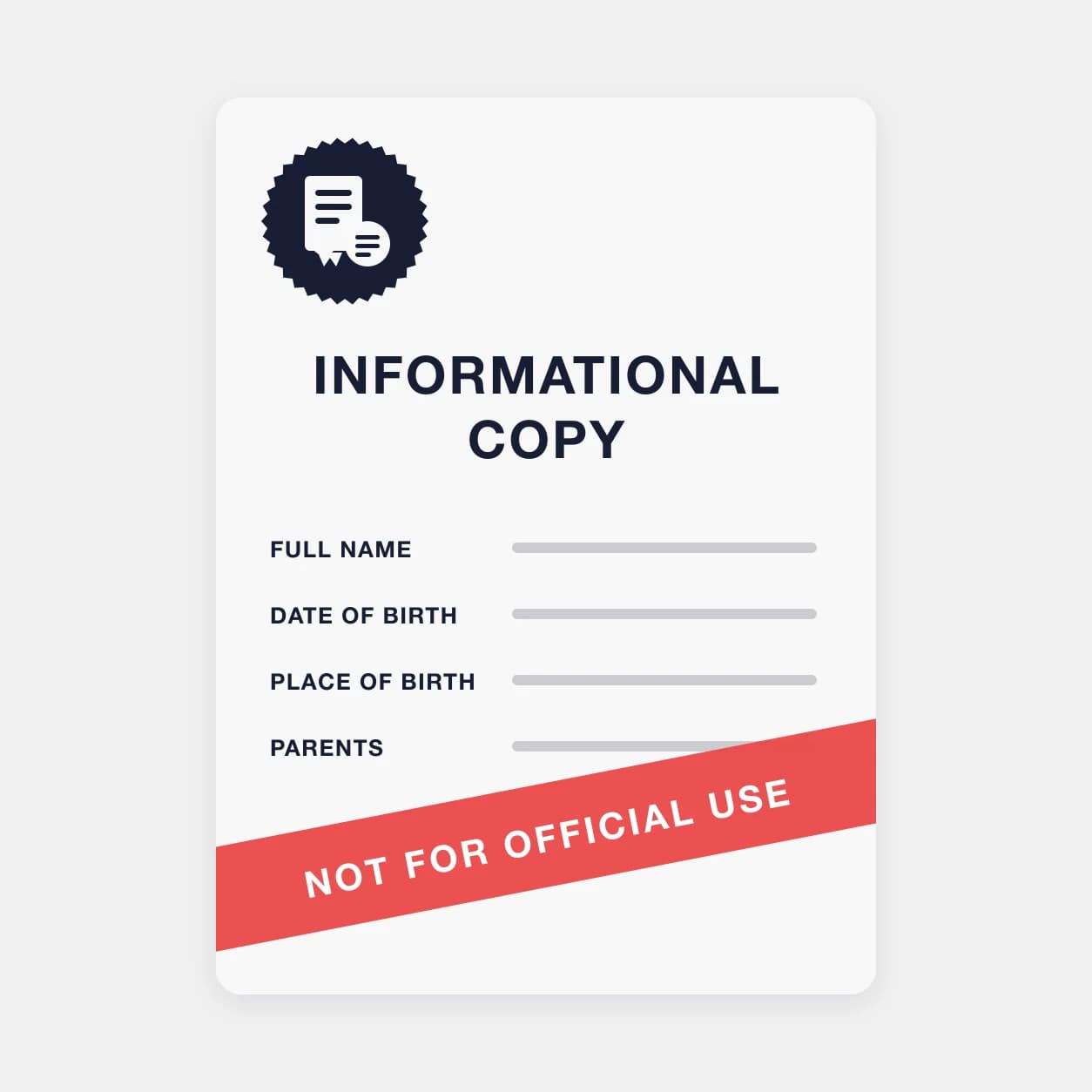
Informational Copy: A Record You Can Read, Not Use
An informational copy is a non-certified reproduction of a vital record. It contains the same recorded facts as the certified version — names, dates, places — but it is issued without the legal standing that makes a document usable for identity, travel, or benefits. Most states print it on plain paper and mark it with a legend such as “informational, not a valid document to establish identity.”
The purpose is access, not proof. Informational copies let people who are not entitled to a certified copy still read what the record says.
How to Tell One From a Certified Copy
| Feature | Certified Copy | Informational Copy |
|---|---|---|
| Legend across the face | None | “Not a valid document to establish identity” |
| Registrar signature and seal | Yes | Usually omitted or reproduced without effect |
| Security paper | Yes | Often plain paper |
| Who may order it | Restricted to eligible requesters | Frequently open to any adult applicant |
| Accepted for passports, REAL ID, benefits | Yes | No |
When an Informational Copy Is Enough
An informational copy answers questions rather than proving anything. It is genuinely useful for confirming the spelling of a name before ordering a certified copy, checking a date for family-history research, verifying which facts a record actually contains, or reviewing a record you are about to ask a state to amend.
When It Will Be Rejected
Any process that verifies who you are will reject it. That includes passport applications, REAL ID and driver’s licence applications, Social Security filings, school enrolment, employment eligibility, insurance and benefit claims, and court proceedings. Agencies are not being strict for its own sake — the document itself states that it cannot be used this way.
Why Some States Issue Them at All
Vital records are not fully public in most of the United States. Access to a certified copy is limited to the person named on the record and a defined circle of relatives and representatives. The informational copy is the compromise: it keeps the contents of the record readable without handing an identity document to someone who is not entitled to one. States vary considerably — some issue both types freely, some issue informational copies only, and some do not offer them at all.
Frequently Asked Questions
Can an informational copy be converted into a certified copy?
No. They are separate issuances. If you become eligible for a certified copy, you order it as a new request from the vital records office; the informational copy you already hold plays no part in it.
Does an informational copy contain less information?
Usually not. In most states the recorded facts are identical — what differs is the certification, not the content. A small number of states redact specific fields, so check your state’s policy if you need a particular detail.
Is an informational copy the same as a short-form certificate?
No, and the two are easy to confuse. A short-form birth certificate is an abbreviated but still certified document. An informational copy may be full-length and is not certified at all.
Why was I sent an informational copy when I asked for a certified one?
Almost always because the eligibility evidence did not satisfy the state — an ID that had expired, a relationship that was not documented, or an application signed by someone other than the eligible requester. The office issues what you qualified for rather than refusing outright.
Related Terms
Certified Copy, Certified Birth Certificate Copy, Short-Form Birth Certificate, Security Paper, Raised Seal