
Raised Seal
Last updated on August 25, 2026
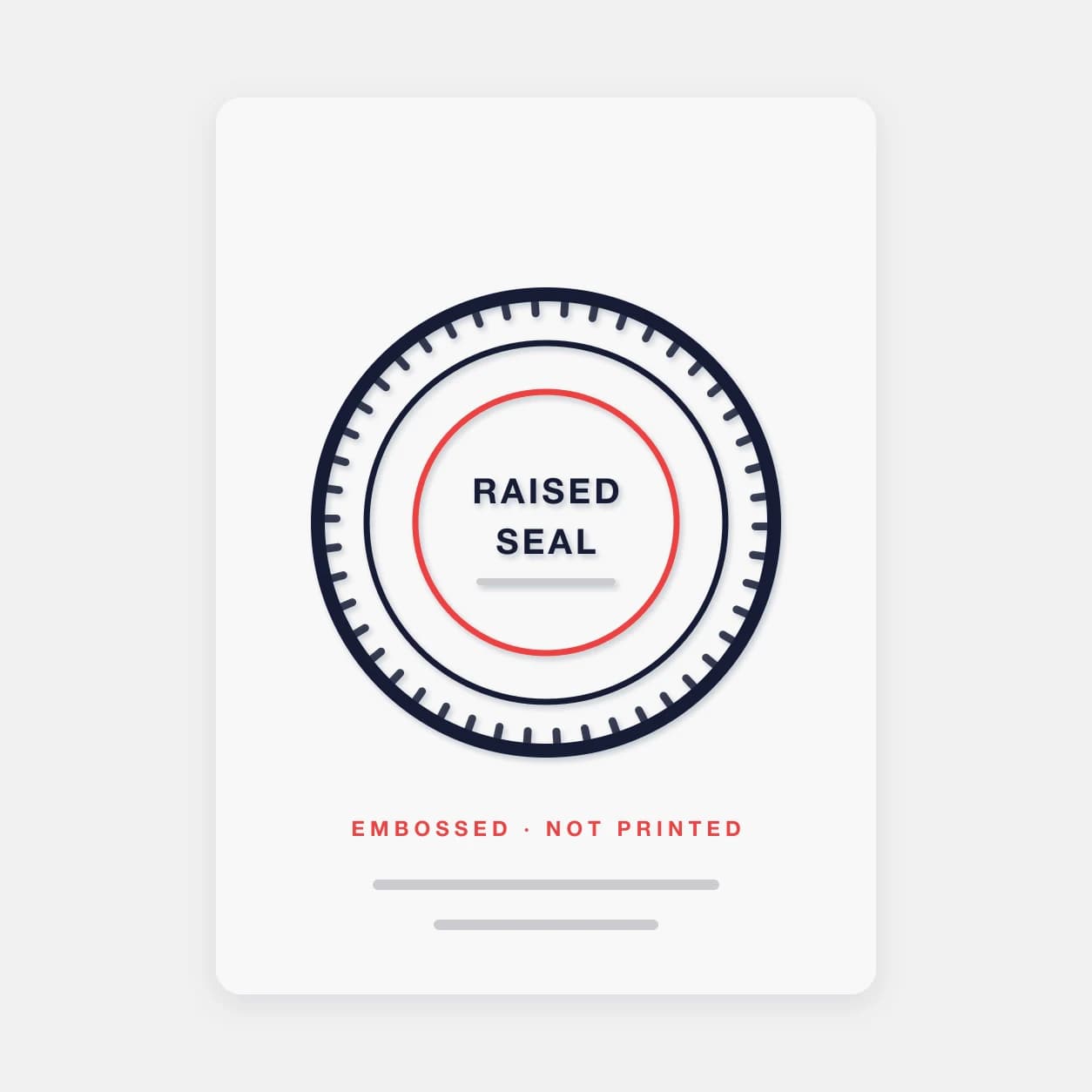
Raised Seal: The Mark You Can Feel
A raised seal is an impression pressed into the paper of a certified vital record by a metal embosser held by the issuing office. Because the paper itself is deformed, the seal stands proud of the surface and can be felt with a fingertip. That physical quality is the point: an embossed seal cannot be reproduced by a photocopier or a printer, so it distinguishes an original certified copy from a duplicate of one.
How to Check the Seal on Your Certificate
Run a finger across the seal area, usually near a lower corner or over the registrar’s signature. A genuine raised seal has texture. Then tilt the document toward a light source at a shallow angle — the embossing casts a shadow that a printed circle does not. A seal that is perfectly flat and uniformly inked has been printed, which means the document in your hand is a copy rather than a certified issuance.
Raised, Printed and Digital Seals
Not every valid certificate carries an embossed seal, and this is where people get caught out. Many states have moved to multicoloured printed seals combined with security features in the paper itself, which are equally valid and in some ways harder to forge. A growing number issue electronically certified records whose validity rests on a digital signature rather than any physical mark. What matters is that the record was issued by the state as a certified copy — embossing is one way of showing that, not the only one.
Why an Agency May Insist on One
Front-line staff are often trained to check for a raised seal because it is the fastest authenticity test available at a counter. If a clerk rejects a certificate that is genuinely certified but carries a printed seal, ask them to check the reverse of the document, where most states describe their current security features.
Frequently Asked Questions
Can I photocopy a certificate with a raised seal?
You can, but the copy has no legal standing. The embossing does not reproduce, and a photocopy of a certified record is not itself a certified record. Order additional certified copies instead.
My certificate has no raised seal. Is it fake?
Not necessarily. Check whether it carries a printed multicoloured seal, a file number, security paper features, and the registrar’s name. If it came from the state vital records office it is valid, whatever form the seal takes. A hospital souvenir certificate, by contrast, is not a certified record no matter how ornate it looks.
Does the raised seal ever wear off?
Embossing can flatten over decades, especially on a document that has been folded or stored under weight. A faint seal does not invalidate the record, but if an agency disputes it, ordering a fresh certified copy is quicker than arguing.
Can a notary’s raised seal certify my birth certificate?
No. A notary attests to a signature, not to the contents of a vital record. Only the issuing vital records office can certify a birth, death, marriage or divorce record.
Related Terms
Certified Copy, Security Paper, Wet Signature, Informational Copy, Notarized Birth Certificate Copy