
Security Paper
Last updated on August 25, 2026
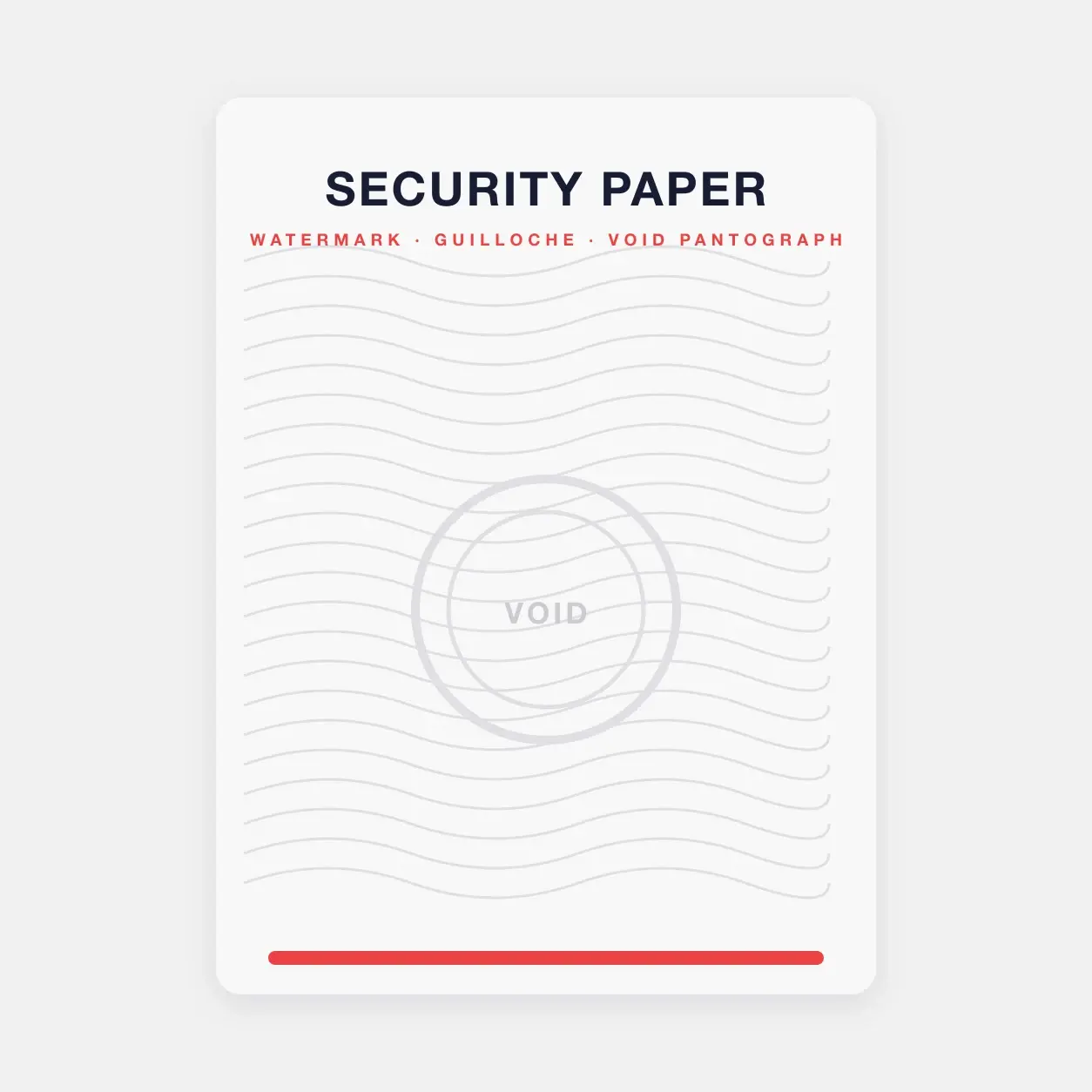
Security Paper: Built to Fail When Copied
Security paper is the controlled stock that state vital records offices print certified copies on. It is manufactured with features that survive on the original and break down on a reproduction, which is what makes a certified copy verifiable at a glance. Ordinary paper carries the same words; only security paper carries the proof that the state printed them.
The Features to Look For
Most state stock combines several of the following. You will rarely see all of them on one document, and the exact mix is deliberately not advertised in full.
- Watermark — a design pressed into the paper during manufacture, visible when the sheet is held up to light and invisible to a scanner.
- Guilloche pattern — the fine interlaced line work around the border, which turns to moiré noise when photocopied.
- Void pantograph — latent text, usually reading VOID or COPY, that is invisible on the original and appears across any duplicate.
- Intaglio or thermochromic ink — ink with texture you can feel, or that changes colour with the warmth of a fingertip.
- Security fibres — coloured or fluorescent threads embedded in the pulp, some visible only under ultraviolet light.
- Sequential control number — a number tied to the individual sheet, letting the issuing office trace it.
Why It Matters When You Order
Security paper is the reason a certified copy cannot simply be printed at home, and the reason states charge per copy rather than per record. It is also why agencies ask for an original rather than a scan: the features that prove authenticity are physical, and a PDF carries none of them. If you will need to submit records to several agencies at once, order multiple certified copies rather than planning to photocopy one.
Security Paper and Electronic Records
States that issue electronically certified records replace the physical features with a cryptographic signature the receiving agency validates. That is a different security model, not a weaker one — but the two are not interchangeable, and an agency that asks for a paper original will not accept a digital file in its place.
Frequently Asked Questions
How can I tell if my certificate is on security paper?
Hold it up to a light for a watermark, tilt it for texture and colour shift, and look closely at the border line work. Many states also print a description of their current features on the reverse.
Why does my copy say VOID across it?
Because it is a photocopy of a certified record, and the void pantograph did exactly what it was designed to do. The document is not usable; order a certified copy from the issuing state.
Does security paper expire?
The paper does not, and certified vital records generally have no expiry date. Some agencies nonetheless ask for a copy issued within the last six months to two years, which is a policy about recency, not about the paper.
Can I laminate a certificate to protect it?
Do not. Lamination flattens embossing, obscures watermarks and can make a genuine record unverifiable — several states will refuse a laminated certificate outright.
Related Terms
Raised Seal, Certified Copy, Informational Copy, Birth Certificate Number, Vital Records Office