Maryland Just Gave Parents a Way to File Their Own Baby's Birth Certificate, Starting October 1
Most parents never think about who files their baby's birth certificate, because they never have to. The hospital does it. A form is signed in a fog of exhaustion, a certificate arrives in the mail weeks later, and the system stays invisible. The system becomes visible only when it fails, and when it fails, parents discover something surprising: the law did not give them the job of filing, so it did not give them a way to fix it either.
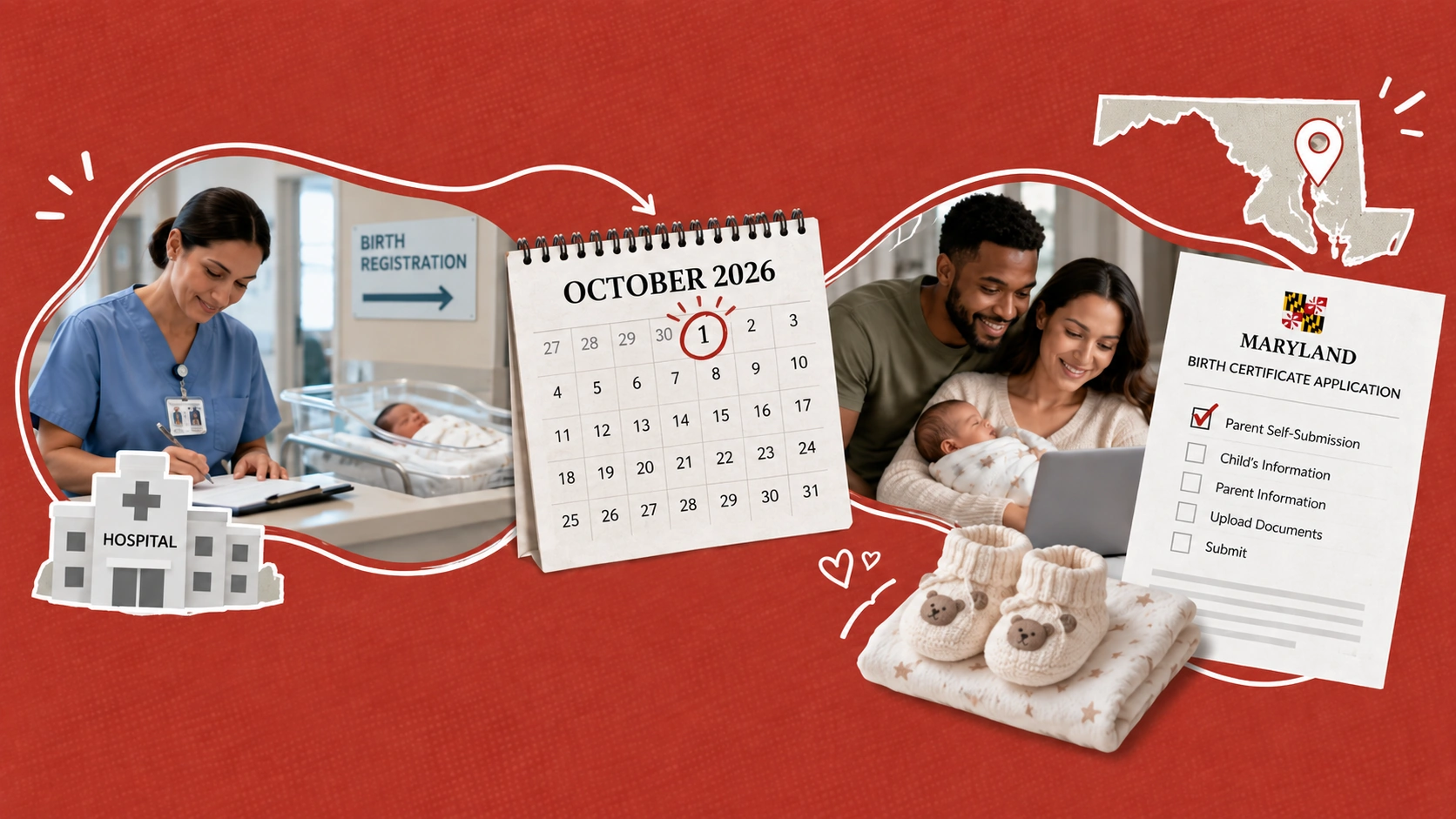
Maryland has just changed that for Maryland births. House Bill 939 of the 2026 Regular Session, approved by the Governor on April 28, 2026 as Chapter 323, takes effect October 1, 2026. This article explains the filing chain it modifies, what it looks like when that chain breaks, and exactly what the new law does. It is not a guide to getting a certificate for a home birth; that guide exists; and it is not about records missing for decades, which is a different process called delayed registration.
Who Files a Birth Certificate (Hint: Not You)
Every state assigns the legal duty to file a birth certificate to someone other than the parents. In most states the rule works like this:
- Birth in a hospital or birthing center: the institution files. Staff collect the information from the parents on a worksheet, complete the record, and transmit it to the state or local registrar, almost always through an electronic birth registration system.
- Birth outside an institution with an attendant: the attendant, typically a licensed midwife or physician, files.
- Birth with no attendant: the duty falls to a person defined by state law, which varies; in some states it is the parent, in others it is whoever was present or the registrar on notification.
The deadline for filing is also set state by state, and it is short, a matter of days, not weeks, in most places. We verified Maryland's structure for this article and no other state's, so we are not going to give you a table. The point is that the clock exists, it is short, and it is running on someone who is not you.
What It Looks Like When the Chain Breaks
When the responsible person files, nobody notices. When they don't, the failure surfaces late and somewhere inconvenient:
- A birth attendant who never submitted the record, or submitted it with an error that stalled it.
- A facility that lost the worksheet between the delivery room and the records office.
- A midwife who left practice, moved, or died with the paperwork unfiled.
- A family that moved out of state before the record cleared, and a registrar on each side assuming the other has it.
The parents find out at the daycare that asks for a certified copy, the pediatrician's office, the school district, the Social Security office, or the passport counter, often months or years later. And then they discover the structural problem: because the statute names the hospital or the attendant as the filer, the parents have no standing to file. They can ask the responsible person to do it; if that person is unreachable, unwilling, or gone, the ordinary process has no door for them. What remains is usually a delayed-registration procedure with its own evidence requirements, which is slower and harder and exactly what the new Maryland law is designed to prevent.
What Maryland's HB 939 Does
The bill amends Health-General §4-208, the section that governs who must file a certificate of birth and when. According to the General Assembly's published synopsis, it authorizes a parent to file a certificate of birth within 10 days after the birth occurred, provided the parent notified the person otherwise required to file, on a form provided by the Secretary of Health, "as soon as practicable after birth, but not later than 5 days after the birth occurred."
So the new route has two steps and a precondition:
- Step one, within 5 days: the parent notifies the person who is legally required to file, the institution or the attendant, using the Maryland Department of Health's form.
- Step two, within 10 days of the birth: the parent may file the certificate of birth themselves.
- The precondition: the notification. A parent who skipped step one has not opened the door to step two. The law gives parents standing, but it makes them earn it by putting the responsible party on notice first.
The measure passed with no opposition, 132–0 in the House, 39–0 in the Senate, with the House concurring 130–0, which tells you something about how uncontroversial the underlying problem is once legislators look at it.
What we have not read is the enrolled statutory text itself; the bill record gives the synopsis, chapter number, and effective date. Before relying on a specific detail, such as what the notification form looks like, what the parent must submit with the certificate, or how the registrar treats a parent-filed record, check the Maryland General Assembly's page for HB 939 and the Maryland Department of Health's Division of Vital Records, which will publish the form the statute refers to.
Why Ten Days Matters
The new law's clock is short on purpose. The ordinary registration process, where the record goes into the system as a routine, timely filing, is only available for a brief window after birth in every state. Miss it, and the record becomes a late or delayed filing, which is a different track with more scrutiny. Maryland's parent route is built to keep a birth inside the ordinary window when the responsible filer is not going to make it.
That has a practical consequence for Maryland parents, and for parents anywhere: confirm the record exists rather than assuming it does. A hospital that says "we filed it" has usually done so, but "usually" is not the same as a certified copy in your hand. Requesting a certified copy from the Maryland Division of Vital Records a few weeks after the birth is the cheapest way to find out whether the record is there. If it is not, and you are still inside the window, you now have a route. If you are outside it, you know sooner rather than at a passport counter three years on.
For the ordering side, who is eligible to request a Maryland birth certificate, what identification is required, and current state fees and processing times, our Maryland birth certificate page covers it. Vital Records Online is a third-party service and not a government agency; certificates are issued by the state, and filing a birth record under HB 939 is done with the Department of Health, not through an ordering service.
If You Are Not in Maryland
Do not assume your state has a parent route. Most do not, and those that do may set different clocks and preconditions. What you can do everywhere:
- Ask, before you leave the hospital or before the attendant leaves your home, who is filing and when.
- Write down the attendant's license number and contact details. If the record stalls, the registrar will ask.
- Request a certified copy within the first couple of months. The absence of a record is far easier to fix at six weeks than at six years.
- If a record is missing and the ordinary window has passed, contact your state's vital records office and ask about its procedure for a birth that was never registered. Do not wait for a deadline to force the issue.
Frequently Asked Questions
Who is responsible for filing a baby's birth certificate? In every state, someone other than the parents: the hospital or birthing center for institutional births, or the attendant (such as a midwife) for births outside one. The specific rule and deadline are set by state law.
What does Maryland's HB 939 change? Effective October 1, 2026, a Maryland parent may file the certificate of birth within 10 days of the birth, if the parent first notified the person otherwise required to file, on the Department of Health's form, no later than 5 days after the birth.
Can a parent in Maryland file without notifying the hospital or midwife first? Not under the synopsis of HB 939. The notification within 5 days is the precondition for the parent's right to file within 10 days.
Does this apply to births before October 1, 2026? The bill's effective date is October 1, 2026. For a birth before that date whose record was never filed, contact the Maryland Division of Vital Records about its procedure for unregistered births.
How do I know whether my baby's birth was registered? Request a certified copy from the state's vital records office. If a record exists, you receive the certificate; if it does not, you find out while the problem is still small.