When the Certified Copy Is Free by Law: Fee Waivers for Survivors, Foster Youth, and Young People Without Housing
A certified copy of a birth certificate costs money in every state, and for most people that is a minor annoyance. For some people it is the wall. A sixteen-year-old sleeping in a friend's car cannot get a job without ID, cannot get ID without a birth certificate, and cannot get the birth certificate without a fee she does not have and a parent she cannot ask. A woman leaving a violent household with her children and nothing else has the same problem with more people attached to it.
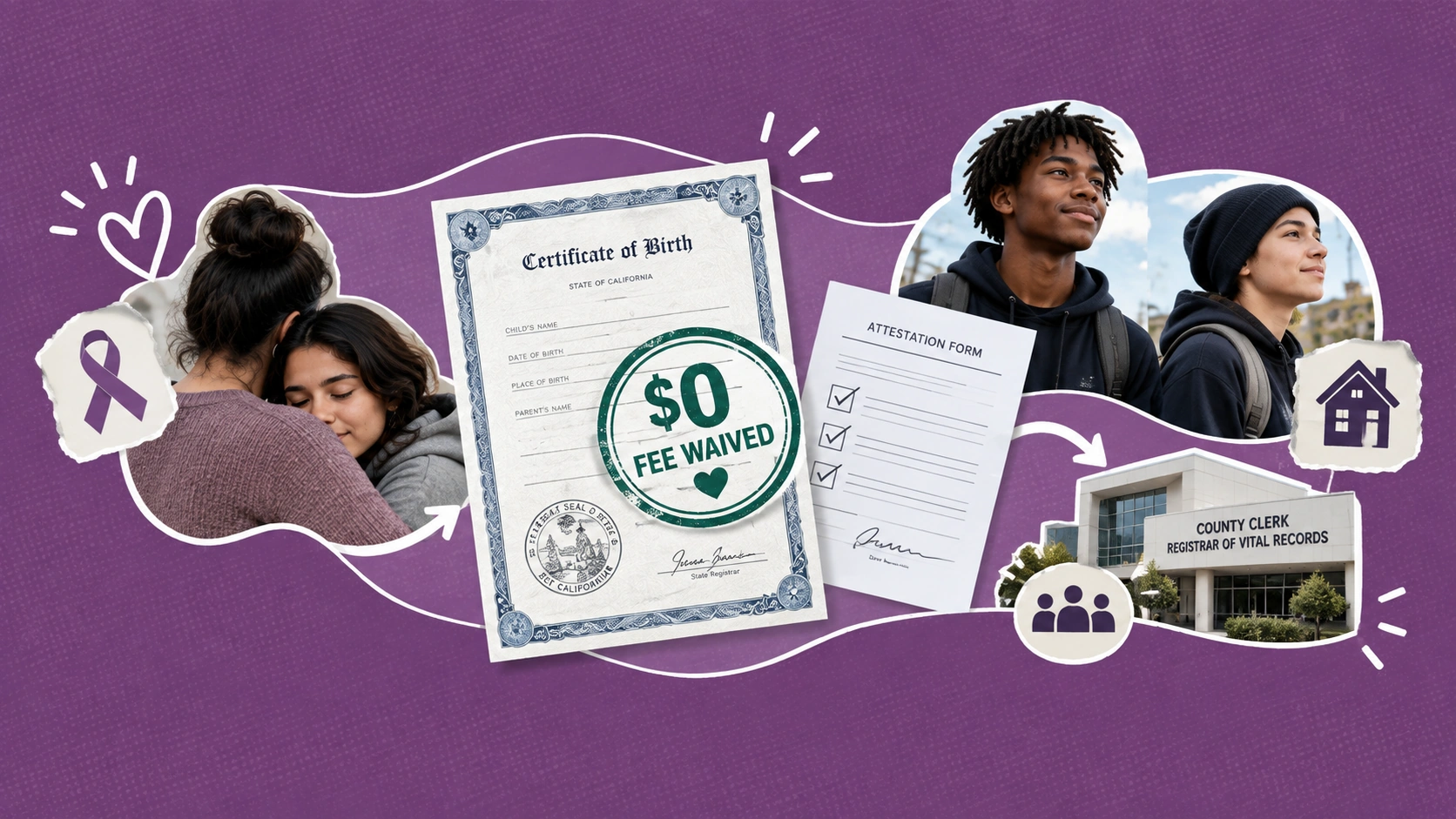
Several states have answered this with a specific kind of law. Not a discount program, not a hardship application, but a duty placed on the registrar: on presentation of an attestation, issue the certified copy without a fee. This article explains the shape of those laws, walks through two states where we verified the statutes and the forms, and tells you how to ask your own state's office. It is deliberately not a fifty-state table, because we have not verified fifty states and a table that is wrong for your state is worse than no table.
One thing to say plainly before anything else: if you qualify for a statutory fee waiver, go to the registrar directly. A paid ordering service, including this one, cannot apply a waiver the law grants at the government counter, and there is no reason to pay a service fee for a document the state owes you for free.
How These Laws Work
The mechanism is the same across the statutes we read:
- The law names a population: victims of family or dating violence, children in state conservatorship, young adults in foster placements, homeless children and youth as defined by federal law.
- The law names the offices bound by it: typically the state registrar, local registrars, and county clerks, so that the waiver applies wherever a certified copy can be issued.
- The law names the trigger: an attestation of status, sometimes with a supporting document from an agency, in place of the fee.
- In some cases the law removes a second barrier: parental consent, because the population it protects is, by definition, often unable to get it.
The important consequence is that the requester does not have to find and enroll in a program. The registrar's duty is triggered when the attestation is presented. What the requester has to know is that the law exists, because a clerk quoting the standard fee to someone who does not know to say the words "fee waiver" will simply lose that person at the counter.
Texas: Three Statutes, Three Populations
The Texas Department of State Health Services lists its vital-statistics legislation on a public page, and it publishes the attestation forms alongside. We read the DSHS page and confirmed each bill's effective date on the Texas Legislature's own records.
Victims of family or dating violence: SB 798
Senate Bill 798 (87th Legislature), signed June 7, 2021 and effective September 1, 2021, provides that the state registrar, a local registrar, or a county clerk "shall issue, without fee, a certified copy of the birth record" to a victim of family or dating violence, as defined in Family Code §71.0021 or Human Resources Code §51.002, and to their children, "who are currently fleeing a dangerous living situation." The supporting document is an attestation of family or dating violence status; DSHS publishes a sample attestation form.
Foster and homeless youth: HB 123
House Bill 123 (86th Legislature), signed June 14, 2019 and effective September 1, 2019, is the one with the clause that matters most. The registrar or county clerk "shall issue, without fee or parental consent, a certified copy of the child's or youth's birth record" to:
- a homeless child or youth as defined by 42 U.S.C. §11434a (the federal McKinney-Vento definition);
- a child in the managing conservatorship of the Department of Family and Protective Services; and
- a young adult aged 18 to 20 who resides in a foster care placement paid for by DFPS.
One supporting document is required: a document from DFPS, a Foster Care Verification form, or an attestation of youth homeless status, for which DSHS publishes a form. Read "without parental consent" again. For a minor who is homeless, the usual requirement that a parent request the record, or consent to a request, is the barrier that makes everything else impossible. HB 123 removes it.
County child welfare boards: HB 4466
House Bill 4466, effective September 1, 2025, adds a narrower waiver: a certified birth record without fee on request of a county, or a child welfare board appointed by a county's commissioners court, where the request relates to a suit affecting the parent-child relationship filed by a governmental entity. It requires proof of a direct, tangible interest, such as a court order establishing conservatorship, plus a board member's attestation. This one is for agencies rather than individuals, but a foster parent or caseworker may find it is the route the board uses.
The DSHS page listing all three, with links to the attestation forms, is Vital Statistics: New Legislation.
California: the Homeless Fee Exemption
California's version is narrower in population and older. Under Assembly Bill 1733, effective July 1, 2015, a homeless person, or a homeless child or youth, is eligible to receive a copy of a birth record without a fee from the county, if the person meets the federal McKinney-Vento Homeless Assistance Act definition and can verify homeless status. Assembly Bill 2490, effective January 1, 2019, extended the duty to the State Registrar, so requests may now go either to the county where the birth occurred or to the state.
The trigger, again, is a document: the Affidavit of Homeless Status for Fee Exempt Certified Copy of Birth Certificate, published by the California Department of Public Health on its AB 1733 page. The affidavit sets out the requirements the applicant must meet and is signed by a person who can verify the status, typically a homeless services provider, a school liaison, or another person the affidavit specifies. We did not verify a California waiver for family-violence survivors and are not claiming one exists; check with CDPH or the county recorder if that is your situation.
What to Prepare: the Attestation, Not the Money
If you or someone you are helping may qualify, the preparation is different from an ordinary order:
- Find the form first. Both Texas and California publish the attestation or affidavit on the vital records agency's site. Other states that have a waiver will too. Search the state vital records site for "fee waiver," "fee exempt," "homeless," or "family violence" before calling.
- Identify who signs it. Some attestations are self-attestations; some require a caseworker, shelter, school liaison, or agency to verify status. The form says which.
- Bring the supporting document if one is named: a DFPS letter, a Foster Care Verification form, or the equivalent in your state.
- Ask for the waiver by name. "I am requesting a certified copy under the fee waiver for [homeless youth / family violence victims]. Here is the attestation." A clerk who hears that knows what to do; a clerk who hears "how much is it?" quotes the fee.
- Identification may still be required, or may be modified. The waiver removes the fee, and in some statutes the consent requirement; it does not automatically remove the ID requirement. Ask the office what it accepts from someone in your situation. Our support page on what to do with no ID covers the general problem.
If Your State Isn't Listed Here
We verified Texas and California. Other states have waivers with different populations and triggers, and some have none. The way to find out is to ask the state vital records office one question: "Does state law provide for a certified birth certificate without a fee for [your situation], and what documentation do you require?" If the answer is yes, ask for the form. If the answer is no, ask whether a local organization, such as a domestic violence program, a youth shelter, or a school homeless liaison, has a fund or a voucher arrangement; many do, and the office will often know.
For readers who do not qualify for a waiver and simply need a certified copy, ordering a birth certificate from the issuing state is the ordinary route; Vital Records Online is a third-party service and not a government agency, its service fee is separate from the state's fee, and it cannot apply a statutory waiver. Two earlier articles cover other fee-relief situations: free copies for veterans' benefits claims and free replacement after the California fires.
Frequently Asked Questions
Can a homeless teenager get a birth certificate without a parent? In Texas, yes. HB 123 requires issuance without fee or parental consent to a homeless child or youth, on an attestation of homeless status. Other states differ; ask the state vital records office.
Is a domestic violence victim's birth certificate free? In Texas, a victim of family or dating violence who is currently fleeing a dangerous living situation, and their children, may receive a certified copy without fee on an attestation (SB 798, effective September 1, 2021). We did not verify an equivalent in California.
Do I need to apply for a program to get the waiver? No. In the statutes we read, the waiver is a duty on the registrar that is triggered when you present the required attestation or affidavit. You do need to know the waiver exists and ask for it.
Can an online ordering service apply the waiver? No. Statutory waivers are applied by the registrar or county clerk when the attestation is presented. If you qualify, go directly to the government office.
Does the waiver also remove the identification requirement? Not automatically. It removes the fee, and in some statutes parental consent. Ask the office what identification it accepts from someone in your circumstances.