Which Deaths Get Investigated, and Why the Autopsy Report Is Not the Death Certificate
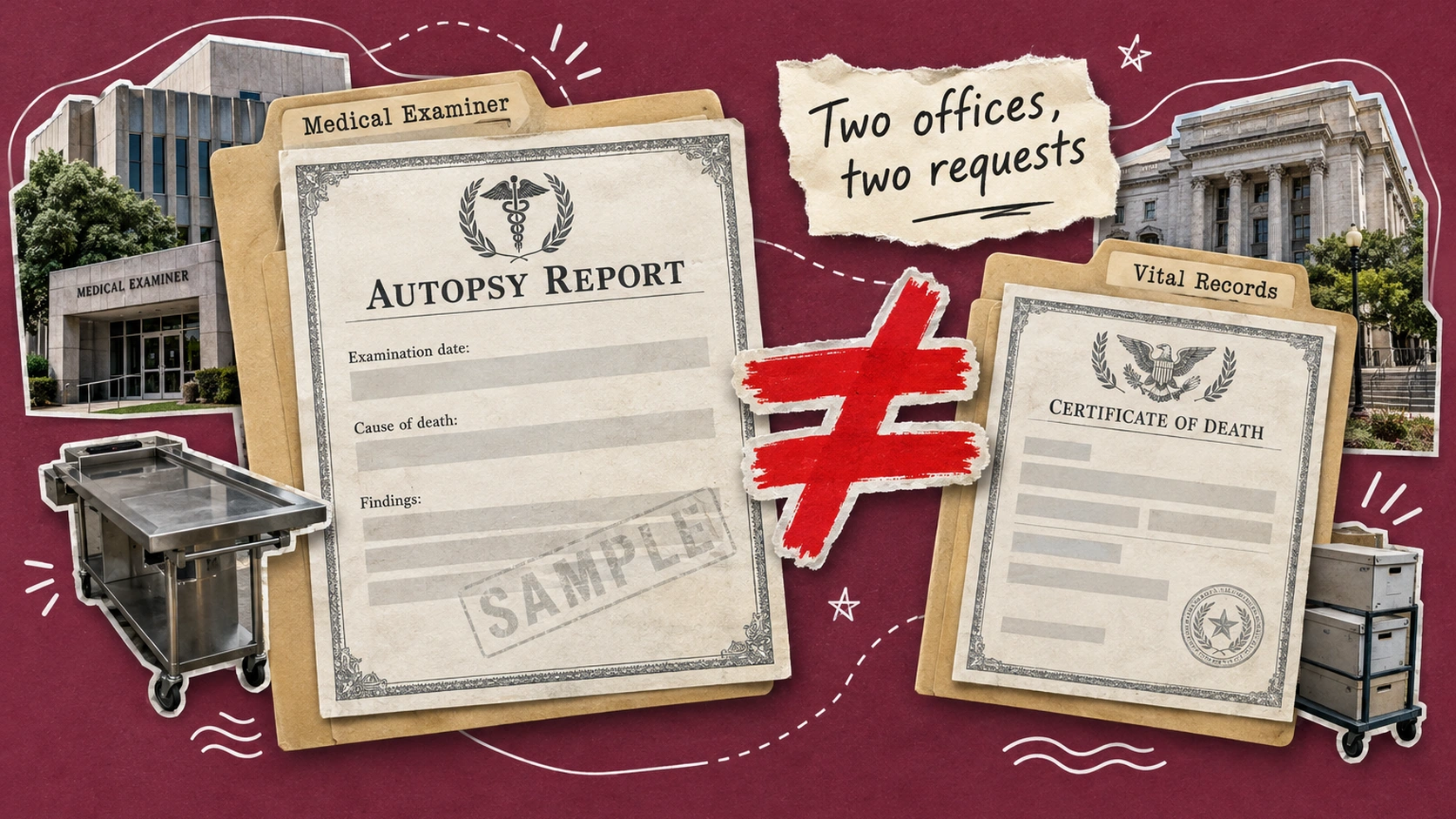
When a death is referred to a medical examiner or coroner, two things happen that families are rarely told about in advance. The first is that the question "why was my mother's death investigated? Nothing suspicious happened" has a published answer, and it is broader than most people expect. The second is that the investigation produces a document the family badly wants and a document the family actually needs, and they are not the same document, are not held by the same office, and do not arrive on the same schedule.
This article is about those two facts. It does not redefine either document: our glossary entries on the autopsy report and the coroner's report cover what each one is and how a request is made. It is also not about a certificate issued with the cause still open, which our guide to a pending cause of death handles.
Which Deaths Get Referred
There is a federal handbook on this, produced by the CDC's National Center for Health Statistics for medical examiners and coroners, and it states the referral categories plainly. Deaths that typically require investigation are those:
- due to unusual or suspicious circumstances;
- due to violence, meaning accident, suicide, or homicide;
- due to natural disease processes when the death occurred suddenly and without warning;
- where the decedent was not being treated by a physician;
- where the death was unattended.
Those last three are the ones that answer the question families ask. A grandfather who died in his sleep of heart disease, with no doctor present and no recent treatment, falls squarely inside the criteria. Nothing about his death was suspicious. It was sudden, and it was unattended, and that is enough. The investigation is not an accusation, and it does not mean anyone suspects anything.
These are general criteria from a federal handbook, not a statute. The actual rules are set state by state, and the offices that apply them differ in kind as well as in name: some jurisdictions elect a coroner, others appoint a physician medical examiner, and some counties run arrangements that mix the two. We are not going to publish a count or a map of which is which, because we did not verify it for any state. If it matters to your situation, the office that handled the death can tell you what it is.
Who Fills In Which Half of the Certificate
Even when a death is investigated, the death certificate is a shared document. The federal handbook describes the division: the medical examiner or coroner completes the medical certification, the cause and manner of death, while "the funeral director, or other person in charge of interment, will otherwise complete those parts of the death certificate that call for personal information about the decedent."
That matters for a practical reason. If the personal details are wrong, the name misspelled or a birthplace incorrect, the office to raise it with is the funeral director, not the medical examiner. If the cause of death is the problem, it is the certifier's to amend. Families routinely call the wrong one and lose weeks. Our guide to what appears on a death certificate sets out the fields.
On timing, the handbook is explicit that there is no federal deadline: "Each State prescribes the time within which the death certificate must be filed with the registrar." So how long an investigated death takes to produce a filed certificate is a state question, and an investigation that runs long is the usual reason a certificate is filed with the cause pending.
The Two-Office Rule
This is the practical payload of the article, and it saves people weeks.
The autopsy report is not a vital record. It is not held by the state or county vital records office, it is not issued by the registrar, and asking the office that issues death certificates for a copy of it will not produce one. The autopsy report is held by the office that performed the examination, which is the medical examiner's or coroner's office.
The District of Columbia is a clean worked example, because it publishes both halves. Its Office of the Chief Medical Examiner states that "An Autopsy Report may be obtained by the decedent's next-of-kin (via an in-person request or via a notarized written request), notarized authorization from the next-of-kin, or pursuant to a validly issued subpoena or court order." The fee there is $15.00 for family members and $75.00 for private organizations. And the page is explicit that the autopsy report comes from the medical examiner while the death certificate comes from the Health Department's vital records division. Two offices, two requests, two sets of rules.
Those DC figures are DC's alone and should not be read as typical. The structure is what generalizes: one office for the certificate, a different office for the report.
The Eligibility Rules Are Different Too
The asymmetry catches people out. Access to an autopsy report is usually restricted to next of kin, often on a notarized request, or to attorneys and law enforcement, or under a subpoena or court order. A certified death certificate follows the issuing state's own eligibility rules, which are a different list and frequently a wider one.
So it is entirely possible to be eligible for one document and not the other. An executor who is not next of kin may be able to obtain certified copies of the death certificate for the estate while being unable to obtain the autopsy report without authorization from the family. That is not an error; it is two statutes doing different jobs.
What to Expect, and in What Order
The sequence families should plan around:
- The certificate comes first, and it is the one institutions want. Banks, insurers, pension administrators, the Social Security Administration and probate courts are served by a certified death certificate. None of them asks for an autopsy report.
- The report comes later, sometimes much later, because toxicology and other testing can run for months after the body has been released and the funeral has taken place.
- A certificate filed with the cause pending is still a certificate. It can usually do the estate work. When the investigation concludes, the cause is amended onto the record.
- Wanting the report is not the same as needing it. Families often want the report for reasons that are real and have nothing to do with paperwork. That is worth separating from the administrative task, which the certificate alone completes.
If what you need is the document institutions accept, certified copies of the death certificate can be ordered from the state where the death occurred. Vital Records Online is a third-party service and not a government agency; it cannot obtain an autopsy report, which comes only from the medical examiner's or coroner's office that performed the examination. Our FAQ on whether death certificates show cause of death covers what the certificate itself discloses.
Frequently Asked Questions
Why was my relative's death investigated when nothing suspicious happened? Investigation criteria include deaths that were sudden and without warning, deaths where the person was not under a physician's care, and unattended deaths. None of those implies suspicion.
Is the autopsy report the same as the death certificate? No. They are separate documents produced by different offices. The certificate is a vital record issued by the registrar; the autopsy report is held by the medical examiner or coroner.
Can I get the autopsy report from the vital records office? No. Request it from the medical examiner's or coroner's office that performed the examination, usually as next of kin and often on a notarized request.
Who corrects a mistake on the certificate? It depends which half. Personal details are completed by the funeral director; the cause and manner of death are the certifier's. Raise it with whichever one entered the information.
Do banks and insurers need the autopsy report? Generally no. Institutions are served by a certified death certificate, including one filed with the cause pending.