Sending Someone Home: The Documents Required to Repatriate Remains to Another Country
When a family decides to take someone home, to Mexico, to El Salvador, to the Philippines, to anywhere the person came from, the funeral director handles the logistics and the family handles the grief. What nobody handles well, in our experience, is the paperwork between them, because it comes from three different offices, on three different clocks, in an order that is not obvious and cannot be reversed. Families miss flights over it.
This article is about those documents and that order. It does not explain what an apostille is or how the Hague Convention works; our guide to apostilles for U.S. vital records does that. It does not cover airline requirements, container specifications, or embalming rules, which are the funeral home's and the carrier's to state. And it does not give a per-country checklist, because the receiving country's consulate sets those and they differ. What it gives is the structure that every one of those checklists sits on.
Three Documents, Three Offices
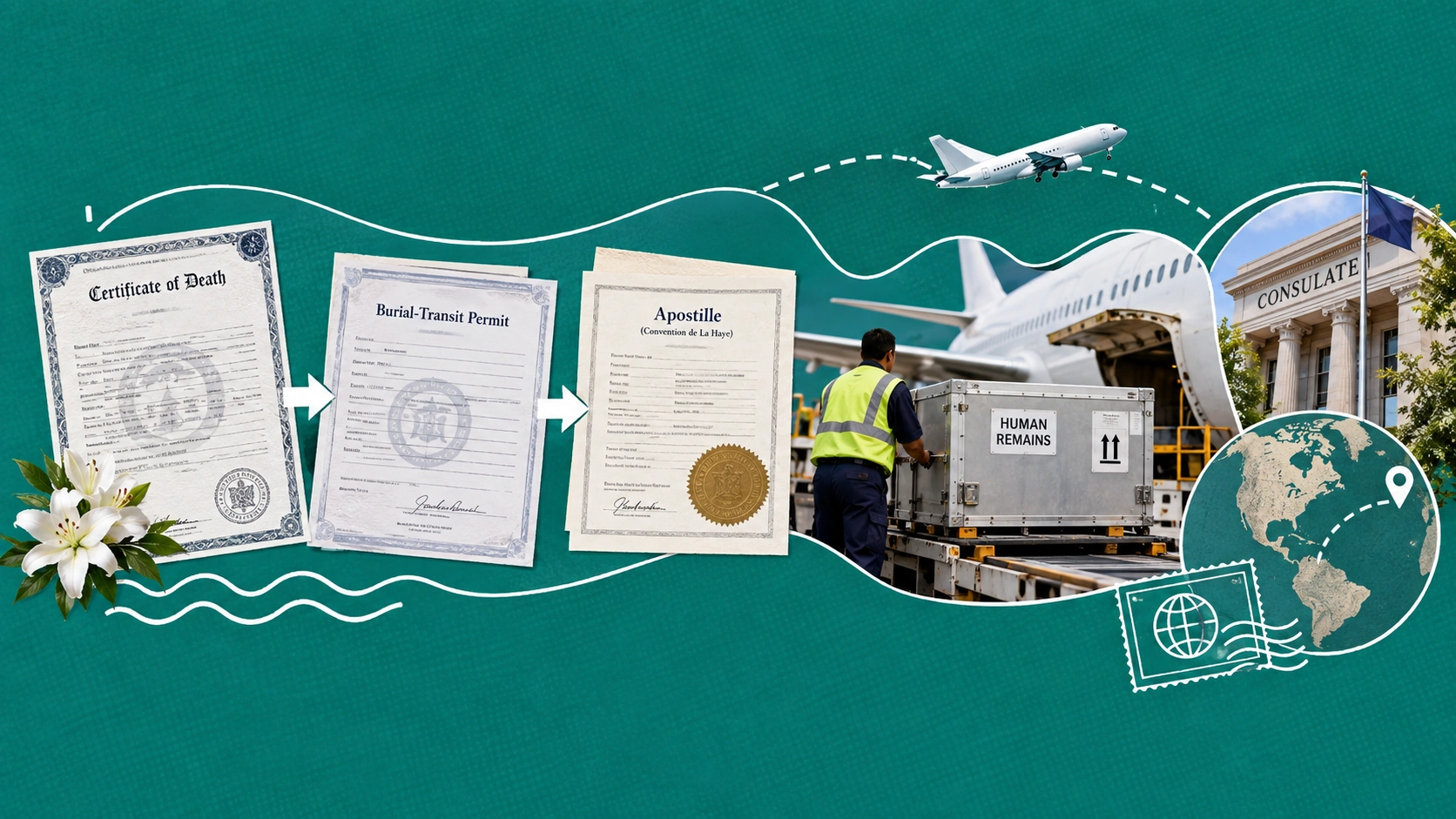
For a body leaving Texas for Mexico, the Texas Department of State Health Services' Handbook on Death Registration lists what is "generally required": a Burial-Transit Permit, a certified copy of the Texas Certificate of Death, and an Apostille from the Texas Secretary of State's Office. The handbook adds that the funeral director "may need to have the death certificate and Apostille translated into Spanish." For countries other than Mexico, the handbook's instruction is to "check with the consulate of that country for specific requirements", and that a Burial-Transit Permit is required whenever a body leaves the state.
Texas is one state, but the three-part structure is general. Wherever the death occurred, the family will need:
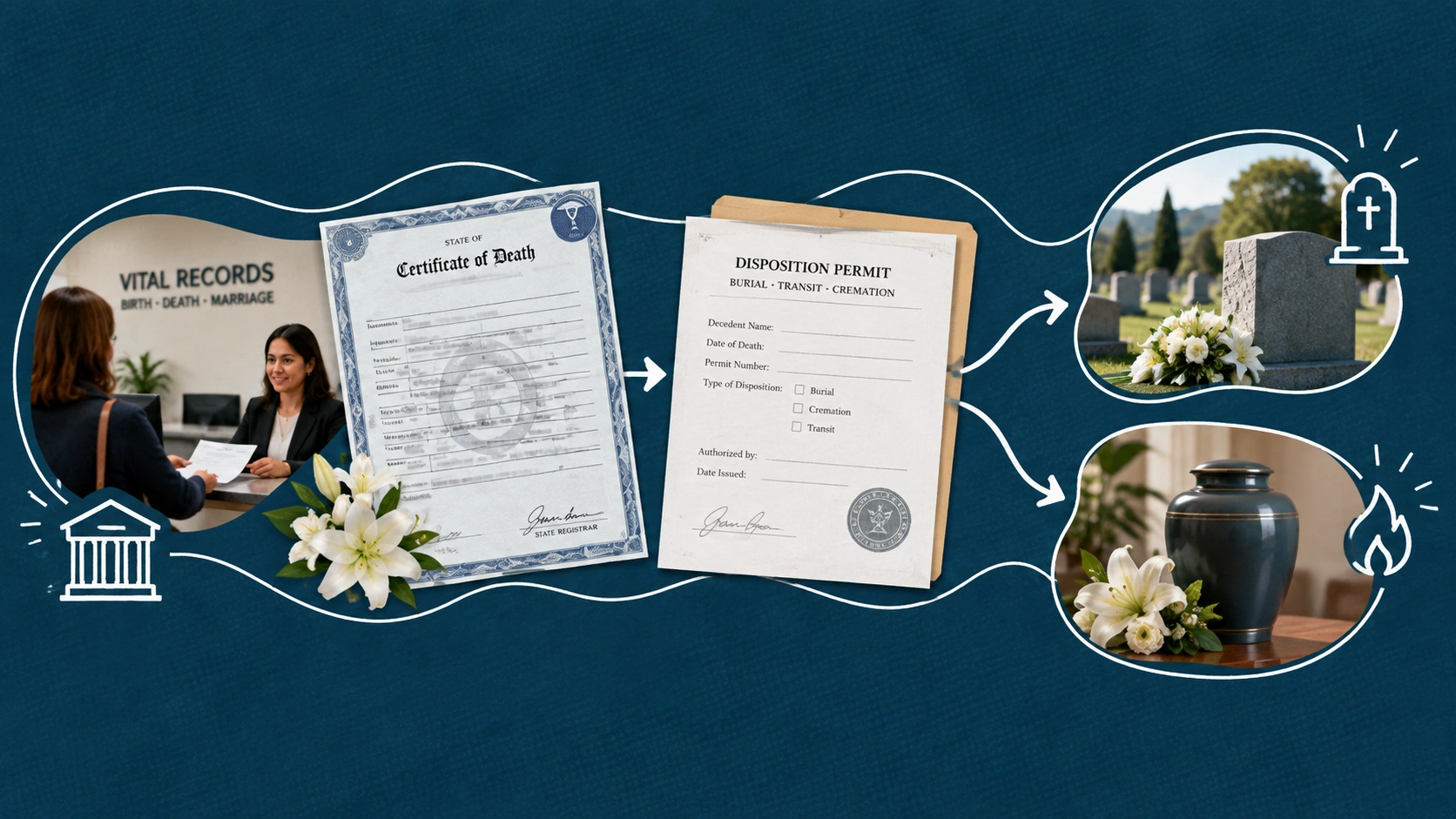
- An authorization to remove the remains from the state: the burial-transit permit, disposition permit, or equivalent, issued by the local registrar of the district where the death occurred, once the death certificate has been filed.
- A certified copy of the death certificate, issued by the state or county vital records office from the registered record.
- An authentication of that certified copy for use abroad, an apostille for a country party to the Hague Apostille Convention, or consular legalization for one that is not, issued by the state's apostille authority, usually the Secretary of State.
Three offices. The registrar does not issue apostilles, the Secretary of State does not issue death certificates, and the vital records office does not issue permits. Each transaction has its own form, fee, and turnaround, and the funeral director can carry some of them but usually not all.
The Order Is Fixed: Register, Certify, Authenticate
The sequence cannot be shuffled, and the reason is what an apostille is. The California Secretary of State states it precisely, and the sentence is worth memorizing: an apostille "authenticates the signature of a public official on a document for use in another country." It certifies the authenticity of the official's signature, the capacity in which the official acted, and, where appropriate, the seal. Then: "The Apostille does not validate the contents of the document."
That has three consequences for a repatriation:
- The apostille attaches to a certified copy that has to exist first. There is nothing to authenticate until a registrar has signed a certified copy. So the death is registered, a certified copy is issued, and only then is the copy sent for an apostille. Register → certify → authenticate, never the other way round.
- Only certain signatures qualify. California, for example, can issue an apostille on a birth or death certificate signed by a county clerk or deputy, a county recorder or deputy, or the State Registrar. A copy signed by a local health officer may first need certification by the county clerk, or replacement with a copy from the county recorder or the state. Ask the apostille office which issuing office's copy it will accept before you order.
- A photocopy will not work. California's request page says it in four words: "A photocopy is not acceptable." The document apostilled is the original certified copy, and the apostille is physically attached to it.
And because the apostille does not validate contents, a foreign consulate may still require a translation the apostille does nothing about; the Texas handbook's Spanish-translation note is the standard example. The apostille proves the registrar's signature is real; it does not tell a Mexican official what the document says.
Clocks and Costs, in One State Each
We are not going to give you a fifty-state table of apostille fees and turnarounds; it would be wrong somewhere the week it published. Two verified data points show the shape of the problem.
In Texas, the Burial-Transit Permit carries no fee, but the local registrar "shall not issue" it "until the Certificate of Death, completed in so far as possible, has been presented", so the permit waits on the certificate, and the certificate waits on the medical certifier. If the family's timeline is tight, the certifier is the person to ask about. In California, the Secretary of State charges $20 per apostille, plus a $6 special-handling fee per different official's signature for in-person requests only; mail requests are processed "strictly in the order received," and the office "cannot pull submissions for expedited service." Same-day service exists only in person, in Sacramento and Los Angeles.
Put those together and the planning fact emerges: the apostille step is the one most likely to have no expedite option, and it cannot start until the other two are done. A family that learns this on day one can plan around it; a family that learns it at the airport cannot.
Order More Copies Than You Think You Need
The single most useful practical instruction in this article: the apostilled certified copy is surrendered to the receiving authority and does not come back. Whatever the consulate, the foreign registrar, or the cemetery abroad takes, they keep. Meanwhile the estate at home will still need certified copies for the bank, the life insurer, the pension, and Social Security, none of which will accept the copy that went to another country.
The moment to order those copies is at the same time as the one to be apostilled, from the same office, in one request. That is the point where the death certificate and the apostille become a single transaction for the family, and where a service that handles both can save a second round of forms. If you need certified copies of the death certificate and an apostille on one of them, ordering the death certificate and the apostille together is the sensible sequence. Vital Records Online is a third-party service and not a government agency; the certificate is issued by the state's vital records office, the apostille by the state's apostille authority, and the receiving country's consulate decides what it will accept.
The Consulate Has the Last Word
Everything above is the U.S. side. The receiving country's consulate, the one covering the place where the death occurred, sets the rest: whether it wants the permit and certificate apostilled or legalized, whether it wants a translation and by whom, whether it issues its own transit document, what the funeral home must certify about the remains. Those requirements differ by country and change without notice, and the consulate is the only source for them. Call the consulate first, with the three-document structure in mind, and ask what it needs from each.
The funeral director will usually have done this before and will know the consulate's habits. If the death occurred in a state without a consulate for the destination country, ask the funeral director which consulate has jurisdiction; it is not always the nearest one.
If the Person Was a Foreign National
The death certificate for a foreign national who died in the United States is issued the same way as anyone else's, by the state where the death occurred. Our guide for families of foreign nationals covers that certificate and who may request it; this article starts where that one ends.
Frequently Asked Questions
What documents are needed to send a body to Mexico? From Texas, the state's handbook lists a Burial-Transit Permit, a certified copy of the death certificate, and an apostille from the Secretary of State, possibly with a Spanish translation. Confirm with the Mexican consulate covering the place of death.
Can I apostille a photocopy of the death certificate? No. The apostille is attached to an original certified copy issued by the vital records office. California's Secretary of State states plainly that a photocopy is not acceptable.
Does the apostille prove what the death certificate says? No. It authenticates the signature, capacity, and seal of the official who signed the certified copy. It does not validate the document's contents, and a consulate may still require a translation.
Do I get the apostilled copy back? Generally not. The receiving authority abroad keeps it. Order additional certified copies for use at home at the same time.
Can the apostille be expedited? It depends on the state. California processes mail requests in the order received with no expedite; same-day service is in person only. Check the apostille office's own page for the state where the certificate was issued.