There Is Money Waiting in Your Dead Relative's Name, and Three Certificates Between You and It
Every state holds money it cannot return. Dormant bank accounts, uncashed payroll checks, insurance proceeds, utility deposits, forgotten brokerage holdings: when the holder cannot find the owner, the property is turned over to the state, and the state keeps it indefinitely until someone claims it. A great deal of it belongs to people who have died.
Searching for it is the easy half. The hard half is proving you are entitled to it, because the state is not satisfied by a surname. It wants the relationship documented in certified records, and because unclaimed property sits for years before anyone goes looking, the claim is often filed by a grandchild, long after the death, against records held in a state nobody in the family lives in any more.
This article is about that documentary chain. It is not a guide to probate, inheritance, or who is legally entitled to an estate, all of which are state law and a matter for a lawyer. Our broader coverage of the records side of a death is in the legal documents guide and our estate planning page.
Why This Is a Chain and Not a Document
Most post-death transactions ask for one thing: a certified death certificate. A bank wants to close an account, an insurer wants to pay a policy, and the certificate answers the question.
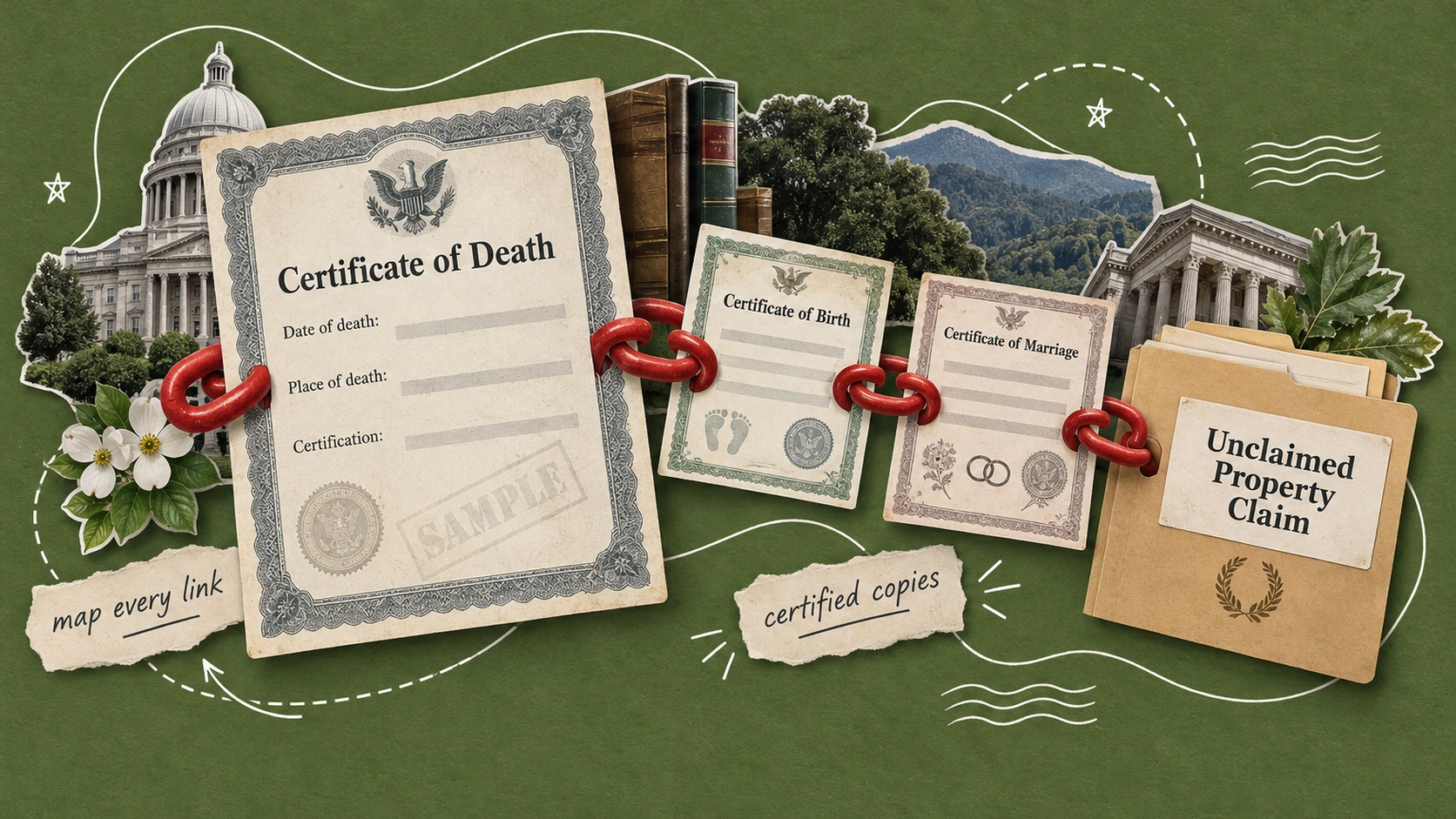
An unclaimed property claim by an heir asks a different and larger question. The state is not just confirming that someone died. It is deciding whether you specifically are entitled to property that belonged to them specifically. That requires three separate proofs, and each one has its own document:
- That the owner died. The death certificate.
- That you are related to the owner in the way you claim. Your own birth certificate, and frequently a parent's or grandparent's as well, because the link often runs through a generation that is also deceased.
- That a name change in between was lawful. A marriage certificate, most often, where the name on your birth certificate is not the name on your identification.
That is the structure. A claimant who sends the death certificate alone and waits is usually waiting for a rejection letter.
The California Example, and Why It Is Only an Example
We verified one state's requirements in detail, and we are naming it rather than presenting it as a national rule. The California State Controller's Office publishes an Unclaimed Property Claim Guide for Heirs, and its requirements show the pattern clearly.
For a deceased owner, the office requires "All pages of the deceased owner's certified final death certificate." Read that phrase carefully, because it contains two traps. All pages, not the first page, which is what most people photograph. And certified, which a scan or a photocopy is not, no matter how legible.
For heirs claiming where there is no will, the office asks for "Certified birth certificate(s)" as documentation of the relationship to the deceased. Plural, in the original, because one birth certificate establishes one link in a chain that may have several.
Marriage certificates enter where a name has changed or where the relationship itself runs through a marriage. And where the claimant is an appointed representative rather than an heir in their own right, the requirement is "Proof of your appointment", such as an "Endorsed and/or Filed copy of your Letters Testamentary or Administration signed by a judicial officer."
Every state runs its own unclaimed property program with its own heir requirements. California is the worked example here because it is the one we read. Do not assume another state's checklist matches it. The instruction that generalizes is to find the heir claim guide published by the state holding the property and read it before ordering anything.
The Age Problem
This transaction has a feature that sets it apart from almost every other use of a vital record: the records you need are usually old, and they are usually somewhere else.
Property escheats to the state after a dormancy period, then sits. By the time a family notices, the owner may have died fifteen years ago in a state they retired to, having been born in a state they left at twenty. The claimant may be a grandchild in a third state. The chain of certificates therefore crosses jurisdictions, and each one has its own eligibility rules about who may request a copy.
That last point is the one that stops claims. Eligibility to obtain a certified copy is set by the issuing state, not by the state holding the money. A grandchild who needs a grandparent's birth certificate to prove the kinship link may find that the issuing state restricts that record to a narrower list of requesters, and will ask what the record is needed for. "To claim unclaimed property, and here is the state's heir guide listing it" is a usable answer; it is worth having in writing when you apply.
Order the Whole Chain in One Pass
The single most useful instruction in this article is a sequencing one.
Claimants typically discover the chain one rejection at a time. They send the death certificate, wait weeks, receive a notice asking for proof of relationship, order a birth certificate, wait weeks, receive a notice about the name discrepancy, order a marriage certificate, and so on. Each cycle costs a month or more, and the records are frequently coming from different states with different processing times.
The alternative is to read the state's heir checklist first, map every link you will have to prove, and order all of the certified copies at once. If a link runs through a deceased parent, you will need that parent's record too. If a name changed twice, both certificates are in the chain.
If you need certified copies from several states for a claim like this, a death certificate, a birth certificate, and a marriage certificate can each be ordered from the state that holds the record. Vital Records Online is a third-party service and not a government agency; certificates are issued by the state's vital records office, each state decides who is eligible to receive a copy, and the state holding the unclaimed property decides the claim itself. Our glossary entries on proof of kinship and probate records cover the vocabulary these claim forms use.
What This Article Will Not Tell You
Three deliberate omissions, each for a reason.
No dollar thresholds. Some states handle small claims differently from large ones, and California's guide contains a figure tied to specific dates of death. The scope of that rule was not established here, and a threshold quoted out of context is worse than no threshold.
No fifty-state table. It would be wrong somewhere the week it published, and the authoritative answer is always the current guide from the state holding the property.
No inheritance advice. Whether you are the person entitled to claim, how intestate succession works where the owner died, whether a small-estate affidavit is available: that is legal advice and state law. The state's claim guide tells you what documents it wants. A lawyer tells you whether you are the right claimant.
Frequently Asked Questions
What documents do I need to claim a deceased relative's unclaimed property? Typically a certified death certificate for the owner, certified birth certificates establishing your relationship, and a marriage certificate where a name changed. The state holding the property publishes its own heir requirements.
Is a photocopy of the death certificate enough? No. California's heir guide requires all pages of the certified final death certificate. Certified means issued by the vital records office, not copied from one.
Why does the state want my own birth certificate? To document that you are related to the deceased owner in the way you claim. Where the link runs through a parent or grandparent who has also died, that generation's records are usually needed too.
What if I am the executor rather than an heir? States generally ask for proof of appointment instead, such as a filed and endorsed copy of letters testamentary or letters of administration signed by a judicial officer.
The records are in a state I have never lived in. Can I still order them? Usually, subject to that state's eligibility rules for who may receive a certified copy. Be ready to explain why you need the record and to show the claim guide that asks for it.