Presumed Dead: How a Missing Person Becomes a Death Record
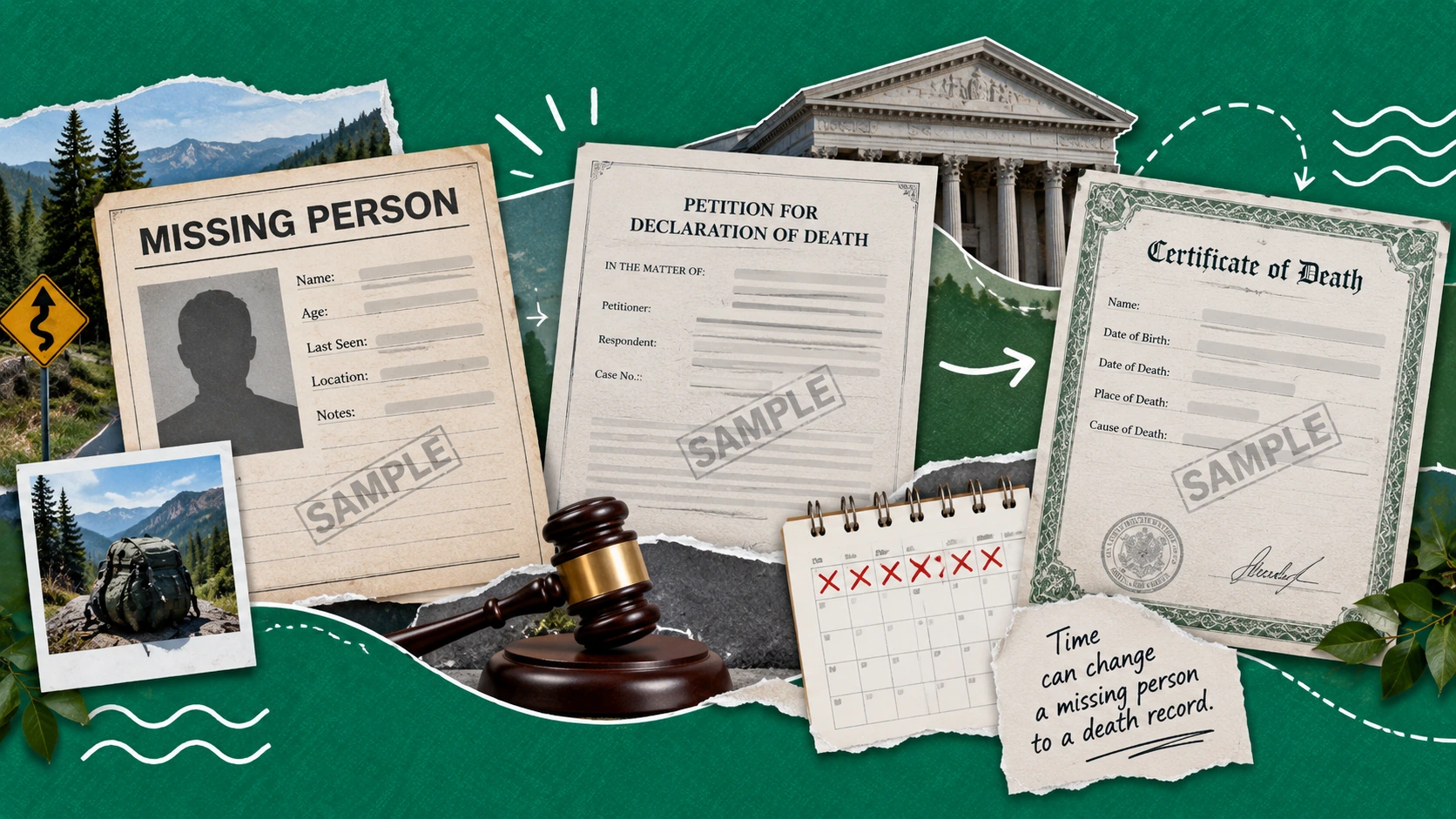
Every guide to what happens after a death starts with a death certificate. A funeral director files it, a physician or coroner certifies the cause, the state registers it, and the family orders copies to close accounts, claim insurance, transfer the house and apply for survivor benefits. None of that can start when the person is missing, because the law does not yet agree that they are dead.
This article is about that gap: the family that cannot close a bank account or collect a pension because there is no body, no certifier and no record. It covers the two separate tracks by which a missing person becomes a legal death, the seven-year default and the exceptions that shorten it, and for one named state, the mechanism by which a court finding becomes an actual death record. It is not about someone wrongly recorded as dead; that is a different problem. And it is not legal advice about how to petition a court.
Two Tracks, and the Gap Between Them
The first thing to understand is that "legally dead" is not one determination. It is at least two, made by different bodies on different standards, and one does not automatically produce the other.
Track One: The Court
A state court, typically probate or family court, depending on the state, can declare a missing person legally dead. The standard, the waiting period and the evidence required are set by state law and vary. That declaration is what unlocks the estate: it lets a personal representative be appointed, property pass, and accounts be closed. Our page on estate planning and vital records describes what happens once a death record exists; the court declaration is what makes one possible.
Track Two: Social Security
The Social Security Administration makes its own determination, under its own rules, for its own benefits. SSA's operating manual, POMS GN 00304.050, states the default: "A presumption of death arises when the evidence establishes that the missing person has been absent from their residence and has not been heard from for 7 years." The reason for the absence does not matter: "The presumption arises without regard to the reason for the absence."
And here is the gap, flagged as IMPORTANT in SSA's own text. A state court's declaration of death based on a presumption "receives great weight depending on the supporting evidence, but is not controlling." Until the seven years have run without rebuttal, the person may not be presumed dead for Social Security purposes on the strength of the court order alone.
So a family can hold a court order declaring a spouse dead and still not have a Social Security determination. The two tracks run in parallel, and the court's finding helps the second but does not finish it.
The Seven Years, and What Collapses Them
Seven years is the default, not the rule for every case. SSA's manual says the presumed date of death is normally the last day of the seven-year period, but it can be set at or near the date of disappearance where the evidence shows the person:
- Met some specific peril: a plane crash, a shipwreck, a natural disaster.
- Was suicidal at the time of disappearance.
- Was in health and circumstances that made survival improbable.
- Vanished suddenly from a settled domestic life with no reason to leave.
The rebuttal standard runs the other way and is high. SSA states that evidence of financial trouble, marital trouble or mental instability before the disappearance "is not sufficient by itself to rebut the presumption." A person who had reasons to leave is not, on that basis alone, presumed alive.
The Instruction That Matters Most: File Now
This is the single most actionable thing a family can be told, and it comes straight from SSA's instructions to its own staff. Take the claim immediately, before the seven years have run. The claim may be disallowed at first, but filing "will protect benefit rights and can be reopened at a later date based on new evidence."
Waiting seven years to file means seven years of benefits that may never be recovered. Filing now establishes the date and preserves the right. SSA will develop the evidence itself: it searches the earnings record for wages after the disappearance, attempts contact through the last employer of record, and takes statements on Form SSA-723-F4, which requires statements from at least three people who knew the missing person and the circumstances. Our page on Social Security and vital records covers the documents that ordinary survivor claims need; a presumed-death claim substitutes this evidence for the death certificate that does not yet exist.
From Court Order to Death Record: California's Mechanism
Here is where most articles stop, and where this one has to be careful. A court declaration does not, by itself, produce a vital record. Whether and how a state registrar turns a court finding into a death certificate is state law, it varies, and in some states the resulting document is not an ordinary death certificate at all. We verified the mechanism for one state.
In California, the California Department of Public Health registers what it calls a Court Order Delayed Certificate of Death. The route runs through the courts first. A petitioner files a Petition to Establish Fact, Time and Place of Death (Judicial Council Form BMD-003, with a supporting declaration on BMD-003A) in Superior Court. If the court is satisfied, it signs an Order Establishing Fact of Death, which is the top portion of state Form VS 109. A certified copy of the signed order, together with the completed delayed-registration form, is then submitted to CDPH Vital Records, which registers the death.
The result is a registered death record, a delayed one, from which certified copies can be ordered like any other. Our delayed death certificate glossary entry defines the category. The same delayed-registration machinery serves a related but different case, the death that happened and was simply never filed, which has its own guide.
California is one state. We did not verify the equivalent procedure elsewhere, and we are not going to describe one. In your state, the questions to put to the vital records office are: does a court finding of presumptive death result in a registered death record; what form does the order need to take; and who may submit it.
What to Do, in Order
- File the Social Security claim now, even if it will be disallowed at first. It protects the benefit rights and the date.
- Report the person missing to law enforcement if that has not been done; the report is evidence on both tracks.
- Consult a probate or family attorney in your state about petitioning the court. The standard and waiting period are state law and we cannot tell you what yours requires.
- Ask your state's vital records office whether and how a court order becomes a registered death record, and what form the order must take.
- Gather the evidence both tracks will want: the last known contact, the circumstances, the names of people who can give statements, and any record of a specific peril.
Once a death record exists, however long that takes, the rest of the process is the ordinary one. Our guide to the legal documents needed after a relative's death picks up there.
When the record is registered, the certified copies the estate, the insurer and the pension will each ask for can be ordered from the state that registered it. Vital Records Online is a third-party service and not a government agency; we cannot create a death record, and nothing here is legal advice. SSA's own rule is at POMS GN 00304.050.
Frequently Asked Questions
How long before a missing person can be presumed dead? For Social Security, the default is seven years absent and unheard from. A court can act on its own state-law timeline, and SSA can set an earlier date where the person met a specific peril or the circumstances made survival improbable.
Does a court order declaring someone dead settle it with Social Security? No. SSA gives a court declaration great weight but says it is not controlling; SSA makes its own determination.
Should I wait seven years to file for Social Security benefits? No. SSA instructs its staff to take the claim immediately. It may be disallowed at first, but filing protects benefit rights and the claim can be reopened on new evidence.
Does a court order automatically produce a death certificate? No. Whether a registrar issues a record on a court finding is state law. In California, a certified copy of the court's Order Establishing Fact of Death is submitted to CDPH with a delayed-registration form.
Can Vital Records Online get a death certificate for a missing person? No. A record has to exist before copies can be ordered. Once the death is registered, certified copies can be ordered like any other.