Your Marriage Was Never Valid. Social Security May Still Treat You as a Spouse.
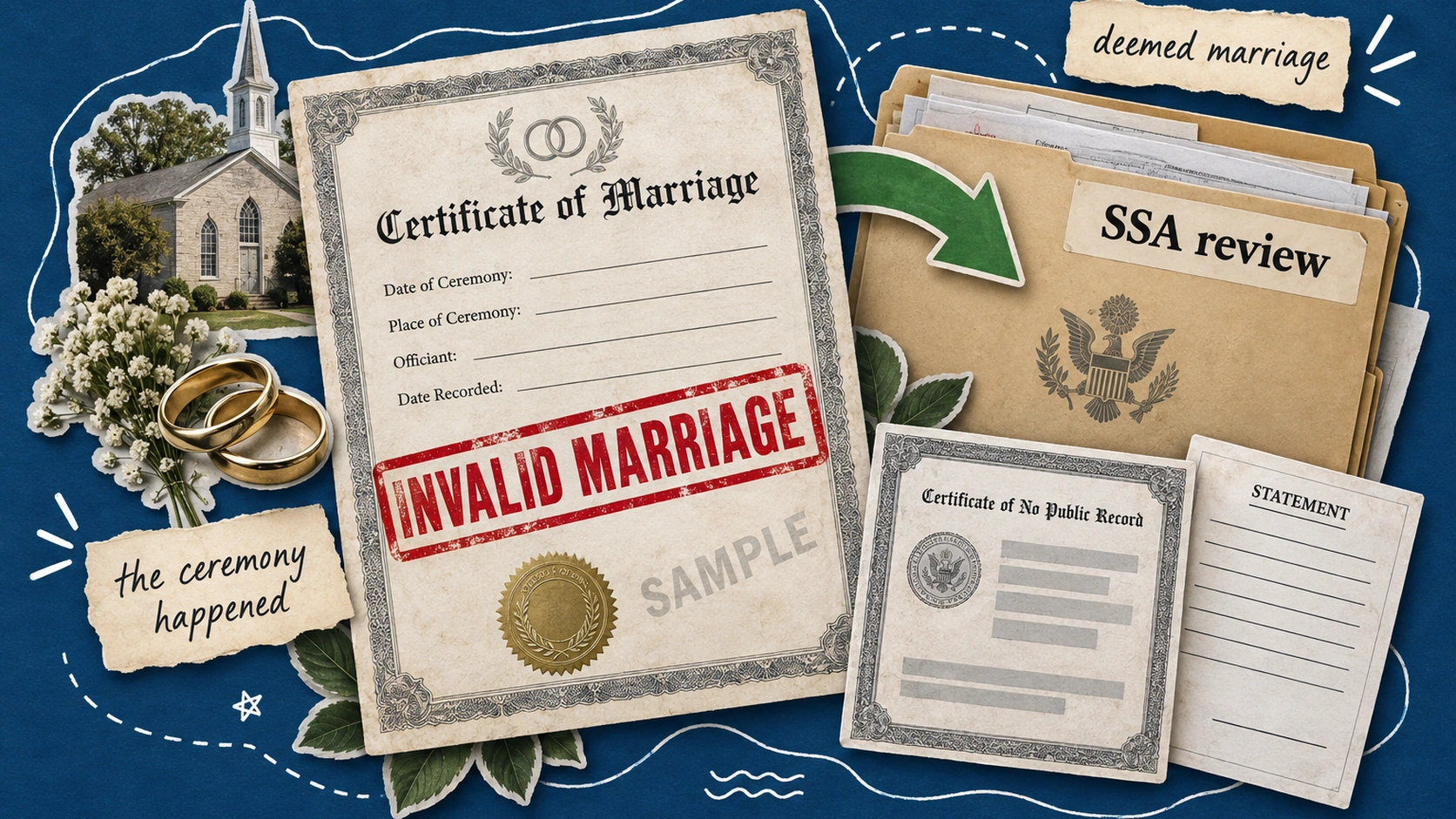
Some people learn at the worst possible moment that they were never legally married. A spouse dies, a claim is filed, and a search turns up an earlier marriage that was never dissolved. The ceremony happened, the certificate exists, decades passed, and none of it was valid.
The reasonable assumption at that point is that the Social Security claim is finished. It may not be. The Social Security Administration has a rule built for precisely this situation, and it is not widely known outside the agency. This article explains what it is, what it requires, and which records do the work, because the records are not the ones people expect.
Two boundaries first. This is not about common-law marriage, which involves no ceremony at all and is covered in our guide to proving a common-law marriage. And nothing here is advice about benefit eligibility, amounts, or filing ages. Those are SSA's to decide and a field office's to explain.
What a Deemed Marriage Is
In SSA's own words, from its Program Operations Manual System, a deemed marriage arises where "the claimant's marriage to the worker would have been valid except for a legal impediment."
The phrase to hold onto is "would have been valid except for." The rule is not a workaround for people who never married. It is for people who did marry, in good faith, in a ceremony that would have worked, and who were defeated by something they did not know about.
A note on what POMS is. It is SSA's internal instruction manual for its own staff. It is authoritative for how SSA processes a claim, and it is not a rule that binds any other agency. A state court, an insurer, a pension plan, or an immigration officer may treat the same marriage completely differently. Do not carry an SSA outcome into another forum and assume it transfers.
The Four Conditions
SSA may establish a deemed marriage where all of these hold:
- There was a ceremony. The parties went through a marriage ceremony. This is the condition that separates a deemed marriage from a common-law marriage, and it is not optional.
- The claimant acted in good faith. The claimant went through the ceremony "in good faith with no knowledge, at the time of the ceremony, of any legal impediment that would invalidate the marriage." Knowledge at the time is what matters, not what was discovered later.
- They were living in the same household. Except for a divorced claimant, the claimant was living in the same household with the worker when the application was filed, or at the time of the worker's death.
- The impediment was of the right kind. The invalidity resulted from "the lack of dissolution of a previous marriage, or otherwise arises out of a previous marriage or its dissolution, or a defect in the procedure followed" in connection with the purported marriage.
That fourth condition covers the two situations that produce most void marriages: an earlier marriage that was never actually ended, and a procedural defect in the ceremony itself. Note also what SSA says for benefits payable from January 1991 onward: a legal spouse does not bar entitlement or reentitlement of a deemed spouse. That surprises people who assume the existence of a first spouse ends the matter.
The Records That Prove It
Here is where this becomes a records problem, and where most people get the instinct exactly backwards.
Order the marriage certificate from the void marriage. People in this situation often conclude the certificate is worthless, because the marriage it records turned out not to be valid. That is the wrong conclusion. The certificate is evidence that the ceremony happened, on a date, in a place, between two named people. The ceremony is the first of the four conditions. Without proof of it there is nothing to assess. A certified copy can be ordered from the state that recorded the marriage.
Then the harder half: the previous marriage. If the impediment was an undissolved earlier marriage, the file has to establish that earlier marriage and establish that it was never dissolved. That means two things, and the second is awkward:
- the earlier marriage record, from whichever state recorded it, often decades ago and frequently in a state the family has long since left;
- evidence that no divorce exists, which is a search that comes back empty. A state that finds no record generally issues a document saying so. Our glossary entry on the certificate of no public record explains what that document is. Proving a negative across every jurisdiction a couple might have used is genuinely difficult, and it is worth asking the field office what it will accept before spending money on searches.
And the statements. SSA develops signed statements from the people involved, which can include the claimant, the worker, and the prior spouse. That last one is worth knowing before a field office visit rather than during it. Being asked to obtain a statement from a husband's first wife, decades later, is a hard conversation that nobody warns people is coming.
Where a divorce did happen but at the wrong time or in a way that created the defect, a divorce record is part of the same file. Our FAQ on needing a divorce certificate to remarry covers the ordinary version of this problem, the one that prevents a void marriage in the first place.
What This Article Will Not Do
Three limits worth stating plainly.
It will not tell you whether you qualify. That is an adjudication, it depends on facts specific to your file, and SSA makes it. The value here is knowing the rule exists so you can ask about it by name.
It will not address the other consequences of a void marriage. Property, inheritance, and the status of children are state law and a matter for a lawyer. A favorable Social Security outcome does not resolve any of them.
It does not cover putative marriage. That is a related doctrine under the law of a handful of states, with its own tests, and it is not the same thing as SSA's deemed marriage. Conflating them is the common error. If someone has told you that your state recognizes a putative marriage, that is a question for a lawyer in that state.
What to Do With This
If you have just discovered a marriage was invalid and a Social Security claim is involved:
- Say the words "deemed marriage" at the field office. It is the term in SSA's own manual, and it moves the conversation faster than describing the situation in general terms.
- Gather the ceremony evidence first. The marriage certificate from the void marriage, and anything else showing the ceremony took place and that you believed it was valid.
- Ask what will satisfy the "no divorce" element before ordering searches in multiple states, because the answer determines how much work and expense is actually required.
- Do not delay filing because the file is incomplete. SSA generally prefers a claim to be filed and developed rather than postponed, and the filing date can matter.
Vital Records Online is a third-party service and not a government agency. Certificates are issued by the state that recorded the event, and the Social Security Administration alone decides a claim. Our Social Security page covers the records SSA commonly asks for.
Frequently Asked Questions
What is a deemed marriage? SSA's rule for a marriage that would have been valid except for a legal impediment, typically an earlier marriage that was never dissolved or a defect in the ceremony's procedure.
Does an invalid marriage end a Social Security claim? Not automatically. If the four conditions are met, SSA may treat the claimant as a spouse. Whether they are met in a specific case is SSA's decision.
Is the marriage certificate from a void marriage useless? No. It is evidence that the ceremony took place, which is the first condition of the rule. Order it rather than assuming it has no value.
Will SSA contact my spouse's first wife or husband? The agency develops signed statements from the parties involved, which can include a prior spouse. It is worth preparing for that before a field office appointment.
Is a deemed marriage the same as a common-law marriage? No. A deemed marriage requires an actual ceremony. A common-law marriage involves no ceremony and is recognized only in some states.