Remarrying After a Spouse Dies: What the Clerk Asks For, and What Nobody Tells Widows
Every guide to getting a marriage license assumes the applicant has never been married or is divorced. The widowed applicant is different in one way that sounds small and is not: the first marriage ended by death, and some licensing clerks do not ask for proof of that at all. What follows from that, at the counter, and years later, is what this article is about.
It is not the general document checklist for a marriage license; that guide covers what every applicant brings. It is not about the divorced applicant, whose question this FAQ answers. And it does not explain the difference between a license and a certificate, which the glossary and our getting-married guide cover.
What the Clerk Asks For
Marriage licensing is a county function. There is no national checklist, and the widowed applicant's requirements are set by the clerk who issues the license. We verified one jurisdiction for this article, and it illustrates the surprise.
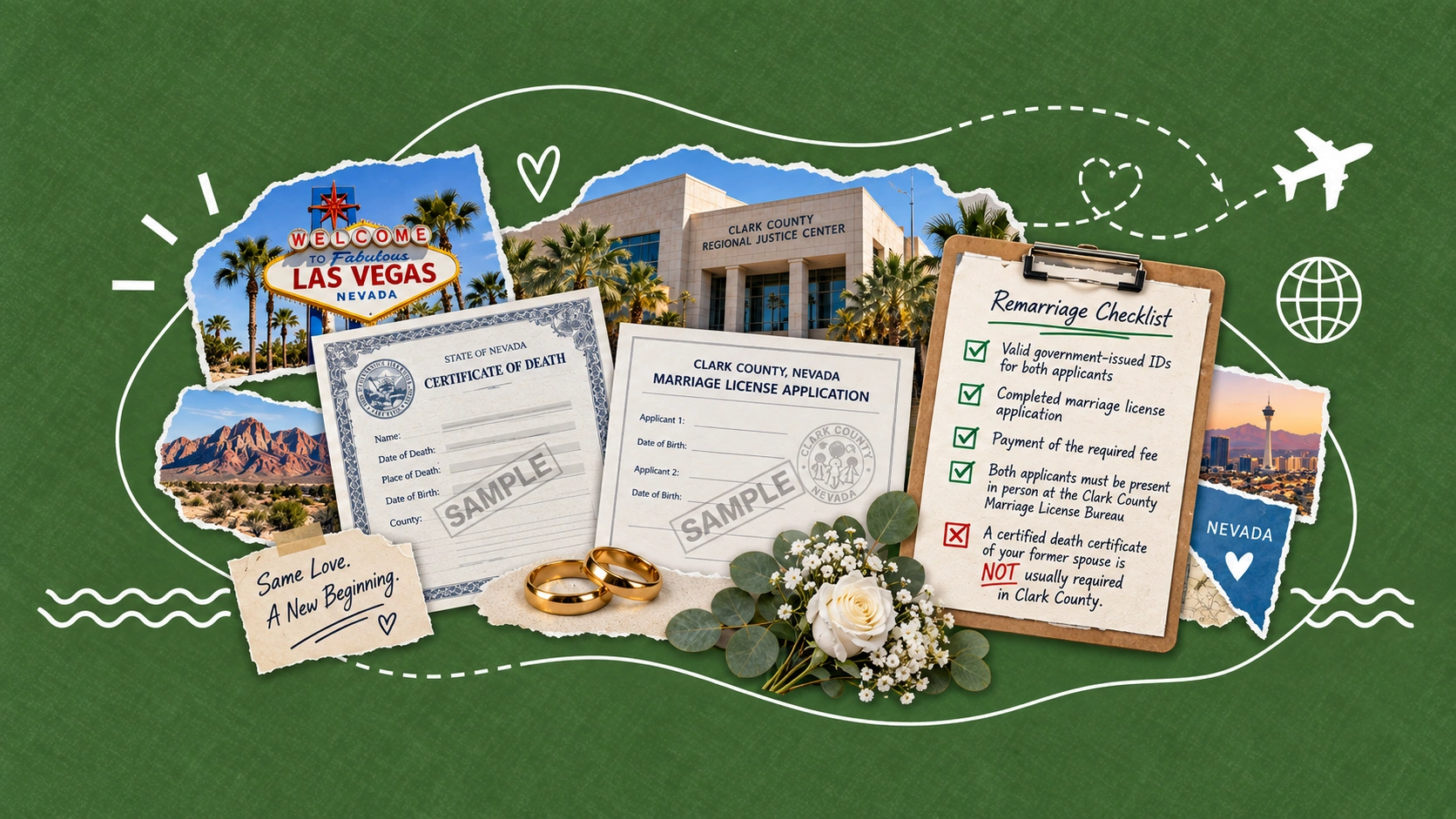
Clark County, Nevada: the Las Vegas clerk, which issues more marriage licenses than almost any office in the country, states plainly that it does not need to see a copy of a death certificate if the applicant is widowed. The applicant states the date and location of the spouse's death on the license application, and that is the end of the inquiry.
Clark County is one jurisdiction. Other clerks may ask to see the death certificate, may ask only for the date, or may ask for nothing. Call the clerk's office that will issue your license and ask what it requires of a widowed applicant before you arrive, and ask specifically, because the general checklist on the website is written for the never-married case.
Why That Is Good News, and Why It Is a Trap
At the counter, a clerk that does not require the death certificate is a relief. There is nothing to order, nothing to wait for, no certified copy to track down from another state.
The trap is downstream. The licensing clerk is the only agency in the widowed applicant's future that may not care how the first marriage ended. Every other one does.
- Social Security survivor benefits on the first spouse's record require proof of that spouse's death, and remarriage rules turn on when the second marriage happened. Our Social Security and vital records page covers the documents.
- Pensions and annuities with a survivor component ask for the death certificate of the participant and, often, the marriage certificate that made you the survivor.
- VA survivor benefits require the veteran's death certificate; our guide to VA burial and survivor benefits lists what the VA wants.
- Immigration filings that depend on a marriage, a petition for the new spouse, for instance, require proof that every prior marriage of both parties ended, and for a death that means the death certificate.
- Life insurance and estates from the first marriage, if anything remains open, run on the death certificate.
The widow who never needed the death certificate at the clerk's window may find, three years later, that she does not have a certified copy, and that the funeral home's copies went to the bank, the insurer and the county months ago. Order it for the file even when the clerk does not ask.
The Name Chain, and Why It Is Longer for Widows
This problem is specific to the widowed applicant, and almost nobody warns about it. A widow who took her first husband's name and kept it after his death now holds:
- A birth certificate in her birth name.
- A first marriage certificate linking the birth name to the married name.
- Identification in the married name: driver's license, passport, Social Security record.
Those three already have to line up whenever an agency traces a name from birth to the present. A second marriage adds another link, whether she takes the new spouse's name, hyphenates, or keeps the first married name. Any agency that later asks "how did you get from the name on your birth certificate to the name on your ID" needs the whole chain, and the first marriage certificate is the link that gets lost: it is the document from a marriage that ended, from a life that has moved on, and it is the one nobody thinks to keep a certified copy of.
The practical instruction: before the second wedding, confirm you hold a certified copy of the first marriage certificate as well as the death certificate. After the second wedding, the new marriage certificate joins the chain, and a name change on the license, passport and Social Security record follows the same order as any other name change.
What to Have Before You Apply
- Whatever the issuing clerk requires: ask about the widowed case specifically.
- The date and place of the first spouse's death, which you will likely have to state on the application even where no document is required.
- A certified copy of the first spouse's death certificate, for the file if not for the counter.
- A certified copy of the first marriage certificate, for the name chain.
- Your own identity documents, in the name you currently use, matching each other.
If you do not hold certified copies of the first marriage certificate or the death certificate, you can order the marriage certificate and the death certificate from the states that recorded them before the second marriage adds another document to the chain. Vital Records Online is a third-party service and not a government agency; marriage licenses are issued only by the county clerk, and you can request certified copies from the state or county office directly.
Frequently Asked Questions
Do I need my late spouse's death certificate to get a marriage license? It depends on the clerk. Clark County, Nevada, for example, does not require one and asks only for the date and place of death on the application. Other clerks may ask to see it. Call the issuing office and ask about the widowed case.
If the clerk does not need the death certificate, why order one? Because nearly every other agency does: Social Security, pensions, the VA, immigration, insurers. The clerk is the exception, not the rule.
I kept my first husband's name. Which documents do I need for the name chain? Your birth certificate, your first marriage certificate, and your current ID, and after the second wedding, the new marriage certificate. The first marriage certificate is the link most often missing.
Does remarrying affect Social Security survivor benefits from my first spouse? It can, depending on your age at remarriage. That is the Social Security Administration's rule to state; check with SSA before the wedding, and have the death certificate ready.
Is there a waiting period to remarry after a spouse dies? Marriage licensing is set by state and county law, and requirements vary. Ask the clerk who will issue your license.