Your Divorce Decree Will Not Split a 401(k). The Order Your Plan Needs Is a Different Document.
Retirement savings are usually the largest asset a divorcing couple divides, and the paperwork that actually moves them is not the document most people think it is. A decree can say, in plain language, that one spouse is awarded half of the other's 401(k), and that sentence on its own may move nothing at all.
The instrument that moves retirement money is a qualified domestic relations order, usually called a QDRO. This article explains what it has to contain, who decides whether it counts, and which document a retirement plan will actually accept, because that last question is a records question and the answer is not the document this site usually talks about.
This is not the general explainer on the difference between a divorce certificate and a divorce decree, which our guide covers. It is also not about claiming Social Security on an ex-spouse's record, which is a different document problem on a different record. And it does not cover military retired pay, which is governed by a separate statute and administered by the Defense Finance and Accounting Service; if that is your situation, go to DFAS rather than applying anything below.
Four Elements, and a Checklist You Can Use Today
The Department of Labor, which administers the federal law governing most private-sector retirement plans, publishes guidance on what a QDRO must contain. An order has to include:
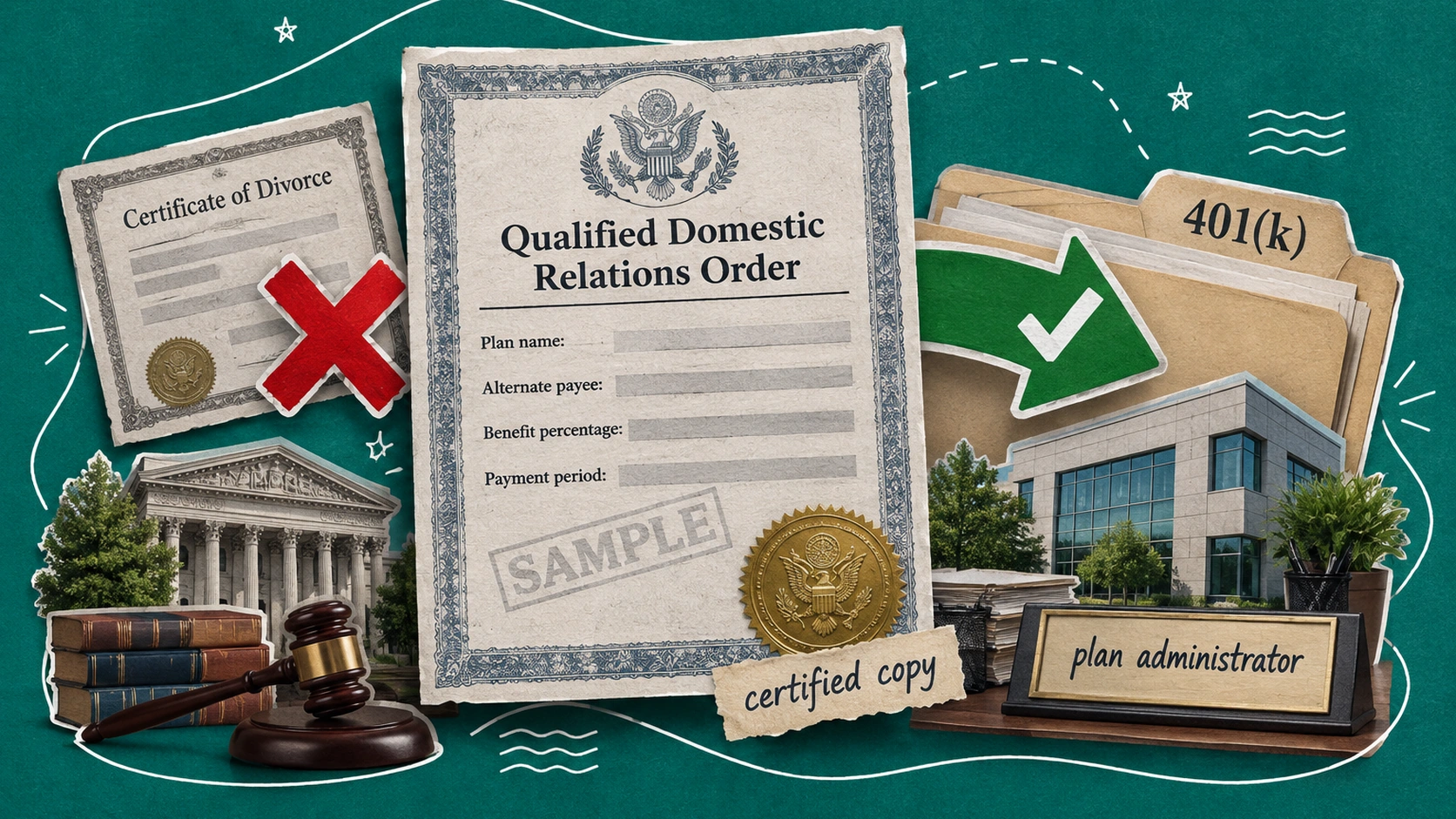
- the name and last known mailing address of the participant and each alternate payee, the alternate payee being the ex-spouse or other person who will receive a share;
- the name of each plan to which the order applies;
- the dollar amount or percentage of the benefit to be paid to the alternate payee, or the method of determining the amount or percentage;
- the number of payments or the time period to which the order applies.
That list is short enough to hold your own paperwork up against this afternoon. Pull out the decree. Does it name the plan, specifically, rather than referring to "the husband's retirement account"? Does it give an amount, a percentage, or a formula? Does it give an address for both people? Does it say over what period or how many payments?
If the answer to any of those is no, the order as written may not qualify, and the time to find that out is now rather than at retirement.
The Decree Can Be the QDRO. It Just Usually Is Not.
This is the point that resolves most of the confusion. The Department of Labor is explicit that a QDRO "may be included as part of a divorce decree or court-approved property settlement, or issued as a separate order, without affecting its 'qualified' status."
So the decree itself can do the job. The form does not matter. What matters is whether the content is there. A decree that happens to contain all four elements, phrased correctly for the plan, is a QDRO. A decree that says "Petitioner is awarded one-half of Respondent's retirement" is a decree that awarded something and specified almost nothing a plan administrator can act on.
The Judge Does Not Decide. The Plan Administrator Does.
Here is the fact that explains how a divorce can go badly wrong decades after it concluded.
A court can sign an order. It is the plan administrator who determines whether that order is a QDRO. On receiving a domestic relations order, the administrator must "promptly notify the affected participant and each alternate payee named in the order of the receipt of the order and to provide a copy of the plan's procedures for determining whether a domestic relations order is a QDRO," and then decide, within a reasonable period, whether it qualifies.
Two consequences follow, and both are harsh.
First, a judge's signature is not the end of the process. It is the beginning of a second review by a private administrator applying the plan's own procedures.
Second, and this is the trap: nothing tells the parties that the order was never qualified until someone tries to collect. If the order was never submitted to the plan, or was submitted and rejected, there is often no alarm. The divorce is final, the file is closed, the lawyer's engagement ended. The discovery happens twenty years later when the ex-spouse applies for a share of a benefit the plan has no record of owing.
Which Document the Plan Actually Wants
Now the records half, and this is where the answer differs from almost everything else on this site.
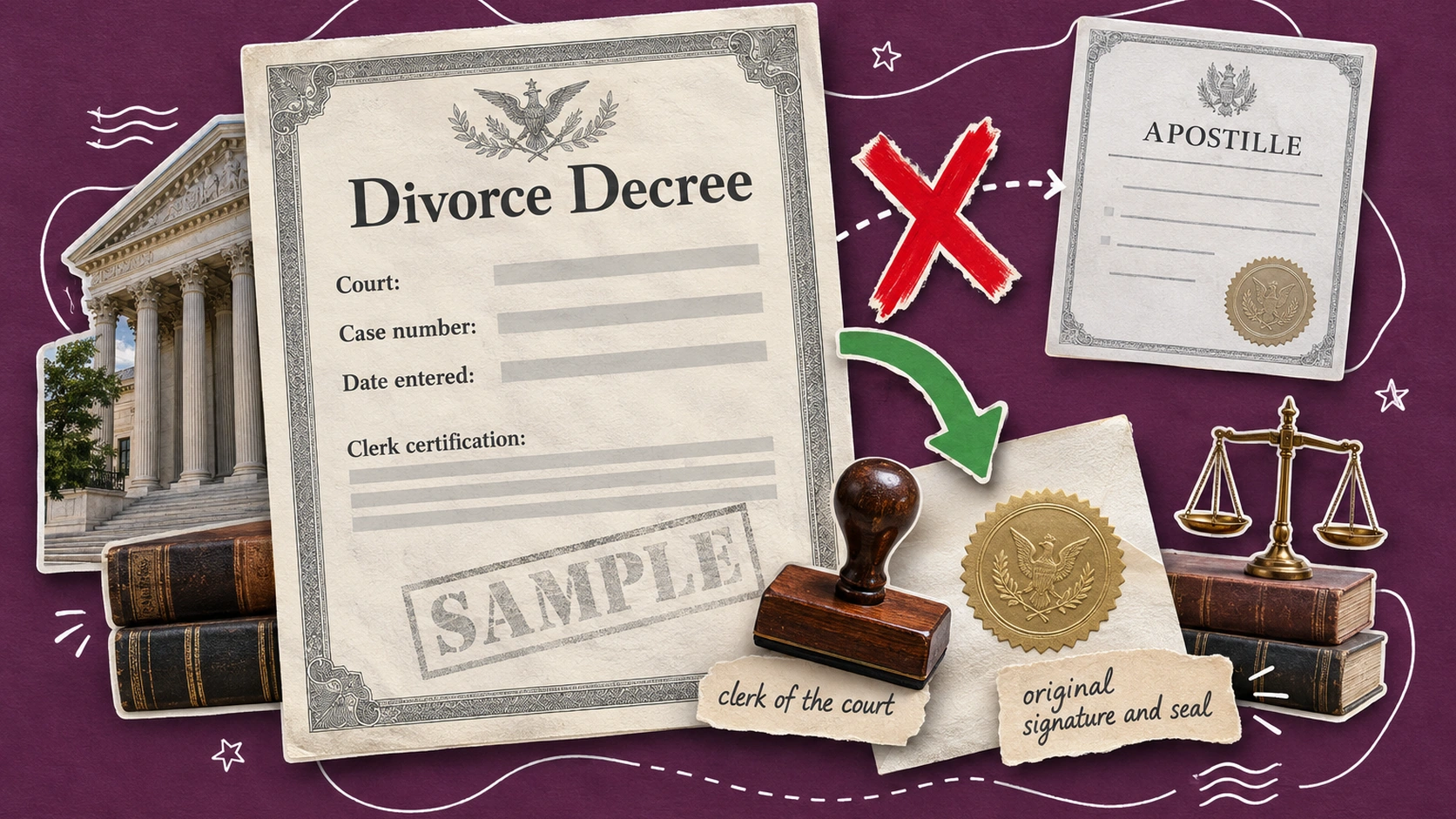
A retirement plan wants a certified or conformed copy of the signed order, obtained from the clerk of the court that entered it. Not a photocopy from the lawyer's file, not a scan, and not the version emailed during negotiations. The copy has to come from the court, bearing whatever the court uses to show it is a true copy of what was entered.
And the document that has no role at all in this transaction is the state-issued divorce certificate. A divorce certificate is a vital record: an abstract produced by a state health department confirming that a divorce occurred, carrying names, a date, a county, and a case number. It says nothing about retirement assets, because it is not derived from the terms of the judgment. It is the right document for proving that a marriage ended. It is the wrong document for dividing a pension, and no plan administrator will act on it. Our glossary entries on the divorce decree and court order set out the distinction.
Where the state certificate does help is upstream: if you cannot remember which court granted the divorce or in what year, the certificate carries the county and case number that let you ask the right clerk for the right file. Our step-by-step guide to getting a divorce certificate covers that, and a certified copy can be ordered from the state that recorded the divorce. Vital Records Online is a third-party service and not a government agency; it can help with the state-issued divorce record, and it cannot obtain a certified copy of a court order, which comes only from the clerk of the court that entered it.
What to Do If You Are Not Sure Where You Stand
- Find out whether an order was ever submitted to the plan. Contact the plan administrator, not the court and not your former spouse, and ask whether a domestic relations order relating to your marriage is on file and whether it was determined to be qualified.
- Request the plan's QDRO procedures. Administrators are required to have written procedures and to provide them. They tell you exactly what that plan wants, which can be more specific than the general requirements.
- Get a certified copy of the signed order from the clerk of court if one exists and the plan does not have it.
- Talk to a lawyer if the order is defective. Fixing a deficient order, or obtaining one years after the fact, is legal work. This article does not provide model language and deliberately so: drafting a QDRO is not a do-it-yourself task, and the cost of getting it wrong is the asset itself.
One note on sourcing. The Department of Labor's QDRO guidance is the authoritative federal explanation, but the edition we worked from carries no visible publication date and its most recent cited advisory opinion is from 2004. The four content elements and the administrator's role are long-standing statutory requirements, and we have deliberately left out several finer rules that circulate online about timing, survivor benefits, and which plans are covered by federal law at all, because those were not confirmed. Check the current edition on the Department's site, and ask the plan.
Frequently Asked Questions
Is a divorce decree enough to divide a 401(k)? Only if it contains the elements a qualified domestic relations order requires and the plan administrator determines that it qualifies. Many decrees do not.
What must a QDRO contain? The participant's and each alternate payee's name and last known mailing address, the name of each plan, the amount or percentage or the method of determining it, and the number of payments or time period covered.
Who decides whether an order qualifies? The plan administrator, applying the plan's written QDRO procedures, after the court has entered the order.
Can I use my state divorce certificate to claim a share of a pension? No. The state certificate confirms that a divorce occurred and says nothing about retirement assets. The plan needs a certified copy of the court order.
What about military retired pay? It is governed by a different statute and administered by DFAS. Nothing in this article applies to it; contact DFAS directly.