Your Apostille Is Valid and That Country Still Won't Take It: The Objection Rule
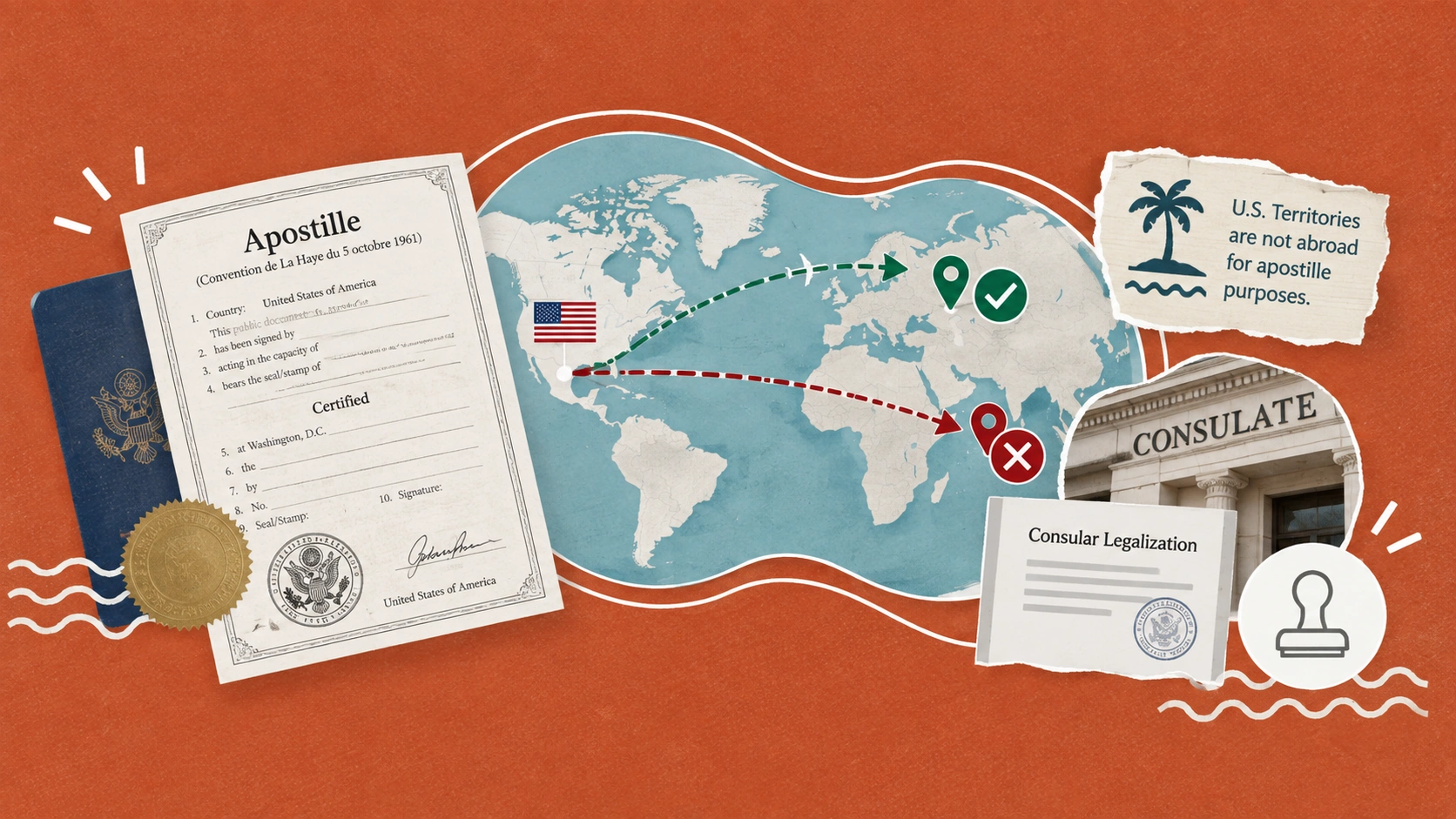
Most explanations of the Apostille Convention, including our own guide, describe it as a list: a country is in, and an apostille works there, or it is out, and you need consular legalization. That is true almost all of the time, and the exception is the single most expensive thing a reader can fail to know, because it is discovered after the certified copy has been ordered, the apostille paid for, and the document couriered overseas, and the answer at the other end is "we do not accept apostilles from your country."
This article is about that exception. It assumes you know what an apostille is; if not, read the guide above first, because nothing here repeats it.
Membership Is a Relationship, Not a Status
The 1961 Convention has a mechanism for letting new countries join, and a mechanism for existing members to say no. When a state accedes to the Convention, joins after the original signatories, the existing Contracting Parties have a window in which any of them may lodge an objection under Article 12. Where a state objects, the Convention does not enter into force between the acceding state and the objecting state. It enters into force between the acceding state and everyone else.
The consequence is that "Is country X in the Convention?" is not quite the right question. The right question is: "Is the Convention in force between country X and the country whose apostille I'm carrying?" For a U.S. document, that pair is the United States and the destination. For the overwhelming majority of pairs, the answer is yes and the distinction never surfaces. For a handful, it is no, and the apostille, perfectly valid, correctly issued, properly attached, is not recognized by the receiving authority. Consular legalization remains the only route for that pair.
A Live Example: Algeria, 2026
This is not a theoretical wrinkle. The Hague Conference's status table, which we read on September 21, 2026, records that Algeria acceded on 5 November 2025, with entry into force on 9 July 2026. Its accession is marked as one that gave rise to the objection procedure, and the notifications page for that accession lists three objections, each citing Article 12(2):
- Germany, 6 March 2026: "the Federal Republic of Germany raises an objection to the accession of the People's Democratic Republic of Algeria in accordance with Article 12 (2) of the Convention."
- Austria, 20 April 2026.
- Greece, 7 May 2026.
So as of July 2026, the Convention is in force between Algeria and the other Contracting Parties, but not between Algeria and Germany, Austria, or Greece. A German public document bound for Algeria, or an Algerian one bound for Greece, goes through consular legalization as if neither country had joined. The United States is not among the listed objectors, which is exactly the kind of fact you should confirm on the notifications page rather than take from this article, because objections can be lodged during the window and this page will not update itself.
Viet Nam is the other recent accession, in force since 11 September 2026; our article on Viet Nam's accession covers what that means for U.S. documents, and the same check applies to it.
How to Check the Pair
The authoritative source is the Hague Conference (HCCH), and the check takes a few minutes:
- Open the Apostille Convention status table and find the destination country's row. If it is not there, the Convention does not apply at all, and consular legalization is the route.
- Look at the row's type column. An accession marked with an asterisk (the table's notation for an accession that triggered the objection procedure) means the acceptance record should be read.
- Open that country's notifications page: linked from its row, and look for objections. If the United States is listed as objecting, or the destination objected to a U.S.-related accession, the apostille route is closed for that pair.
- Check the entry-into-force date. A country can be on the table months before the Convention is in force for it; an apostille presented before that date is presented to a country that is not yet bound.
Do not trust any list of "apostille countries", including this site's, as a substitute for the table. The status table is updated by the Conference as instruments are deposited and objections lodged; every other list is a copy that started going stale the day it was made. The table's own header carries a last-update date and a count of Contracting Parties (130 at its June 30, 2026 update), and that header is the thing to read first.
The Practical Order of Operations
For a destination you have not sent documents to before, the sequence is:
- Check the pair first, before ordering anything. Five minutes on the status table decides whether you are getting an apostille or starting a legalization chain, and the two require different things from the certified copy.
- Then order the certified copy from the issuing state or county, and if the destination requires legalization rather than an apostille, ask the destination's consulate what it wants before the copy is issued, because some consulates specify the issuing office.
- Then authenticate. An apostille from the state's competent authority for a Convention pair; the legalization chain: state authentication, then federal, then the destination's consulate, for a non-Convention pair. Our glossary entry on consular legalization gives the short version of that chain.
The failure mode this order prevents is the one in the title: an apostille obtained, paid for, and shipped to a country that will not honor it from the country that issued it.
The Mirror-Image Error: U.S. Territories
At the other end of the same misunderstanding is a document going the short distance: to Puerto Rico, Guam, the U.S. Virgin Islands, the Northern Mariana Islands, or American Samoa. People order apostilles for these because the destination feels foreign. It is not, for this purpose, and the apostille is the wrong product.
The California Secretary of State's FAQ answers the question directly: it does not issue apostilles for Puerto Rico, Guam, the U.S. Virgin Islands, the Northern Mariana Islands, American Samoa, "or any other American territories or possessions," because apostilles "can only be issued for documents to be used outside the United States of America." The same page notes that "Generally, the notarial act is sufficient for use in any American territory or possession." Other states' apostille offices apply the same rule, since it comes from the Convention rather than from state law; a certified copy from the issuing state is what a Puerto Rican agency will ask for, and a birth certificate issued in a territory is itself a U.S. vital record, not a foreign one.
One Apostille, Any Destination
A related point that older guidance gets wrong: some states, California among them, now issue "a single Apostille for documents to be used outside of the United States, regardless of the country of destination." There is no longer a separate "authentication certificate" product for non-Convention destinations in those states; the same certificate is issued, and the difference is what happens to it afterwards: nothing more for a Convention pair, the legalization chain for a non-Convention pair. If your state's apostille office asks which country the document is going to, answer accurately anyway; the office may use it to route the document or to warn you about a pair it knows to be closed.
If the pair checks out and you need a certified copy of a U.S. vital record apostilled, our apostille service handles the state-level authentication for birth, death, marriage, and divorce records. Vital Records Online is a third-party service and not a government agency; apostilles are issued by the state's competent authority, and whether the destination honors it is governed by the Convention's status between the two countries, which no service can change.
Frequently Asked Questions
Can a country in the Apostille Convention refuse my apostille? Yes, if the Convention is not in force between that country and the country that issued the apostille, which happens when one objected to the other's accession. Check the destination's notifications page on the HCCH status table.
Which countries have objected to Algeria joining the Apostille Convention? As recorded by HCCH on September 21, 2026: Germany (6 March 2026), Austria (20 April 2026), and Greece (7 May 2026). Check the notifications page for any later objections.
Does the United States accept apostilles from Algeria? The United States is not listed among the objectors on Algeria's HCCH notifications page as of the date above, which would mean the Convention is in force between the two. Confirm on the HCCH page before relying on it.
Do I need an apostille for Puerto Rico or Guam? No. Apostilles are only issued for documents used outside the United States, and the territories are inside it. A certified copy, and where relevant a notarization, is what the receiving office will ask for.
Where is the authoritative list of Apostille Convention countries? The HCCH status table for the 1961 Convention. Any other list, including ours, is a copy that may be out of date.