Leaving Prison Without a Birth Certificate
Someone leaves a correctional facility with a bus ticket, a release document, and no birth certificate. To get a job they need identification. To get identification they need a birth certificate. To get a birth certificate from most states they need identification. The loop closes, and it closes on people with no money and a deadline from a parole officer.
This article is about that loop: what one state has done to break it, what the Social Security side requires, and the federal rule that catches people who assume the document corrections handed them will work. Our general guidance for anyone without identification is on our support page for having no ID, and this article does not repeat it. This is the reentry-specific version, which has its own agencies and its own trap.
What One State Requires Before Release
Virginia legislated a direct answer, and it is worth reading closely because the structure is instructive even if you are elsewhere.
Under Va. Code § 53.1-31.4, before releasing a prisoner who has been confined for at least 90 days and who does not already have a government-issued identification card, birth certificate, or Social Security card, the Department of Corrections shall, working with the Department of Motor Vehicles, the State Registrar of Vital Records, and other relevant agencies, provide that person with a certified copy of his birth certificate, his Social Security card, or a government-issued identification card.
Three details inside that sentence matter.
It is "or," not "and." The obligation is satisfied by one of the three. Someone can be released holding a state ID card and still have no birth certificate.
The 90-day threshold excludes short stays, which is where a great many people cycle through.
And the duty is triggered by not already possessing the documents, so the system depends on that being accurately known at intake and before release.
The Fallback Document, and Its Expiry
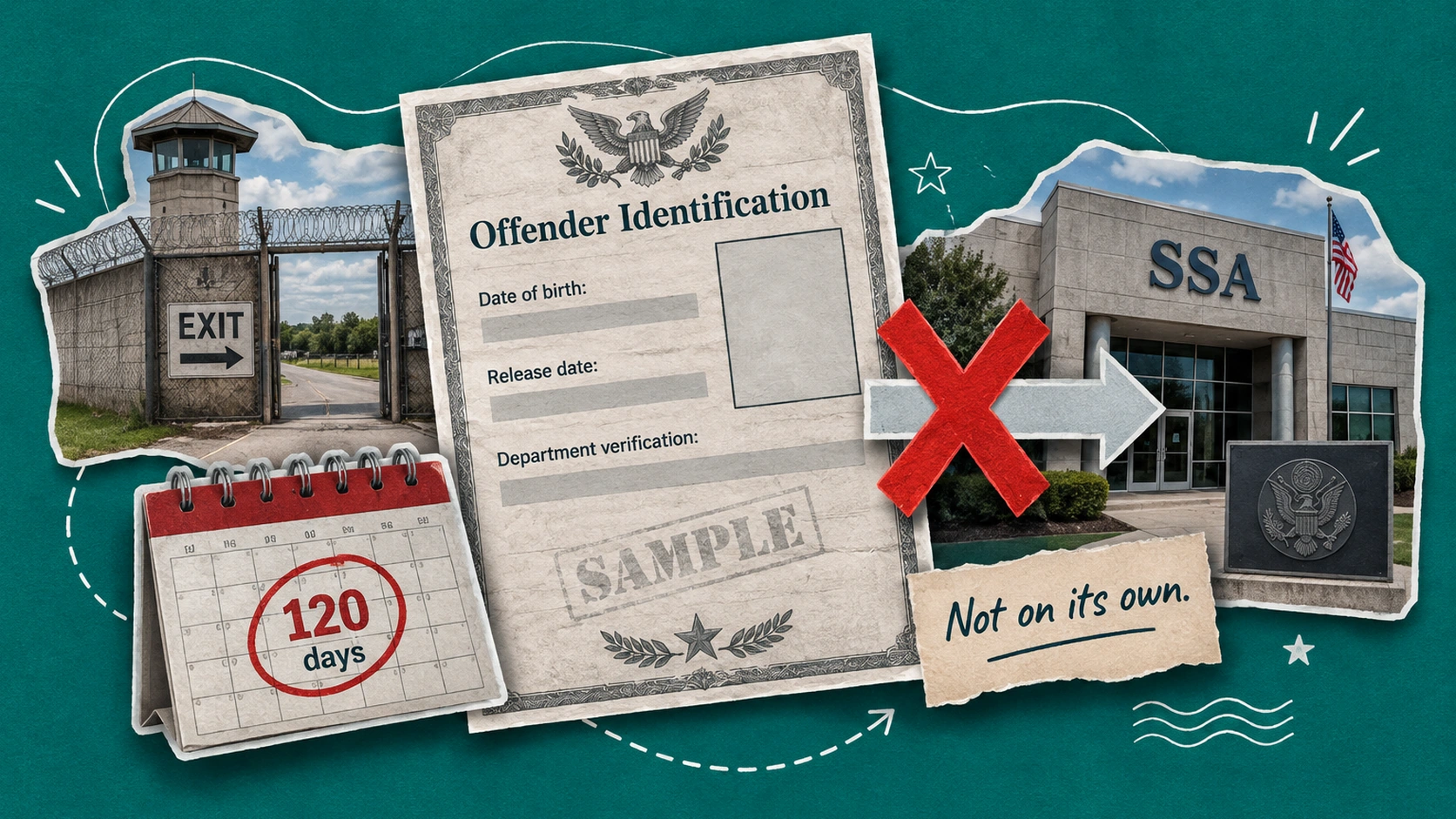
Where a government-issued ID card cannot be obtained, Virginia's Department of Corrections issues an Offender Identification form instead. The statute specifies its contents: a photograph, the person's full name, date of birth, the address of the facility where they resided at release, their release address, and, if available, citizenship or legal presence and Social Security number. The form is verified by the Department and transmitted to the DMV securely.
What it does: it serves as proof of identity and proof of Virginia residency, and may serve as proof of legal presence or of a Social Security number where that information is available, "for the 120 days immediately following the release or discharge."
So it is a bridge with an expiry date. One hundred and twenty days to convert a temporary form into permanent documents, starting on the day someone is released into circumstances that are rarely stable.
Two further provisions deserve attention. If the Department receives a birth certificate, Social Security card, or ID card after the person is released, it must forward it to them, which only works if the Department has a current address. And the statute is explicit that the Offender Identification form is not a REAL ID credential, which matters for domestic air travel and for federal building access.
Who Pays
This is the part most summaries leave out, and it is the part that decides outcomes.
Virginia's statute: "Unless the prisoner is determined to be indigent pursuant to § 19.2-159, all costs and fees associated with applying for and obtaining any identification or documents pursuant to this section shall be paid by the prisoner."
The state created the obligation and left the bill with the person least able to pay it, unless they are formally determined to be indigent. If you are preparing for someone's release, the indigency determination is the thing to ask about early, because it governs whether the documents arrive or the process stalls at the fee.
Separately, some states require registrars to waive fees entirely for defined populations. Those are statutory waivers triggered by an attestation rather than programs you apply to, and our guide to fee waivers covers how they work. It is worth asking the state registrar whether any apply.
The Social Security Side Starts Before Release
The Social Security Administration runs prerelease agreements with correctional facilities. In SSA's description, these "provide additional time for individuals to apply for benefits and/or a replacement social security card prior to their expected release from a facility."
The operative phrase is prior to. The entire value of a prerelease agreement is that the application starts while the person is still inside, so the card or the benefit determination is moving before they walk out. After release, the same person joins an ordinary queue with no identification.
So the instruction for anyone with a release date approaching is to ask the facility whether it has a prerelease agreement with SSA and to begin the process through it. Where previously suspended benefits need to be restarted, SSA instructs people to bring their official prison release documents to the appointment as proof of release.
The Rule Nobody Mentions, and It Is the Important One
Here is where the systems collide.
SSA publishes a list of documents it will not accept as evidence of identity for a Social Security card. On that list: "Prison and parole documents unless received directly from the prison under a formal MOU enumeration agreement." Also on it: "Any document that is completed by the applicant."
Read that against the Virginia statute. A state law says the Offender Identification form serves as proof of identity for 120 days. SSA's own manual says prison documents are not evidence of identity unless they reach SSA directly from the facility under a formal memorandum of understanding. Both are correct, because they are answering different questions: the state form works for the state DMV, and SSA applies its own evidentiary rules for its own card.
The practical consequence is blunt. Do not walk into a Social Security field office expecting a prison-issued ID to work on its own. Ask the facility, before release, whether it has an enumeration MOU with SSA, because that is what determines whether the document travels usefully.
One qualification, in SSA's favor and worth knowing: its manual notes that a document on the not-acceptable list may still be useful to support a secondary or approved third-level identity document. It is not worthless. It is just not sufficient alone.
What Generalizes, and What Does Not
We verified one state's statute and the federal rules. We are not going to publish a fifty-state survey of reentry document laws, because we did not verify a second state and the one comprehensive survey we located is not a government source.
What travels anywhere:
- Ask the corrections department what it is obligated to provide, and whether that obligation is triggered in this case. Several states have enacted something; the terms differ.
- Ask about the indigency determination before the fee becomes the obstacle.
- Ask whether the facility has an SSA prerelease agreement, and start that process inside.
- Ask the state registrar of the birth state, which may not be the state of incarceration, what it accepts as identification from someone recently released. Registrars have alternative-evidence procedures, and the answer is sometimes more flexible than the published list suggests.
Rights restoration, expungement, voting eligibility, and employment law are all outside this article and all require a lawyer or a reentry organization rather than a records service.
If you are already out, have identification, and need a certified copy of a birth record from a state you no longer live in, it can be ordered from the state that holds it. Vital Records Online is a third-party service and not a government agency; certificates are issued by the state's vital records office, which sets its own eligibility and identification rules, and a paid service cannot substitute for the free routes described above. Our support page on replacing a Social Security card and our guide to a replacement card cover that side.
Frequently Asked Questions
Does the prison have to give me a birth certificate before release? It depends on the state. Virginia requires its Department of Corrections to provide a certified birth certificate, a Social Security card, or a government-issued ID to a prisoner confined at least 90 days who has none of them. Other states differ.
Who pays for the documents? Under Virginia's statute, the prisoner pays, unless determined to be indigent under a separate code section. Ask about the indigency determination early.
Will Social Security accept my prison ID? Not on its own. SSA's manual excludes prison and parole documents as evidence of identity unless received directly from the prison under a formal MOU. It may still support another identity document.
What is a prerelease agreement? An arrangement between SSA and a facility that lets someone apply for a replacement card or for benefits before release rather than after it.
Is the Department of Corrections ID a REAL ID? No. Virginia's statute states that the government-issued identification card referred to does not include a REAL ID credential.