Your Passport Was Lost or Stolen Overseas: What the Embassy Actually Needs From You
Your bag is gone, or the hotel safe is empty, or the passport simply is not where you put it. You are in another country and the document that gets you home is missing. The U.S. Department of State has a process for exactly this, it works, and it works fastest for the travelers who can show who they are.
This article walks through what State's own lost-or-stolen-abroad guidance says the consulate needs from you, what it will do for you if you have nothing, and what the replacement document you receive can and cannot do. It is not the general passport checklist; what you need for a passport covers that; and it does not cover losing documents at home, which what to do if you lost all your IDs handles. Nor does it quote passport fees; they apply, they change, and the State Department is the place to read them.
Step One: Report It
Report the loss or theft to the State Department as soon as you know the passport is gone. State says that when you report online, it cancels the passport within one business day, and that after you report it lost or stolen, the passport is no longer valid for international travel.
That second sentence cuts both ways. Once reported, the passport cannot be used by whoever has it, but it also cannot be used by you if it turns up in the lining of the suitcase tomorrow. Report when you are reasonably sure, not on the first moment of panic.
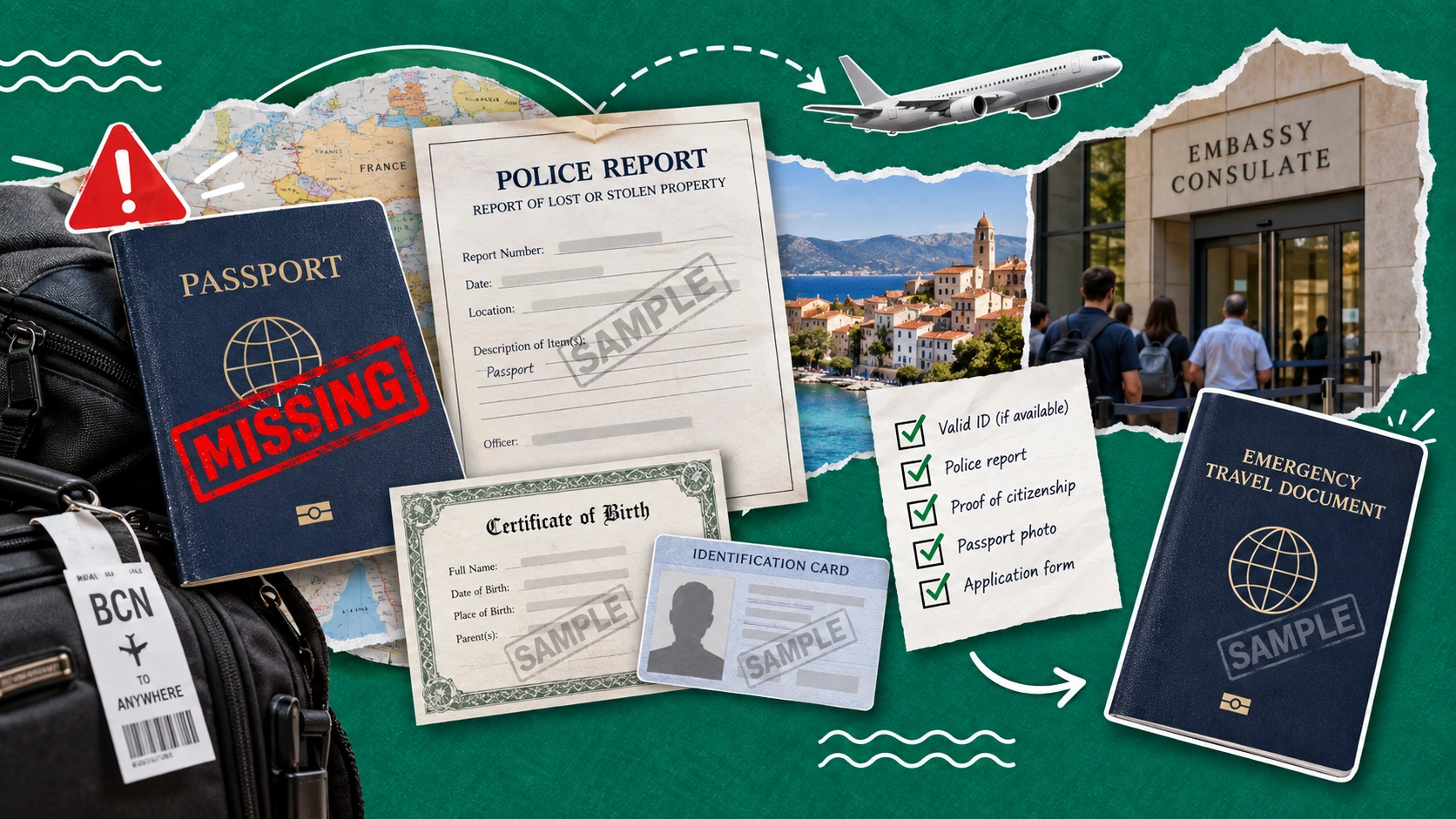
A police report is worth getting. State says police reports "are not mandatory but can help confirm the circumstances of the loss or theft." If you were robbed, the report also matters for the relief described further down.
Step Two: Go In Person
You must appear in person at a U.S. embassy or consulate. There is no mail-in or online route for a replacement abroad. State lists what to bring.
- A passport photo, 2 by 2 inches.
- Identification: State's examples are a driver's license or an expired passport.
- Proof of U.S. citizenship: State's examples are a birth certificate or a photocopy of the missing passport.
- Your travel itinerary, so the consulate knows how soon you need to move.
- Form DS-11, the standard passport application, completed.
- The applicable fees.
A note on the form, because it trips people up. DS-11 is the application you use abroad. Form DS-64, the lost-or-stolen statement, is not the primary form in this process: State says that if you do not provide all the required information on the DS-11, it "may pause your application and ask you to submit Form DS-64." Fill the DS-11 completely and the DS-64 may never come up.
The Birth Certificate Line
Look again at the third item. State explicitly names a birth certificate as proof of citizenship at the consular counter. A photocopy of the missing passport works too and this is why every travel-preparation guide tells you to photograph your passport, but a photocopy of a passport you no longer have is only useful if you made it before the trip.
The travelers who get through this process fastest are the ones who can put a citizenship document on the counter, and in practice that means one of three people:
- The traveler who packed a certified copy of their birth certificate separately from the passport.
- The traveler who left a certified copy with someone at home who can scan or courier it.
- The traveler who can have a certified copy sent from the issuing state to wherever they are.
The third option exists but is slow, and slow is the problem when your flight is in four days. The first two are decisions you make before you leave.
If You Have Nothing: The Free File Search
This is the fact almost nobody knows. If you cannot present proof of citizenship, State says it can perform a free file search, checking its own passport records to confirm that a passport was issued to you. For the traveler standing at the counter with no birth certificate, no photocopy and no ID, this is the actual answer. Passports are records, and the government that issued yours has a copy of the file.
State pairs this with two other relief paths. If you cannot pay, the consulate can look at emergency financial assistance. And if you are the victim of a serious crime or a disaster, you may be eligible for a limited-validity emergency passport at no charge, with the regular fee still applying later to a full-validity replacement.
The sentence from State's page worth carrying into the consulate: "Even if you cannot present all these documents, consular staff will do their best to help you get a new passport quickly."
The Emergency Passport and Its One-Year Ceiling
When time is short, the consular section can issue an emergency passport. State says this passport "may be valid for up to 1 year." It gets you home, or on to the next stop, and it can be exchanged for a full-validity passport once the trip is over.
The ceiling surprises people later. An emergency passport issued in September does not cover a trip the following autumn, and some countries apply their own validity rules to any passport presented at the border. Treat the emergency document as what it is, a bridge, and apply for the full-validity replacement when you are home. Our U.S. passport glossary entry describes the standard document.
What Varies, and What We Cannot Tell You
Individual embassies and consulates set their own appointment systems, hours and local procedures, and those vary by post. We have not verified any of them and this article does not describe them. Find the specific post's website through the State Department and follow its instructions; the general process above is the framework every post works within.
Before Your Next Trip
Everything in the emergency section is faster for the traveler who did three things in advance.
- Photograph the passport's data page and store the image somewhere reachable without the phone in your pocket.
- Carry a second form of identification separately from the passport.
- Hold a certified copy of your birth certificate: packed separately, or left with someone at home who can send it.
If you do not have a certified copy of your birth certificate to leave at home or pack for the trip, you can order one from the state that issued it before you travel. Vital Records Online is a third-party service and not a government agency; passports are issued only by the U.S. Department of State, and our passport services page explains what we can and cannot help with. The State Department's own lost or stolen passport abroad page is the authoritative source for the process above.
Frequently Asked Questions
What do I do first if my passport is lost or stolen abroad? Report it to the State Department, which cancels the passport within one business day of an online report, then contact the nearest U.S. embassy or consulate to appear in person.
What does the embassy need from me? A 2x2 passport photo, identification, proof of U.S. citizenship such as a birth certificate or a photocopy of the missing passport, your itinerary, a completed Form DS-11, and the applicable fees.
What if I have no proof of citizenship at all? The State Department can perform a free file search of its passport records to confirm a passport was issued to you. Consular staff will work with what you have.
How long is an emergency passport valid? Up to one year. It can be exchanged for a full-validity passport after your trip.
Do I need a police report? It is not mandatory, but State says it can help confirm the circumstances, and it matters if you are seeking crime-victim relief.