Apostilling an International Adoption Dossier: What Goes in It and Why It Costs Less Than You Think
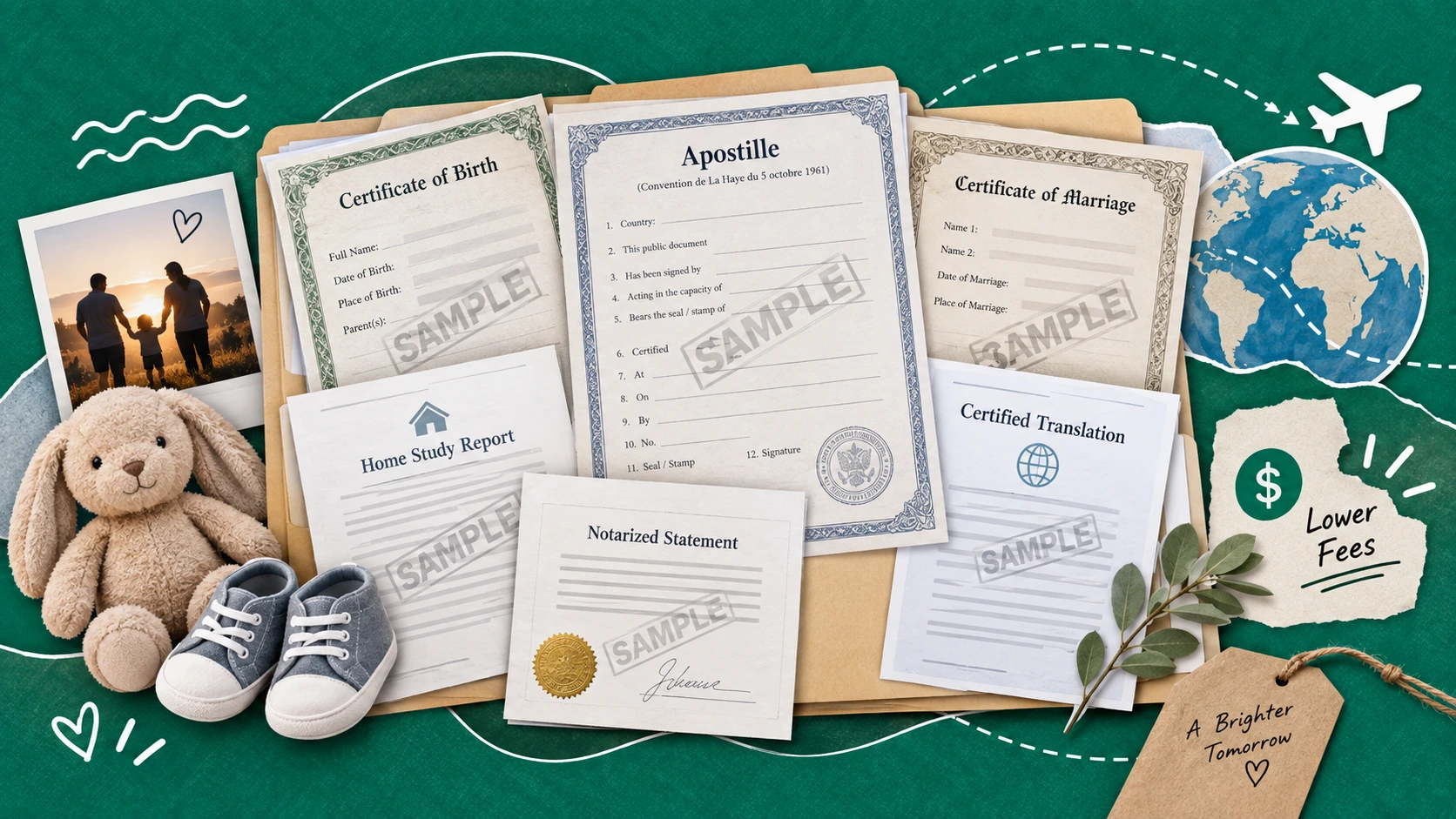
An international adoption dossier is the thickest stack of paper most families will ever assemble: birth certificates, a marriage certificate, a home study, financial and employment letters, medical statements, police clearances, powers of attorney, and a translation of nearly all of it. The foreign authority wants every page authenticated. The thing almost no one tells you is that the documents in that stack do not all take the same road to the apostille desk, and at least one state charges less for the whole dossier than you would expect.
This article is about the dossier itself: how the documents sort, what each kind needs before it can be apostilled, and where dossiers get rejected after the fee is already paid. It ends at the airport. What happens after the child arrives, including the U.S. birth record and the citizenship-evidence question, is a different subject with its own guide: the Certificate of Foreign Birth for an internationally adopted child. And it does not re-explain what an apostille is; our apostille guide does that.
We verified the specifics below against the Texas Secretary of State, which handles adoption apostilles as a separate category. Everything that follows is Texas. Other states set their own fees and forms, and most have no adoption discount at all.
The Two Piles: Recordable and Non-Recordable
Before anything else, sort the dossier into two piles. Texas draws the line between documents issued by a public official and documents created by private people, and that line decides what each document needs.
Recordable Documents
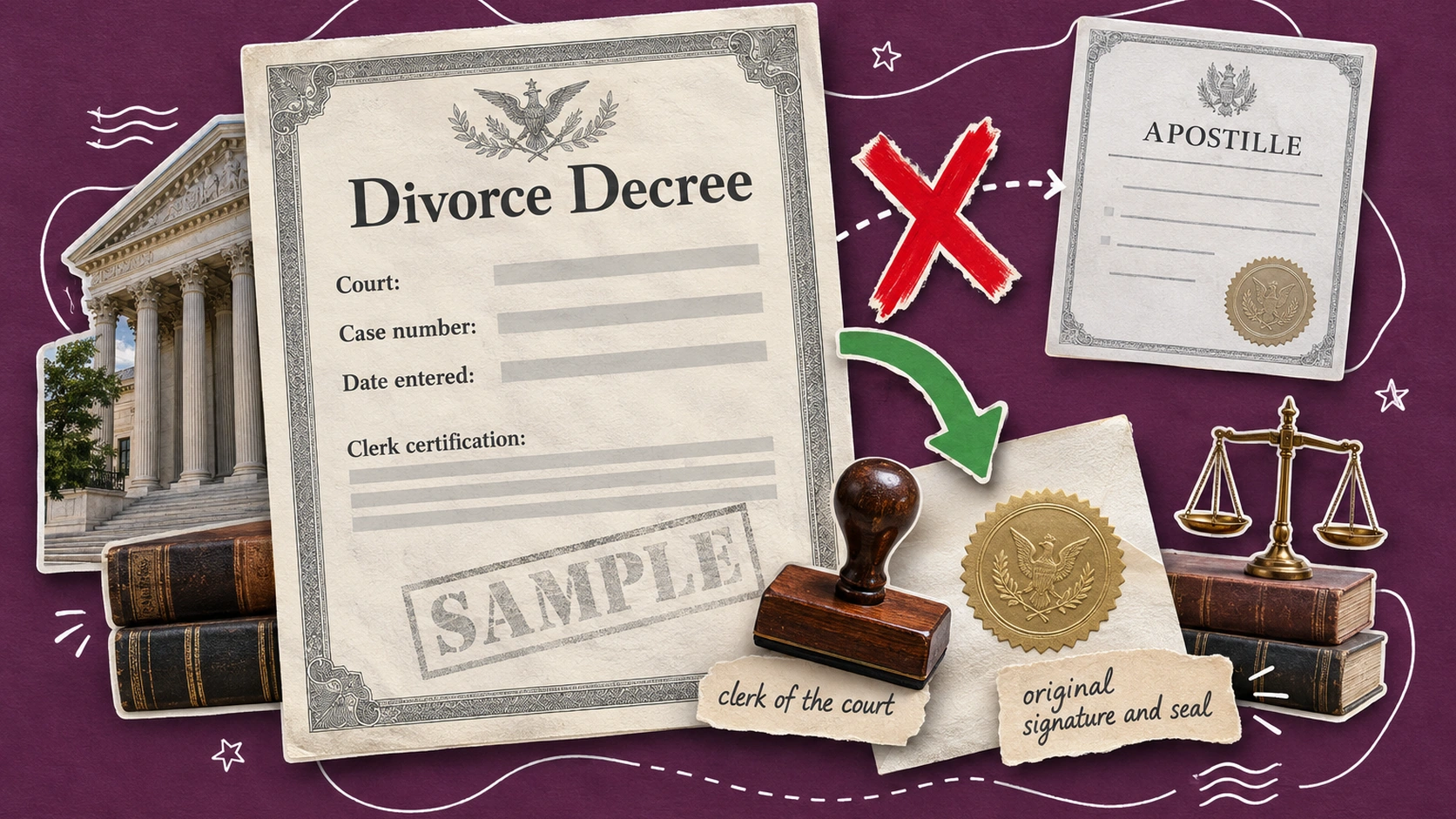
These are documents issued and signed by a state or county official: birth certificates, marriage licenses and certificates, divorce decrees. The apostille authority verifies the issuing official's signature against its files. Two consequences follow.
- A notary cannot stand in for the issuing office. Texas is explicit that recordable documents cannot be notarized by a notary public as a substitute. A notarized photocopy of a birth certificate is not apostillable.
- The copy has to be fresh enough to verify. Texas will not apostille a certified record issued more than five years ago. If the birth certificate in your file is older than that, a new certified copy is the first thing to order. Our article on the certified-copy recency rule explains why.
For a dossier, the recordable pile is usually short: each parent's birth certificate, the marriage certificate, and any divorce decree from a prior marriage.
Non-Recordable Documents
Everything else is non-recordable: the home-study letter, employment and financial affidavits, medical statements, powers of attorney, personal references, and the translations. Nobody at a records office signed these, so there is no issuing signature to verify. Instead, the apostille authority verifies the notary.
- Each one must be properly notarized by a notary commissioned in the state doing the apostille. In Texas that means a Texas notary.
- Translations get their own notarization. Texas requires a notarized translator statement, together with the original or a copy of the document that was translated. The translation and the translator's sworn statement travel as a set.
The practical split, then: recordable documents need a fresh certified copy from a records office; non-recordable documents need a notary appointment. A dossier usually needs both, in that order, because the notary appointments can happen this week and the certified copies cannot.
The Per-Child Fee Cap
This is the fact that makes the article worth reading. Texas charges $15 per document for a standard apostille. For documents in an adoption matter, the fee drops to $10 per document, and the office states in two places that "total fees may not exceed $100.00 for the adoption of each child."
On a dossier of fifteen to twenty documents, the cap is the difference between what a family expects to pay and what the state actually charges. The cap is per child, so a family adopting siblings has a separate ceiling for each.
Two conditions attach.
- Form 2103 is mandatory. Texas requires its adoption apostille form for every document apostilled in an adoption matter. Sending the dossier with the standard request form gets the standard rate.
- The discount is Texas's. We did not verify any other state's adoption rate, and the brief we worked from notes that most states have none. Do not assume a $10 rate or a $100 cap anywhere else. Check your state's authentication office.
Two Ways a Dossier Gets Bounced
Both of these are stated on the Texas page, and both catch families after time and money are already spent.
"Notario Publico"
Texas rejects outright any document using the term "Notario Publico." In much of Latin America a notario is a trained legal professional, and foreign authorities and translators sometimes render the U.S. notary's title that way. A U.S. notary public is not that, and Texas will not apostille a document that implies otherwise. Check the translator's statement and the notarial certificate wording before submitting.
Remote Online Notarization
Texas accepts remote online notarization, and the office will apostille a RON document. The trap is the destination: Texas warns that "some countries reject RON documents." The apostille goes on, the fee is paid, the dossier ships, and the foreign authority refuses the notarization underneath it.
This is the most modern and least-documented way an adoption dossier fails. Ask your agency, or the receiving country's central authority, whether it accepts remotely notarized documents before booking an online notary for the home-study letter and the affidavits. If there is any doubt, an in-person notarization avoids the question.
Hague, Non-Hague, and the Universal Certificate
Texas now issues a single universal certificate that serves as both an apostille and an authentication, so at the state level the destination country no longer changes the product. If the receiving country is not a party to the Apostille Convention, an additional federal step at the U.S. Department of State follows the state step. Our apostille guide covers that routing; we did not re-verify the federal office's current fees or times for this article, so we are not quoting them.
Sequencing the Dossier
- Order the certified copies first. Birth and marriage certificates come from the state or county that issued them, on that office's timeline. Check the issue date of any copy you already hold against your state's recency rule.
- Book notary appointments for the non-recordable pile while the certified copies are in transit, confirming in-person versus RON with your agency first.
- Have translations done and the translator's statement notarized once the underlying documents are final.
- Submit the whole dossier together with the adoption form, so the per-child cap is applied to a single request.
- Add the federal step only if the destination requires it.
If a birth or marriage certificate in your dossier needs a fresh certified copy, you can order one from the issuing state, and our apostille services can carry the recordable pile through authentication once it arrives. Vital Records Online is a third-party service and not a government agency; apostilles are issued only by the competent government authority, and you can submit to that office directly. Our FAQ on when a birth certificate needs to be translated covers the translation layer, and our certificate of foreign birth entry covers the record your child may receive after the adoption is final.
Frequently Asked Questions
Which documents in an adoption dossier need a certified copy rather than a notary? Documents issued by a public official, such as birth certificates, marriage certificates and divorce decrees, need a certified copy from the issuing office. A notary cannot substitute for that. Privately created documents like home studies and affidavits are notarized instead.
Is there a discount for adoption apostilles? In Texas, yes: $10 per document instead of $15, with total fees capped at $100 per child, and Form 2103 is required. Other states set their own fees, and most have no adoption rate.
Can I use an online notary for the home study and affidavits? Texas accepts remote online notarization, but warns that some countries reject RON documents. Confirm with your agency or the receiving country before using one.
Why was my document rejected for saying "Notario Publico"? Texas rejects documents using that term because it implies a legal role a U.S. notary public does not hold. Check the wording of notarial certificates and translations.
What about the child's U.S. birth certificate and citizenship documents? That is a separate process that begins after the child arrives. See our guide to the Certificate of Foreign Birth.