Proof of Citizenship to Vote in the 2026 Midterms: Which Documents Count
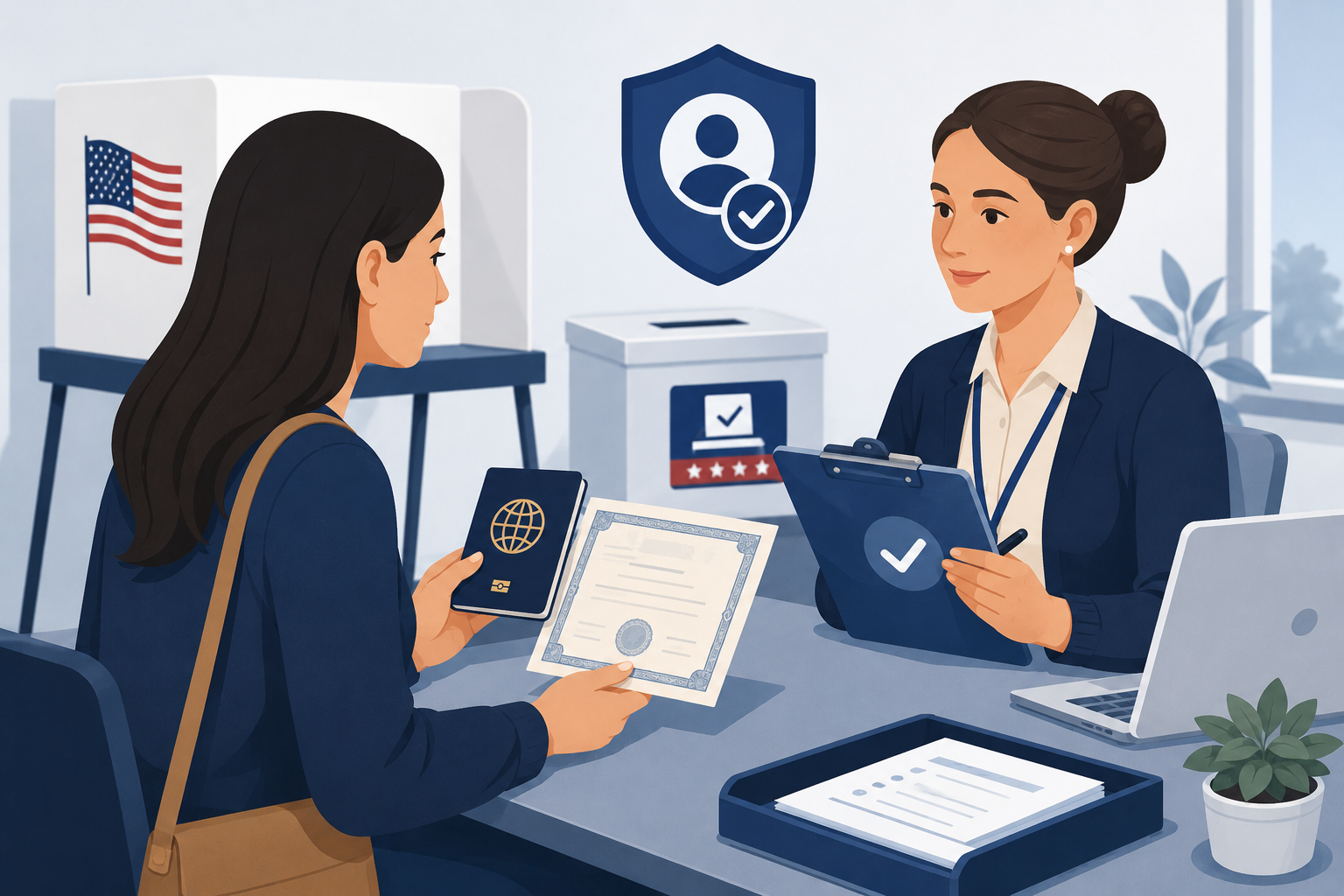
If your state asks for documentary proof of citizenship when you register, the documents that typically qualify are a U.S. passport or passport card, a certified U.S. birth certificate, or a Certificate of Naturalization or Citizenship, and a REAL ID or standard driver’s license alone generally does not prove citizenship. Rules differ from state to state, and several are being litigated, so the single most useful thing you can do before the 2026 midterms is confirm your own state’s current requirements and make sure you can access the right paperwork.
This is a fast-changing area of law. The overview below reflects the situation as of July 21, 2026, and is offered for general information only. Always verify the details with your official state or local election office and with vote.gov.
Where the Federal SAVE Act Stands
Much of the national conversation centers on the Safeguard American Voter Eligibility (SAVE) Act, introduced as H.R.22. Here is what is verified as of this writing:
- Passed the House, not yet law: The SAVE Act passed the U.S. House of Representatives in February 2026 but has not become federal law.
- A scaled-back version is being weighed: A narrower, incentive-based approach is under consideration through the budget reconciliation process rather than as a stand-alone mandate.
- Funding, not a requirement: The House’s July 15, 2026 budget resolution set aside $10 billion to help states that choose to adopt documentary proof of citizenship or photo voter ID. Under that framework, no state would be required to adopt those measures.
You can track the bill’s official status on Congress.gov (H.R.22), and read a nonpartisan explainer at FactCheck.org.
Which States Require Documentary Proof of Citizenship
Separate from the federal debate, about 14 states have enacted proof-of-citizenship-type laws. The practical effect for the 2026 midterms varies:
- States set to enforce a requirement: Among states requiring documentary proof of citizenship from all voters, several, including New Hampshire, Wyoming, South Dakota, Ohio, and Utah, were positioned to enforce such requirements for the 2026 midterms.
- States that had not implemented theirs: Florida and Louisiana had enacted measures but had not yet put them into effect.
- An important update from the courts: In May 2026, a federal judge struck down New Hampshire’s law and ordered the state to stop enforcing it. Litigation in this area is ongoing, so requirements can change with little notice.
Because a law can be enacted, paused, enforced, or struck down, the status listed above may already have shifted by the time you register. Treat your official state election office as the authoritative source. The U.S. Election Assistance Commission also maintains registration resources.
Which Documents Count as Proof of Citizenship
Where a state does require documentary proof of citizenship to register, the following documents are commonly accepted:
- U.S. passport or U.S. passport card: A current passport book or card is widely recognized proof of citizenship.
- Certified U.S. birth certificate: An official certified copy issued by a state or local vital records office, not a hospital souvenir certificate or an uncertified photocopy.
- Certificate of Naturalization or Certificate of Citizenship: The federal document issued to citizens who were naturalized or acquired citizenship.
A note on REAL ID: A REAL ID-compliant driver’s license or a standard driver’s license, on its own, generally does not establish U.S. citizenship, because these credentials are also issued to lawful noncitizens. If you want to understand that distinction more fully, see our guide linked below.
What Voters Should Do Before the 2026 Midterms
- Confirm your state’s current rules: Check your official state or local election office and vote.gov for the requirements that apply to you.
- Locate an accepted document: Make sure you can access a valid passport, a certified birth certificate, or a naturalization/citizenship certificate if your state requires documentary proof.
- Request replacements early: If your certified birth certificate is missing or your passport is expired, start the replacement process well ahead of any deadline, since processing takes time.
- Register or update on time: Register, or update an existing registration, before your state’s deadline so any document review can be completed.
A Note on Government Services Versus VRO’s Help
Registering to vote and confirming election rules are handled exclusively by your government election officials; there is no cost to register, and vote.gov can point you to the right office. Vital Records Online is a third-party service and is not a government agency and does not register voters or issue any document. What we can do is help you complete and submit an application to obtain a certified copy of a document you may need, such as a certified birth certificate. Certified records are issued only by the relevant government vital records office; using an assistance service is always optional, and you may apply directly with the issuing agency on your own.
Frequently Asked Questions
Is the SAVE Act now federal law?
No. As of July 21, 2026, the SAVE Act (H.R.22) passed the U.S. House in February 2026 but has not become law. A scaled-back, incentive-based version is being weighed through budget reconciliation, and the House’s July 15, 2026 budget resolution set aside $10 billion to fund states that choose to adopt documentary proof of citizenship or photo voter ID, without requiring any state to do so.
Does a REAL ID prove citizenship for voter registration?
Generally no. A REAL ID or standard driver’s license alone does not establish U.S. citizenship, because those credentials are also issued to lawful noncitizens. Documents that typically qualify include a U.S. passport, a certified U.S. birth certificate, or a Certificate of Naturalization or Citizenship.
Which states require documentary proof of citizenship for the 2026 midterms?
About 14 states have enacted proof-of-citizenship-type laws. Several, including Wyoming, South Dakota, Ohio, and Utah, were set to enforce requirements for the 2026 midterms, while Florida and Louisiana had not yet implemented theirs. A federal judge struck down New Hampshire’s law in May 2026. Because litigation is ongoing, confirm your state’s current status with your election office.
What if I can’t find my birth certificate?
Request a certified copy from the vital records office in the state where you were born, and do so early because processing takes time. You can apply directly with that office, or use an optional assistance service such as Vital Records Online to help prepare and submit your application.
Related Guides
- Does a REAL ID Prove Citizenship?: why a driver’s license alone usually isn’t enough
- Voter ID Requirements by State: a state-by-state look at identification rules
- How to Register to Vote in 2026: step-by-step registration basics
- Florida and the SAVE Act in 2026: documents to have on hand in Florida
Confirm your state’s rules at your official election office and vote.gov, make a plan to vote, and if you need a certified copy of your birth certificate to prove citizenship, start your birth certificate application with Vital Records Online.