Nothing Can Happen Until the Death Is Registered: The Permit Behind Every Burial and Cremation
In the first days after a death, families ask the funeral director a question that sounds simple: "Why can't you do anything yet?" The answer is a document most people have never heard of, sitting between the death certificate and the funeral. No burial, cremation, or transport out of state can lawfully happen until the death has been registered and a permit has been issued on the strength of that registration. Understanding that sequence explains most of the waiting, and it tells you who to ask when the waiting goes on too long.
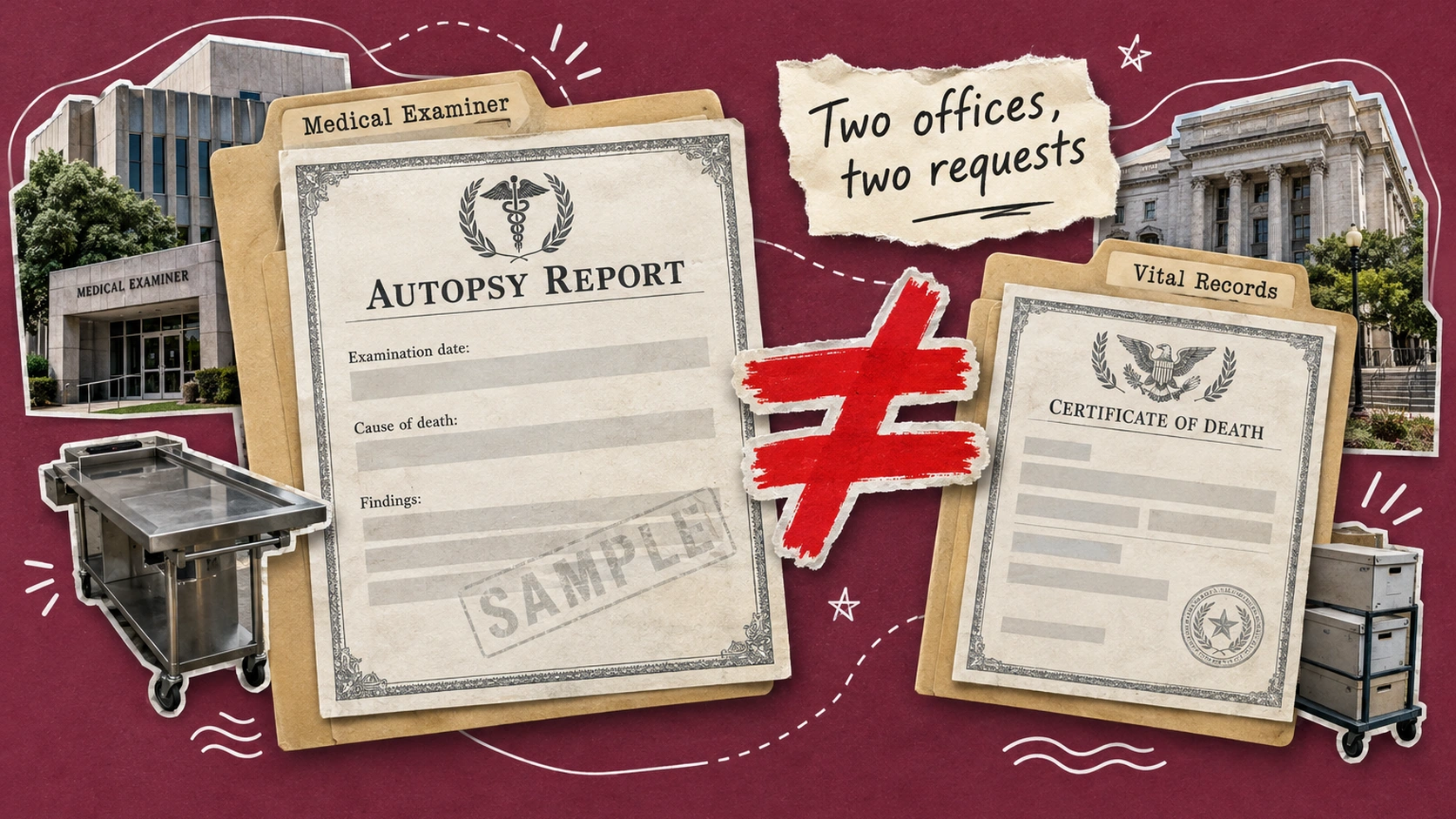
This article is about that sequence. It is not about how long it takes to order certified copies once the record exists; that has its own guide; and it is not the checklist of what to do after a death. It is the part that comes before both.
Three Documents, in Order
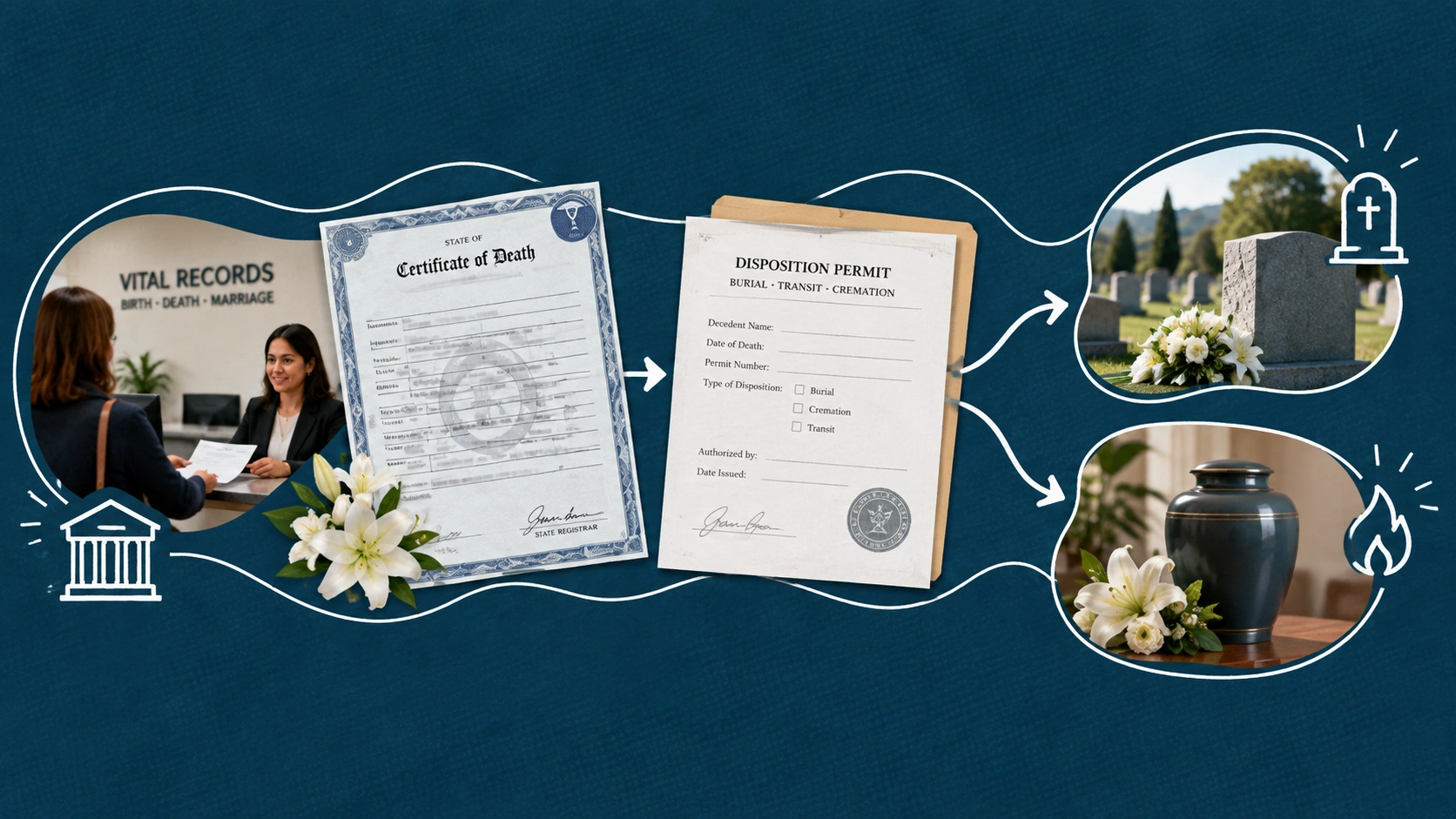
Three separate things happen, and they happen in this order everywhere in the United States, even though the names and the clocks vary by state:
- 1. The death is registered. The funeral director (or whoever is legally acting as such) gathers the personal details, the medical certifier, who is the attending physician, medical examiner, or coroner depending on the circumstances, completes the cause and manner of death, and the completed certificate is filed with the registrar of the district where the death occurred. Almost everywhere this now happens electronically.
- 2. An authorization to dispose is issued. Once the registrar has the certificate (or, in some states, a preliminary report), the registrar issues a permit, called a disposition permit, burial permit, or burial-transit permit depending on the state, that authorizes burial, cremation, entombment, or removal from the state. Our glossary entry on burial permits gives the short definition.
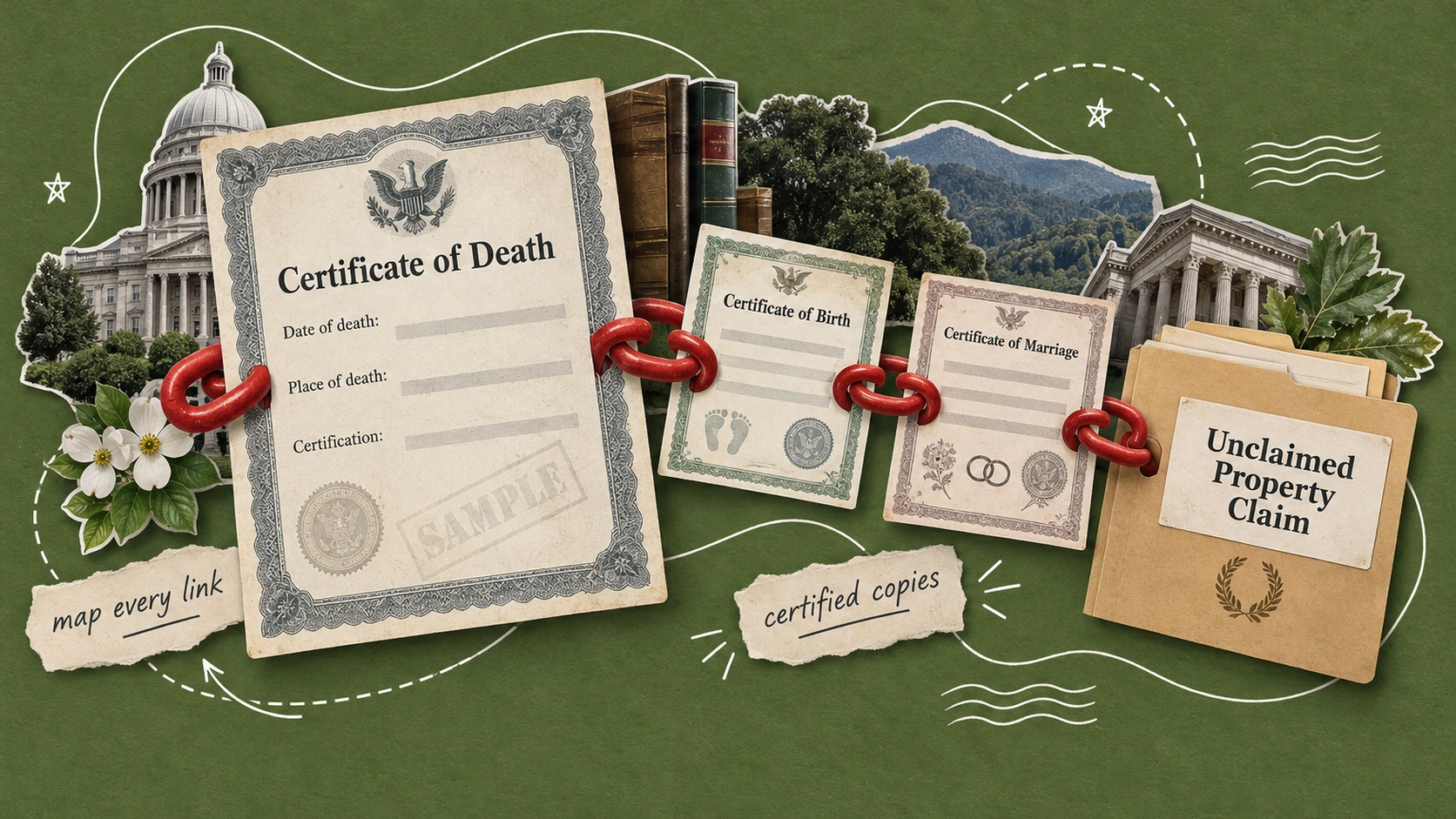
- 3. Certified copies are issued. The certified copies that banks, insurers, pension administrators, and the Social Security Administration will ask for come from the registered record, and only after it is registered.
The consequence families find confusing is that the funeral can go ahead while they still have no certified copies. That is not a mistake. Step two needs step one; step three needs step one; but step two does not need step three. The funeral home is working from the permit, and the copies are a separate, later transaction.
New York: Registration Gates Everything
New York is a state where disposition waits for full registration, and it said so to every licensed funeral director in a letter from the Department of Health's Bureau of Funeral Directing dated February 10, 2026 (BFD 26-01), which we read in full.
The clock, quoting Public Health Law §4140(1): the death "shall be registered immediately and not later than seventy-two hours after death or the finding of a dead human body," by filing the certificate with the registrar of the district where the death occurred. And the gate, under §4142(d): the certificate must be filed "prior to the disposition of the remains." The Bureau's own gloss is the sentence that answers the family's question: in New York State the death certificate must be fully certified and registered with the local registrar before a burial, cremation, entombment, removal from the state, or any other disposition can occur. The letter adds that the certificate "shall be officially registered, and a disposition permit shall be lawfully issued before completing any final disposition."
The letter is written to funeral directors, not families, and it is worth knowing why it exists: the Bureau lists "transporting remains to crematory or cemetery without a valid disposition permit" and "arranging or performing disposition without a registered death certificate" among the failures that can bring administrative penalties or licensing sanctions. When a New York funeral director says they cannot proceed yet, they are not being cautious. They are following a rule with their license attached to it. The letter also tells directors that if the family did not notify them promptly, they must record in the electronic system why registration ran past the 72-hour threshold, which is the one place a family's own delay shows up in the record.
Texas: a Fast Report, Then a Slower Certificate
Texas is built differently, and the difference is instructive. Its Department of State Health Services publishes a Handbook on Death Registration (the current edition is dated 2019), which we read in full. Texas separates a quick preliminary document from the certificate itself:
- The Report of Death (VS-115) comes first and fast. The funeral director must obtain or complete a report of death "before transporting the body," and transmit it to the local registrar within 24 hours [25 TAC 181.2(a)]. A copy of that report "shall serve as authority to transport or bury the body or fetus within this state."
- The Certificate of Death (VS-112) runs a ten-day clock. It "must be filed within ten (10) days of the date of death for every death in Texas" [HSC 193.003(a)]. The medical certifier "must complete the medical certification not later than five (5) days after receiving the death certificate," or notify the funeral director why there is a delay [HSC 193.005(b)].
- The Burial-Transit Permit (VS-116) is the gate for anything beyond a local burial. It "is required to ship or transport a body out of the state or to transport a body by common carrier within the state," and it "is also required for cremation" [HSC 193.008]. The local registrar "shall not issue a Burial-Transit Permit until the Certificate of Death, completed in so far as possible, has been presented." The handbook defines "completed in so far as possible" as all the information about the deceased: name, date and place of death, funeral director's details, with the cause of death sometimes still pending. There is no fee for the permit.
So in Texas, an in-state burial can proceed on the 24-hour report while the certificate is still being completed, but a cremation or an out-of-state transfer waits for the permit, and the permit waits for a substantially complete certificate. Two further Texas rules that families run into: a body "may not be cremated until 48 hours after death" as shown on the certificate, except for four named communicable diseases or on a written waiver from the medical examiner or justice of the peace; and if a lengthy investigation such as an autopsy is under way, the certificate is filed "Pending Investigation" and amended later, which lets the permit issue while the cause is still open.
Texas also has one narrow accelerator. Under House Bill 1011, signed June 4, 2021, in counties with a medical examiner whose commissioners court has passed an enabling resolution, an authorized person may submit a written request stating that expedited completion is necessary for religious purposes and that the remains will be laid to rest in a foreign country; the funeral home must then provide an official death certificate within 48 hours unless an inquest will be conducted. It is county-conditional, and the funeral director will know whether it is available where the death occurred.
Where the Delay Actually Is
Put the two states side by side and a pattern appears that holds more broadly. The registrar's part is fast; registrars are set up to receive and issue. The funeral director's part is fast; it is their business. The part that stalls is almost always the medical certification: a physician who has not signed, a medical examiner waiting on toxicology, a question about which certifier has jurisdiction. Both New York's 72-hour rule and Texas's five-day certifier deadline exist because legislators know that.
That gives a family one operational instruction. If the funeral home says it is waiting, ask specifically: "Is it waiting on the certifier?" If the answer is yes, the funeral director will often tell you which physician's office is holding it, and a call from the family to that office is frequently what moves it. The Texas handbook says so in as many words: the funeral director "may ask the family for assistance as they are often very effective in expediting the certification process."
What a family should not do is treat a filed-but-pending certificate as a problem to be fixed before the funeral. A certificate filed "pending investigation" is a registered certificate. The permit can issue on it. The cause of death will be amended when the investigation ends, and certified copies issued after the amendment will carry the final cause.
After the Permit: the Copies
Once the death is registered, the funeral director will typically order an initial set of certified copies for the family. Those run out, banks, insurers, and pension administrators each want one, and further copies are ordered from the state or county vital records office where the death was registered, by anyone the state considers eligible. That is the point at which ordering additional certified copies of the death certificate becomes the family's own task rather than the funeral home's. Vital Records Online is a third-party service and not a government agency; certificates are issued by the state, and nothing in the ordering process affects the registration or the permit described above.
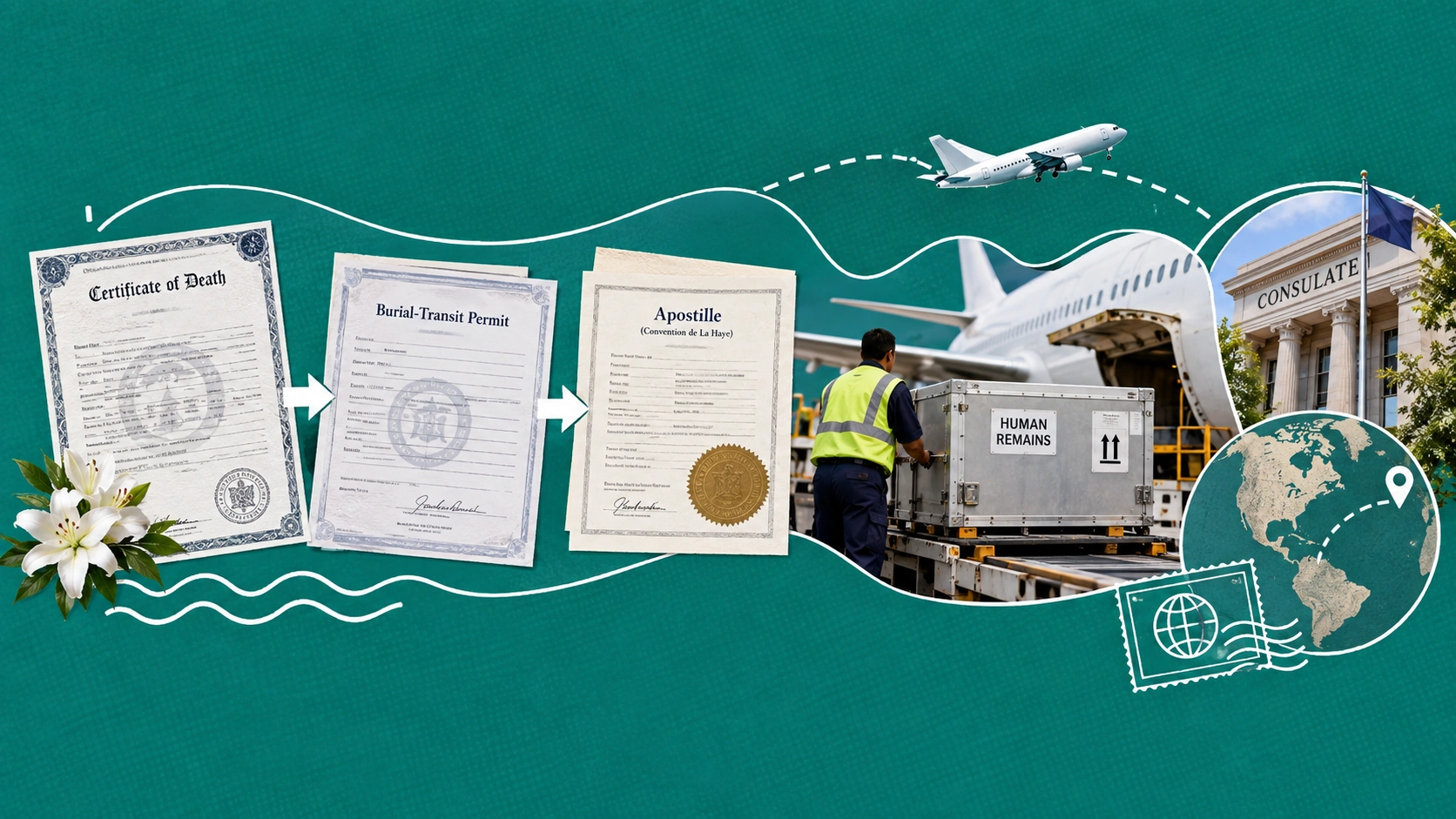
If the family's plan is to take the person home to another country, the permit described here is the first of three documents that journey requires; our guide to repatriating remains covers the other two.
Frequently Asked Questions
Why can't the funeral home schedule the burial yet? Because a burial, cremation, or transport requires a permit, and the registrar issues that permit only after the death has been registered (or, in Texas, after a preliminary report for in-state burial). The most common hold-up is the medical certification.
What is a disposition permit or burial-transit permit? The registrar's written authorization to bury, cremate, entomb, or remove remains from the state, issued on the basis of a filed death certificate. The name varies by state.
How long does a state give to register a death? It varies. New York requires registration within 72 hours; Texas requires the certificate within 10 days, with a report of death within 24 hours. Your state's rule is set by its own law.
Can a death be registered before the cause of death is known? In Texas, yes. The certificate is filed "Pending Investigation" and amended when the cause is determined. Many states have an equivalent. The permit can issue on a pending certificate.
The funeral is done but I have no death certificates. Is something wrong? No. The funeral proceeds on the permit; certified copies are a separate transaction. Ask the funeral director whether copies were ordered, and order more from the state if needed.