Your Certified Copy Is Too Old to Apostille: The Recency Rule Nobody Warns You About
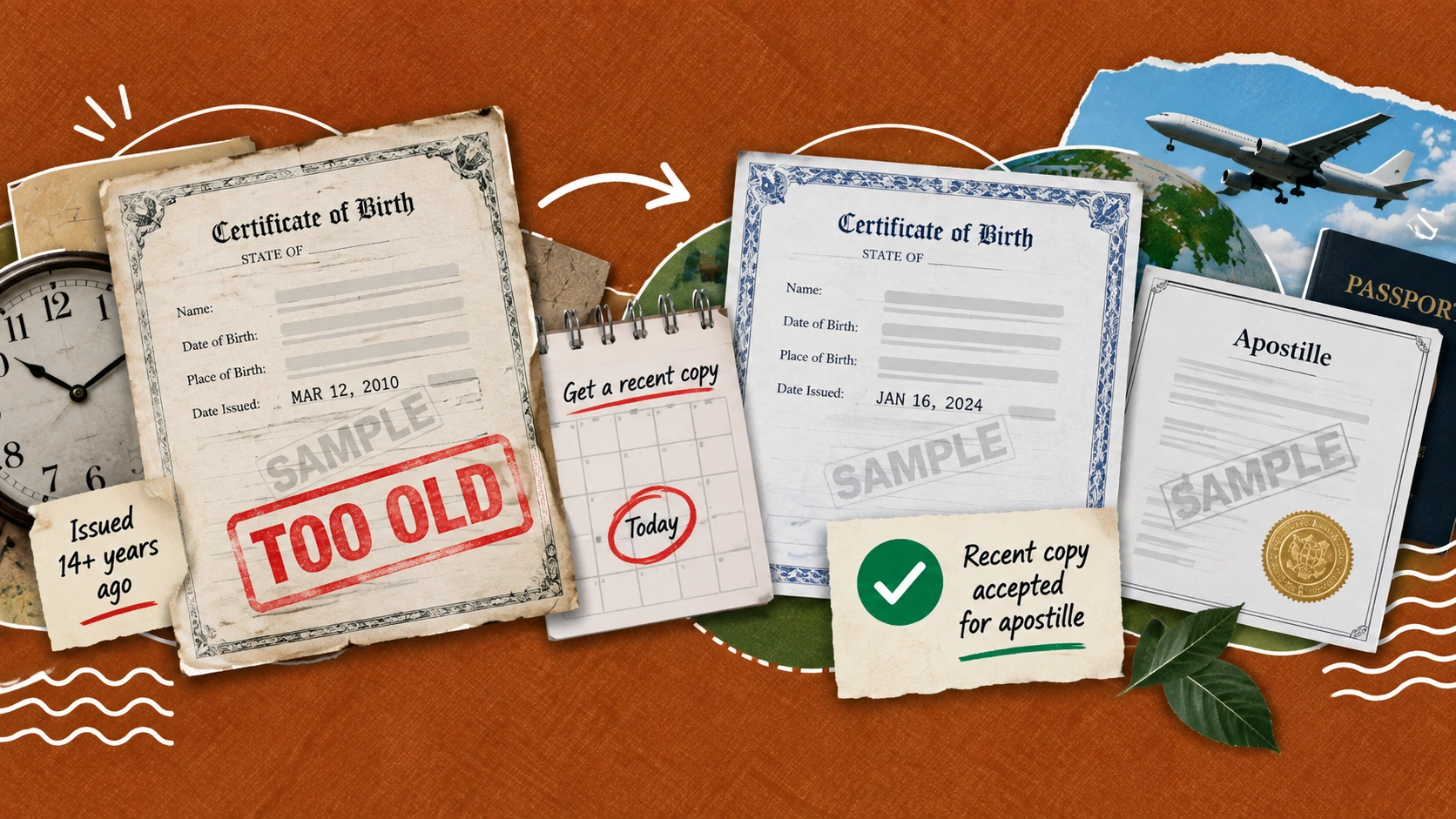
You have the certified copy. It has the raised seal, the registrar's signature, the works. You send it to the state for an apostille and it comes back rejected. The single most common reason an apostille request is refused is not a defect in the document. It is that the certified copy is too old.
This article is about that rule, why it exists, and what it means for the order in which you do things. It assumes you already know what an apostille is and who issues one: our guide to apostilles for U.S. vital records used abroad covers the framework and the state-versus-federal split, and we will not repeat it here.
The Rule, in One State's Words
Texas is the state we verified for this article, and its Secretary of State says the rule plainly in two separate places. Recordable documents "must be less than five (5) years old." And again, on the request page: "Certified records must have been issued within the past five (5) years to be eligible for apostille."
The office also explains why. Older documents "may not be verifiable and cannot be apostilled."
That reason is the whole thing, and it is worth understanding rather than just memorizing the number.
Why an Apostille Authority Cares How Old the Copy Is
An apostille does not certify the facts on your birth certificate. It certifies that the official who signed and sealed the copy was genuinely authorized to do so. To do that, the apostille authority compares the signature and seal on your document against the signature files it holds for the officials who issue records in that state.
Those files are current. Registrars retire, deputies change, seals get redesigned. A certified copy issued fifteen years ago carries the signature of someone the office may no longer be able to verify, and an apostille authority that cannot verify the signature cannot, by definition, apostille the document. The age limit is not bureaucratic caution. It is the point at which verification stops being possible.
The Second Rule: No Copies of Copies
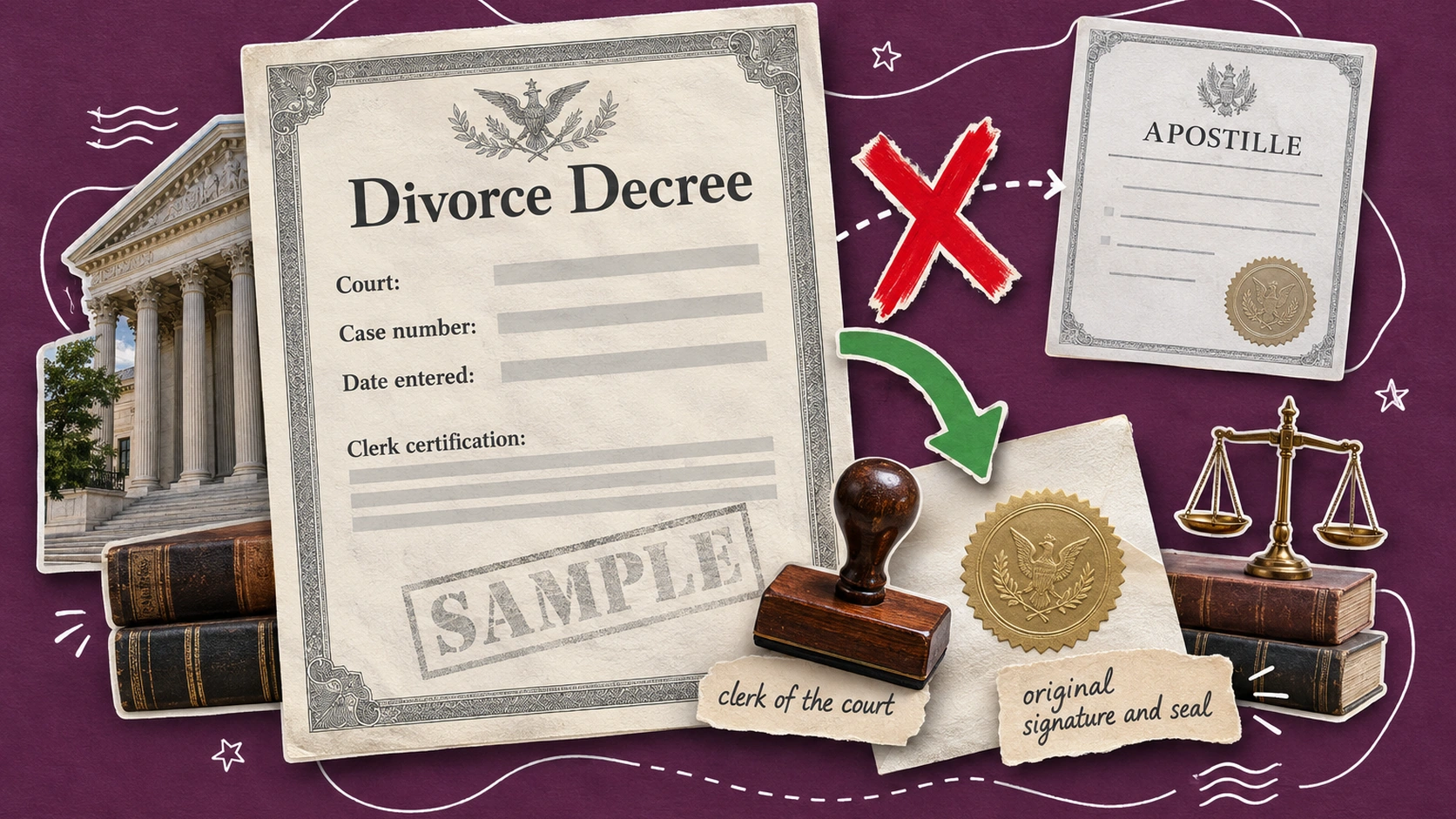
The Texas page carries a second sentence that catches nearly as many people: "We do not apostille copies of certified or notarized records."
The office requires the original Texas-issued document or a Texas-issued certified copy. It will not apostille:
- A photocopy of a certified copy, however good the scan.
- A notarized photocopy. A notary attests to a signature, not to the authenticity of the underlying record, and the apostille authority has no signature file for your notary's copy of a registrar's seal.
- A certificate someone already apostilled for a different purpose. The apostille attaches to that specific copy; it does not transfer.
Between the two rules, the document that qualifies is narrow: a certified copy issued by the state's own records office, recently enough that the signing official is still on file. Our certified copy glossary entry defines what that document is.
What This Does to Your Sequence
Most people plan an apostille job in this order: find the certificate, send it in, wait. The recency rule reverses the first two steps.
The first step in an apostille job is usually ordering a fresh certified copy, not sending in the one you have. That is true even when the one you have looks perfect, because "looks perfect" is not the test; the issue date is. If the copy in your file is older than your state's window, sending it in costs you the apostille fee, the mailing time both ways, and the weeks you would have spent ordering a new copy anyway.
The sequencing consequence is sharpest for anyone working against a foreign deadline: a citizenship application, a foreign marriage, an estate abroad. The state's processing time for a new certified copy and the apostille authority's processing time run one after the other, not in parallel, and a rejected first attempt adds a third wait on top.
What Else Texas Verified, for Context
A few other facts from the same office are worth knowing because they change how people plan, and they show what a single state's rules look like when read all the way through.
- Texas now issues one universal apostille certificate that "acts as both an authentication and an apostille." The old two-product split is gone at the state level. For destinations outside the Hague Convention, the additional step is federal, at the U.S. Department of State's Office of Authentications.
- The fee is $15 per document, not per page, paid to the state. Any third-party service fee, including ours, is separate.
- Mailed requests can take up to two weeks from the day the office receives them. In-person same-day service runs by appointment Tuesday through Thursday and walk-in Monday and Friday, capped at ten documents per person or company per transaction, with walk-in waits that "may exceed an hour." More than ten documents go into a bulk drop box processed within 72 hours.
Texas Is One State. Yours May Differ.
This is the part we want to be careful about. The five-year window is Texas's rule. Other states set their own windows, some set different ones, and some set none at all. We verified Texas and we are not going to imply its number is national.
What generalizes is the principle, not the figure: apostille authorities verify signatures against current files, so a copy old enough to predate those files is at risk anywhere. The practical instruction is the same in every state.
- Find your state's apostille authority: for a state-issued vital record it is normally the Secretary of State. And read its own page before you order anything.
- Look for a recency rule specifically. It is often a single sentence and easy to miss.
- Check the copy-of-a-copy rule while you are there. It is nearly universal.
- Read the issue date on the copy you have, not the date of the event it records.
If your state has no published window, that is worth knowing too, but ask, rather than assuming an old copy will be accepted.
If the copy you have is outside your state's window, the fix is a fresh certified copy: you can order one from the issuing state, and our apostille services can carry it through authentication once it arrives. Vital Records Online is a third-party service and not a government agency; apostilles are issued only by the competent government authority, and you can work with that office directly. Our FAQs on apostilling a birth certificate and apostilling a marriage certificate cover the mechanics.
Frequently Asked Questions
How old can a certified copy be for an apostille? It depends on the state. Texas requires certified records to have been issued within the past five years. Other states set their own windows or none; check your state's apostille authority.
Why does the age of the copy matter? The apostille authority verifies the signing official's signature against current signature files. An old copy may carry a signature the office can no longer verify.
Can I apostille a photocopy of my certified copy? Generally no. Texas states it does not apostille copies of certified or notarized records. You need a certified copy issued by the state's records office.
Can I use a certificate that was already apostilled for something else? No. An apostille attaches to that specific copy for that purpose. A new use needs a new certified copy and a new apostille.
What should I do first? Check the issue date on the copy you have against your state's rule. If it is outside the window, order a fresh certified copy before sending anything for an apostille.