Certificate of Foreign Birth: The U.S. Birth Certificate for an Internationally Adopted Child
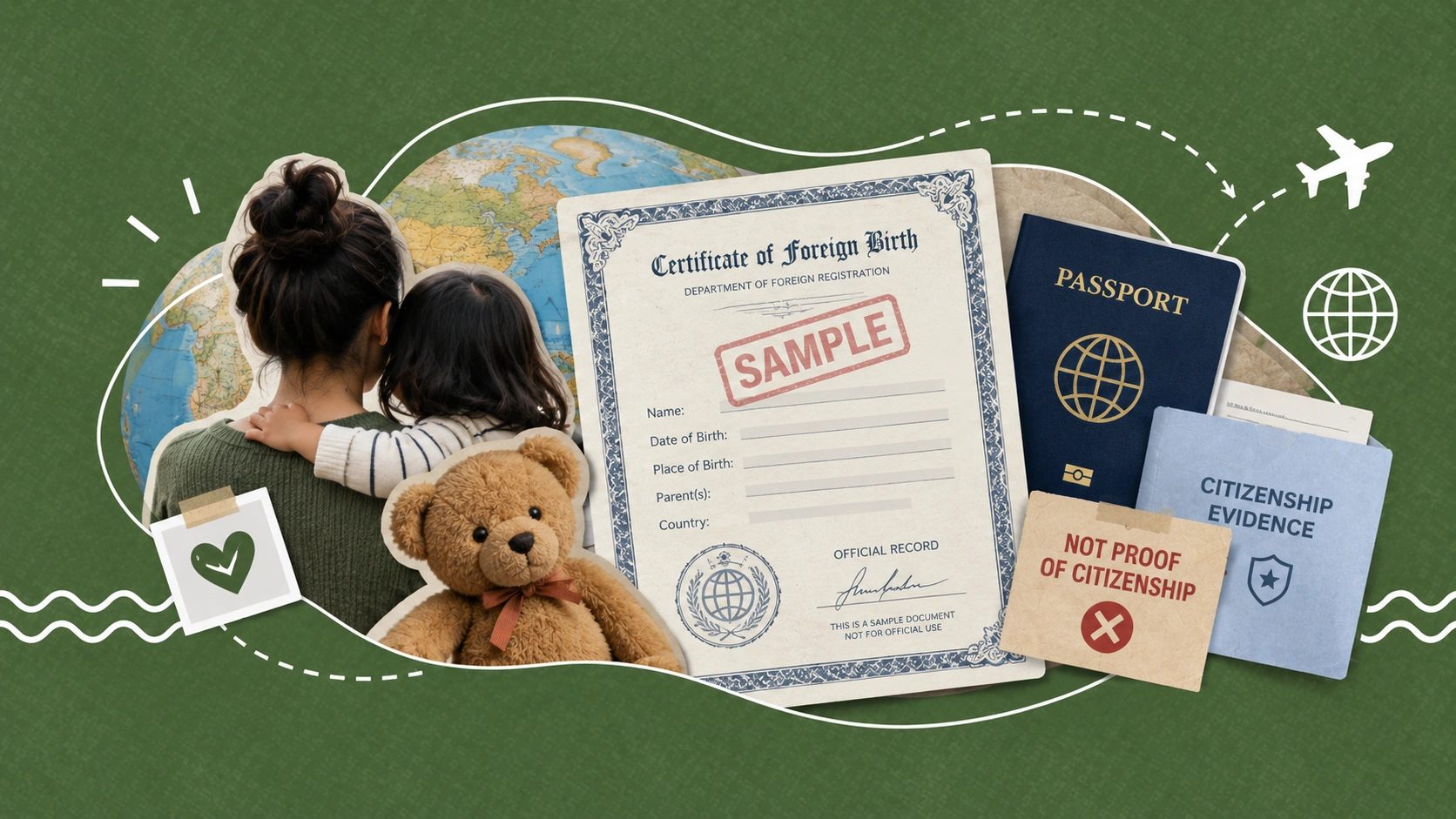
Adoptive parents of a foreign-born child arrive at this question with a very specific frustration: my child is a U.S. citizen, so why can I not get a U.S. birth certificate, and what exactly do I hand the school district? The answer is that two different governments issue two different documents, and neither one substitutes for the other.
Every page in the usual adoption-records literature assumes a domestic adoption of a child born in the United States. This one does not. It covers what a Certificate of Foreign Birth is, what it explicitly is not, and which document to reach for in which situation. It does not cover how to adopt internationally or how to file immigration paperwork: name the form, name the agency, and go there.
Why No State Has a Birth Record
State vital records offices register births that occur within their borders. A child born in Colombia, Korea or Bulgaria had that birth registered there, by that country. No U.S. state was involved and none has a record of the event.
That is a gap with practical consequences, because American institutions ask for a birth certificate constantly: school enrollment, youth sports, camps, insurance. Several states solve it by creating a state record after an adoption is finalized. Our certificate of foreign birth glossary entry defines the document.
What the Document Contains
Florida is the state we verified for this article, and its Department of Health describes the record precisely. Florida files a Certificate of Foreign Birth for children born in foreign countries to non-U.S. citizens, based on orders of adoption whose judgment occurs in Florida. The certificate:
- Shows the adoptive name the child now uses.
- Shows the adoptive parents.
- Shows the true country of birth. It does not pretend the child was born in the United States.
- Includes court order information from the adoption.
- Carries a disclaimer that the record is not proof of citizenship.
That last line is the one that resolves most of the confusion, and it is worth sitting with. The state is telling you plainly what the document does and does not do. It establishes who the child is and who the parents are. It says nothing about citizenship, because citizenship is not a state's to confer.
Canadian-Born Children Are Handled Differently
Florida excludes children born in Canada. By mutual agreement, adoption orders for Canadian-born children are forwarded to the vital statistics office in the relevant province rather than producing a Florida record. If your child was born in Canada, expect a different route.
The Florida Application
- Form DH1178, Application for Certificate of Foreign Birth.
- Form DH527, Certified Statement of Final Decree of Adoption.
- Fees: $20 to file, $9 for a second copy, and $4 for each additional copy ordered at the same time. These are Florida government fees, separate from any third-party service fee.
Order more than one while you are there. The per-copy price for simultaneous copies is the cheapest this will ever be, and school, sports and medical enrollment each tend to want their own.
The Two-Track Structure
This is the mental model that makes everything else make sense.
Track one: the state issues a birth record. The Certificate of Foreign Birth. It proves identity, parentage and date of birth.
Track two: the federal government issues citizenship evidence. According to the State Department, evidence of citizenship comes from a Certificate of Citizenship, obtained through USCIS Form N-600, or from a U.S. passport. Our certificate of citizenship glossary entry covers the term.
The tracks are parallel and neither is a substitute for the other. A family holding only the state certificate has proof of who their child is and no proof of citizenship. A family holding only the Certificate of Citizenship has the reverse.
How Citizenship Was Acquired Depends on the Visa
The State Department describes two paths, and which one applies determines what you have:
- IR-3 and IH-3 visas: the adoption was finalized abroad. These children may acquire citizenship automatically under the Child Citizenship Act of 2000.
- IR-4 and IH-4 visas: the child is admitted as a lawful permanent resident and acquires citizenship only after the adoption is finalized in a U.S. state court.
There is also a timing detail that matters for older adoptees. USCIS began automatically issuing Certificates of Citizenship to IR-3 adoptees on January 1, 2004 and to IH-3 adoptees on April 1, 2008, and not retroactively. So a child adopted before those dates may be a U.S. citizen without ever having been issued a certificate documenting it: the citizenship exists, the paperwork was never generated automatically.
These facts come from the State Department's guidance on citizenship for adopted children. USCIS's own site was not reachable for this article, so confirm N-600 specifics with USCIS directly before filing.
Which Document to Hand Over
In practice the division of labor is clean.
The Certificate of Foreign Birth is usually enough for:
- School and preschool enrollment.
- Youth sports leagues and camps.
- Medical records and pediatric registration.
- Anything that needs a name, a date of birth and a parent.
Citizenship evidence, the Certificate of Citizenship or a U.S. passport, is what you need for:
- A DMV issuing a license or a REAL ID.
- Employment eligibility verification.
- A passport application.
- Federal benefits.
- Anything asking your child to prove they are a U.S. citizen.
Many adoptive families find that obtaining a U.S. passport early is the single most useful step, because a passport is both citizenship evidence and widely accepted identification, and it removes the need to hand over the Certificate of Citizenship repeatedly.
This Is a State-by-State Process
We verified Florida. That is one state, and we are not going to generalize from it.
The name of the document, the forms, the fees, and whether re-adoption in a U.S. court is required before the state will issue anything all vary. Some states use a different name for the record entirely. Check with the vital records office in the state where the adoption was finalized, and ask specifically whether they issue a record for a foreign-born adopted child and what has to be finalized first.
Our guide on amending a child's birth certificate for adoption and the FAQ on getting a birth certificate after adoption cover the domestic process, which is different but shares vocabulary.
For a child born in the United States, you can order a certified birth certificate through our service. Vital Records Online is a third-party service and not a government agency; a Certificate of Foreign Birth is issued by the state that finalized the adoption, and citizenship documents come only from USCIS or the State Department.
Frequently Asked Questions
Can my internationally adopted child get a U.S. birth certificate? Not an ordinary one, because no U.S. state registered the birth. Several states issue a Certificate of Foreign Birth after the adoption is finalized there.
Does a Certificate of Foreign Birth prove citizenship? No. Florida's record carries an explicit disclaimer that it is not proof of citizenship. Citizenship evidence comes from a Certificate of Citizenship or a U.S. passport.
Does it show the country of birth? Yes. The certificate shows the adoptive name and adoptive parents and the true country of birth.
My child was adopted before 2004 and we never received a Certificate of Citizenship. Why? USCIS began automatically issuing them to IR-3 adoptees on January 1, 2004 and IH-3 adoptees on April 1, 2008, and not retroactively. Confirm your child's status with USCIS.
Is the process the same in every state? No. The document name, forms, fees, and whether re-adoption is required vary by state. Check with the state where the adoption was finalized.